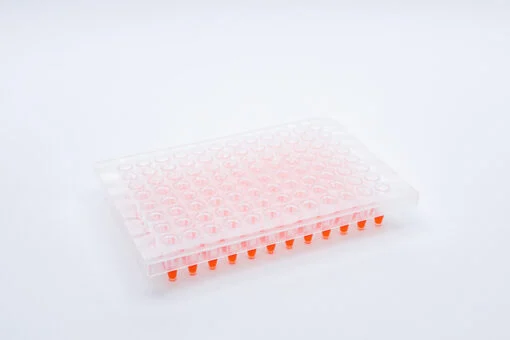
Thin polyester heat sealing film which is easily pierceable with autosampler needles/ABI® 3730. The seal is suitable for PCR, qPCR and optical applications.
Detail
Overview
Thin polyester heat sealing film which is easily pierceable with autosampler needles/ABI® 3730. The seal is suitable for PCR, qPCR and optical applications.
Heat sealing offers a 100% effective method for plate sealing for a complete seal integrity, as well as being quick and cost effective
Our ClearASeal Pierce heat sealing film is an optically clear polyester backed film, forming a pierceable seal to polypropylene, polyethylene, polystyrene and cyclic olefin copolymer (COC) plates
The optical clarity of this seal enables its use for sealing plates required for imaging use, including fluorescent detection methods such as qPCR and colorimetric assays
Its pierceability renders it useful for automation and for use on needle, capillary and tip based liquid handling systems
It is effective on the ABI®3730 capillary sequencer, removing the need for the use of expensive septa mats
The ClearASeal Pierce forms a complete seal to a plate enabling moderately low and high temperature uses, including PCR when using a pressurized heated lid thermal cycler
It demonstrates a moderate solvent resistance and can be utilized for short term compound storage
This seal is available as sheets, for use with manual and semi-automated sealers, such as our HeatASeal 500 Sealing Machine
Also available in multiple roll formats compatible with specified automated heat sealers, such as our Wasp or Chameleon XT
Attogene Universal Lateral Flow Assay Kits are a convenient ready-to-use kit for quick and cost-effective development of a lateral flow dipstick assay for detection of DNA and RNA products.
Formats (strep gold conjugate pad):
Detection of nucleic Acid (DNA or RNA) requires the use of a biotin and FAM-labelled primer during amplification. Test line: anti-FITC/FAM, Control Line: Biotin
Multiplex detection of nucleic Acid (DNA or RNA) requires the use of a biotin, FITC/FAM and Dig labelled primers during amplification.: Test Line #1: anti FITC/FAM, Line #2: anti-Dig, Line #3 Biotin.
Can be used for development of a lateral flow assay for detection of a variety of different molecules such as amplified DNA products from PCR, LAMP and RPA reactions.
No need to stripe capture antibodies
No expensive equipment required
Cost-effective way to screen for further downstream lateral flow assay development.
Document
50 Lateral Flow Dipsticks (4.5mm) 10 mL Sample assay running buffer 96 well plate Controls
Suspend 111 g in 1 L of distilled or deionized water. Heat with frequent agitation and boil to completely dissolve the powder. Distribute into flasks. Autoclave at 121°C for 15 minutes. Cool to 50°C and pour into sterile Petri dishes.
Formula (per liter)
Pancreatic digest of casein—————5g Pancreatic digest of animal tissue——5g Beef extract————————————1g D-mannitol————————————-10g Sodium chloride—————————–75g Agar———————————————15g Phenolred——————————–0.025g Final pH———————————–7.4±0.2
Storage
Keep container tightly closed, store in a cool, dry place, away from bright light. Storage period of 3 years.
Purified RNA is suitable for a variety of downstream applications, including Small RNA Sequencing. Find out more information on Norgen’s NGS services
Purification is based on spin column chromatography that uses Norgen’s proprietary resin separation matrix
These kits provides a rapid method for the purification of total RNA from non-preserved saliva and nasal/throat swabs, and from preserved saliva collected on Norgen’s Saliva RNA Collection and Preservation Devices Dx (Cat. 53800) or preserved swabs collected in Norgen’s Total Nucleic Acid Preservative Tubes Dx (Cat. Dx69200). Purification is based on using Norgen’s proprietary resin separation matrix. RNA is preferentially purified from other cellular components such as proteins, without the use of phenol or chloroform. The chemistry employed in the kit allows the purification of total RNA, including viral and bacterial RNA, irrespective of size or GC content. The purified RNA is ideal for in vitro diagnostic use for medical purposes.
Saliva/Swab RNA Purification Kit Dx (Spin Column)
This kit is optimized to be used with any downstream application employing enzymatic amplification or other enzymatic modifications of RNA followed by signal detection or amplification. Any diagnostic results generated using the RNA isolated with Norgen’s Saliva / Swab RNA Purification Kit Dx in conjunction with an in vitro diagnostic assay should be interpreted with regard to other clinical or laboratory findings.
To minimize irregularities in diagnostic results, suitable controls for downstream applications should be used.
Norgen’s Saliva/Swab RNA Purification Kit Dx is intended for use by professional users such as technicians, physicians and biologists experienced and trained in molecular biological techniques.
Norgen’s Saliva/Swab RNA Purification Kit Dx does not provide a diagnostic result. It is the sole responsibility of the user to use and validate the kit in conjunction with a downstream in vitro diagnostic assay.
This kit is optimized to be used with any downstream application employing enzymatic amplification or other enzymatic modifications of RNA followed by signal detection or amplification. Any diagnostic results generated using the RNA isolated with Norgen’s Saliva / Swab RNA Purification 96-Well Kit Dx in conjunction with an in vitro diagnostic assay should be interpreted with regard to other clinical or laboratory findings. To minimize irregularities in diagnostic results, suitable controls for downstream applications should be used. Norgen’s Saliva / Swab RNA Purification 96-Well Kit Dx is intended for use by professional users such as technicians, physicians and biologists experienced and trained in molecular biological techniques. Norgen’s Saliva / Swab RNA Purification 96-Well Kit Dx does not provide a diagnostic result. It is the sole responsibility of the user to use and validate the kit in conjunction with a downstream in vitro diagnostic assay.
High throughput 96-well plate format for rapid purifications
Very consistent well-to-well RNA isolation
Bind & elute all RNA irrespective of size or GC content, without bias
Storage Conditions and Product Stability All solutions should be kept tightly sealed and stored at room temperature. All solutions and plastics can be used until the expiration date specified on their labels.