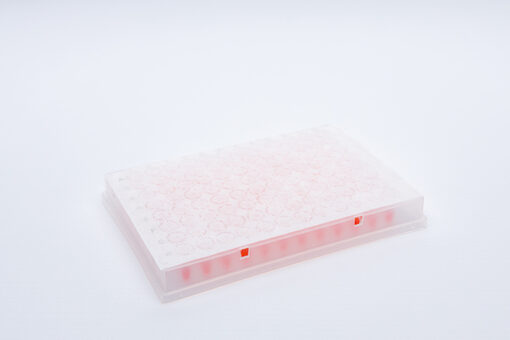
Non-woven gas permeable seal that limits evaporation. The seal is peelable, pierceable; suitable for cell culture and seed & insect storage too.
Detail
Overview
Non-woven gas permeable seal that limits evaporation. The seal is peelable, pierceable; suitable for cell culture and seed & insect storage too.
Heat sealing offers a 100% effective method for plate sealing for a complete seal integrity, as well as being quick and cost effective
Our Gas PermASeal Heat Seal is made from a non-woven material and is designed for use in cell culture, due to its porous nature
The seal is compatible with polypropylene and polystyrene
It can be removed by peeling, or it can be pierced with a pipette tip manually, using a liquid handling robot.
Gas PermASeal Heat Seal can be utilized for effective overnight incubations, during which it demonstrates significant reductions in evaporation compared to lids
It can also be used for insect and seed storage as it enables gas exchange, whilst providing an inert surface with no adhesive to interfere with the well contents
This seal is available as sheets, for use with manual and semi-automated sealers, such as our HeatASeal 500 Sealing Machine
Also available in multiple roll formats compatible with specified automated heat sealers, such as our Wasp or Chameleon XT
Other Products
Taq DNA Polymerase Hot-Start
Product Info
Document
Product Info
Non-specific amplification is prevented by using this Taq DNA polymerase variant as the DNA polymerase is hotstart-formulated. The 10x reaction buffer supplied together with the DNA polymerase has been specifically designed for optimal PCR performance and DNA polymerase activity. This allows the use of this DNA polymerase in a wide range of PCR applications.For research use and further manufacturing. Designed and manufactured under ISO13485. Please contact us for bulk quantities and quotes.
Broad Amplification Range
Different-sized amplicons from 3 ng of a DNA plasmid were amplified. The use of Taq DNA polymerase resulted in clean and high yield of products, as analysed after PCR on a 0.8% agarose gel.
Faster Detection and Higher Sensitivity
A fragment (64 bp) of the human blood-coagulation factor IIa (F2) was amplified from 20 ng, 2 ng, 200 pg and 20 pg of a human genomic DNA extract. The same experiment was performed in parallel using the Taq DNA polymerase mix from another well-established and known supplier. PCR products were subsequently analysed on a 2.5% agarose gel.
Document
Non-specific amplification is prevented by using this Taq DNA polymerase variant as the DNA polymerase is hotstart-formulated. The 10x reaction buffer supplied together with the DNA polymerase has been specifically designed for optimal PCR performance and DNA polymerase activity. This allows the use of this DNA polymerase in a wide range of PCR applications.
High yield and high quality genomic DNA with no RNA or protein contamination
DNA ready for any application including PCR, qPCR, genotyping and more
Norgen’s Cells and Tissue DNA Isolation Kits are designed for the rapid preparation of genomic DNA from cultured cells as well as various tissue samples and urine. The purified genomic DNA is fully digestible with all restriction enzymes tested, and is completely compatible with PCR and Southern Blot analysis.
Cells and Tissue DNA Isolation Kit (Spin Column)
Purification is based on spin column chromatography as the separation matrix. Norgen’s columns bind DNA under optimized salt concentrations and release the bound DNA under low salt and slightly alkali conditions. The protocol can be completed in approximately 30 minutes for cells and within 90 minutes for tissues. Each kit contains sufficient materials for 50 preparations.
Cells and Tissue DNA Isolation Micro Kit (Micro)
Optimized for small inputs of cells and tissues, such as Laser-Captured Microdissection (LCM). Purification is based on spin column chromatography as the separation matrix. Norgen’s columns bind DNA under optimized salt concentrations and release the bound DNA under low salt and slightly alkali conditions. Preparation time for a single sample is approximately 60 minutes, and each kit contains sufficient materials for 50 preparations.
Cells and Tissue DNA Isolation Kit (Magnetic Bead System)
Purification is based on the use of magnetic beads that bind DNA under optimized binding conditions. Norgen’s Cells and Tissue DNA Isolation Kit (Magnetic Bead System) allows for the isolation of genomic DNA from various types of animal tissues or cell samples. Preparation for 10 purifications is approximately 40 minutes of hands-on time.
Cells and Tissue DNA Isolation 96-Well Kit (High Throughput Magnetic Bead System)
Purification is based on the use of magnetic beads that bind DNA under optimized binding conditions. Norgen’s Cells and Tissue DNA Isolation 96-Well Kit (Magnetic Bead System) allows for the isolation of genomic DNA from various types of animal tissues or cell samples. The Cells and Tissue DNA Isolation 96-Well Kit (Magnetic Bead System) also can be integrated with a robotic automation system.
8-10 µg (20 mg of animal tissue) 8-12 µg (3 x 10⁶ cells)
Average Purity (OD260/280)
1.8 – 1.9
Time to Complete 10 Purifications
40 minutes hands-on time (Cat. 59100) 50 minutes hands on time (Cat. 62500)
* Average DNA yield will vary depending on the donor
Storage Conditions and Product Stability All solutions should be kept tightly sealed and stored at room temperature (15 – 25°C). This kit is stable for 1 year after the date of shipment.
DBCO-PEG8-amine TFA salt is a PEG linker which contains DBCO and amine moieties. The DBCO group is commonly used in copper-free Click Chemistry reactions. The amine group is reactive with carboxylic acids, activated NHS esters, carbonyls (ketone, aldehyde) etc. The hydrophilic PEG spacer increases the water solubility of the compound. Reagent grade, for research purpose. Please contact us for GMP-grade inquiries.
Document
DBCO-PEG8-amine TFA salt is a PEG linker which contains DBCO and amine moieties. The DBCO group is commonly used in copper-free Click Chemistry reactions. The amine group is reactive with carboxylic acids, activated NHS esters, carbonyls (ketone, aldehyde) etc. The hydrophilic PEG spacer increases the water solubility of the compound. Reagent grade, for research purpose. Please contact us for GMP-grade inquiries.