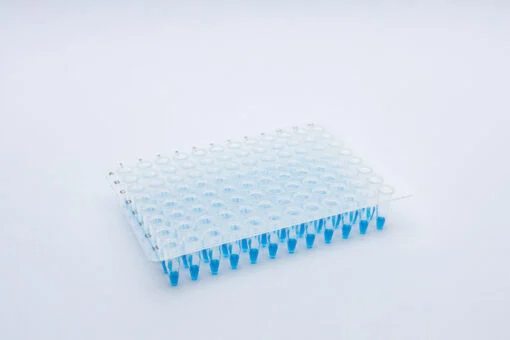
IST-122 QuickSeal qOpticTM Self Adhesive Sealing Film
Facebook
X
Pinterest
Email
Adhesive film with 96 optically clear windows. This seal is peelable, suitable for qPCR and optical applications.
Detail
Overview
Adhesive film with 96 optically clear windows. This seal is peelable, suitable for qPCR and optical applications.
These unique seals combine the strong sealing integrity of our QuickSeal PCR Seal with improved optical properties, thanks to the 96 adhesive-free windows
The seal is made of a durably transparent polyester film, and a strong adhesive is applied across the seal, apart from the 96 round windows
The QuickSeal qOptic seal is recommended for qPCR and other optical applications, such as fluorescence or colorimetric measurements
For all adhesive seals, the best sealing results are achieved using our Hand Roller or KAPS 500 Auto Sealer
Other Products
NGS Low Input DNA Library Prep Kit (illumina and MGI Platforms)
Product Info
Document
Product Info
The NGS Low Input DNA Library Prep Kit (illumina and MGI Platforms) was developed for construction of high quality NGS libraries with low input DNA amount from 1 ng to 400 ng. The kit allows scientist to study samples with limited DNA such as tumor samples, patient samples, and other specially collected samples (FACS sorting etc.). The kit has high library conversion efficiency with as little as 1 ng DNA input. The fast and simple 1.5-hour protocol makes libraries with even coverage and low GC-bias based our unique chemistry for DNA end-polishing and ligation.
The kit needs double strand DNA fragments (blunt and/or sticky) as input DNA for NGS library preparation, and is compatible with DNA fragments generated from both enzymatic approach (for example, BioDynami DNA fragmentation enzymes, Cat.# 40061 and Cat.# 40062) and mechanical approaches such as sonication and nebulization etc.
NGS Low Input DNA Library Prep Kit Workflow
Three index types are available for the NGS Low Input DNA Library Prep Kit of illumina platform:
Non-index (Cat.# 30022): Libraries do not have index.
Index (Cat.# 30024): Each of our index primers contains a unique barcode sequence with 6 bases that can be used to identify the low input DNA libraries. Library multiplexing up to 48 samples is possible. Index information can be downloaded here.
Unique dual index (Cat.# 30025): Library multiplexing up to 96 low input DNA libraries is possible with unique dual indexes with our Four-Base Difference Index System. The system allows us to make indexes for the libraries that have at least 4 bases different from each other in the 8-base barcode length. Our unique dual index primers can reduce sequencing errors such as de-multiplexing errors, amplification errors, mis-assignment of reads, index cross-contamination, and also index hopping. The kit includes 96 pre-mixed unique pairs of index primers. Index information can be downloaded here.
Indexes are available for the MGI platform kits (Cat.# 34024).
Kit advantages:
Fast protocol
The hands-on time is only 10 minutes
The total protocol time is around 1.5 hours
Simple procedure
Ready-to-use master mix makes it simple for reaction setup
Less reaction components
Less magnetic beads required for cleanup steps: Save the cost more than 50%
Low input DNA amount: Starts from 1 ng of DNA
Comparison of library conversion efficiency under the same NGS library preparation condition. Input DNA amounts are 1 ng and 10 ng, respectively. DNA was mechanical sheared with Covaris before library prep. BioDynami kit: NGS Low Input DNA Library Prep Kit (Cat. #30022).
Comparison of library yield under the same NGS library prep condition. Input DNA amounts are 1 ng, 10 ng, and 100 ng. DNA was mechanical sheared with Covaris before library prep. BioDynami kit (Cat. #30022). PCR cycle numbers were indicated.
Document
The NGS Low Input DNA Library Prep Kit (illumina and MGI Platforms) was developed for construction of high quality NGS libraries with low input DNA amount from 1 ng to 400 ng. The kit allows scientist to study samples with limited DNA such as tumor samples, patient samples, and other specially collected samples (FACS sorting etc.). The kit has high library conversion efficiency with as little as 1 ng DNA input. The fast and simple 1.5-hour protocol makes libraries with even coverage and low GC-bias based our unique chemistry for DNA end-polishing and ligation.
Neisseria gonorrhoeae is a Gram-negative coccus of the Neisseria genus. N. gonorrhoeae is usually seen in pairs infecting human cells. It has a circular DNA genome of approximately 1Mbp encoding over 2000 genes. N. gonorrhoeae is transmitted by sexual contact and usually causes infection in cells of the mucous membrane of the male urethra or the endocervix and urethra in females. During infection, polysaccharides are released from the bacteria that stimulate host cell production of tumour necrosis factors that cause an inflammatory response.
There is no vaccine against N. gonorrhoeae infection and antibiotic resistance is beginning to increase, therefore treatment includes a course of antibiotics that will be effective against resistant strains. Complications in males caused by the infection can result in prostatitis or orchitis if the bacteria spread. In females, invasion of the fallopian tubes or ovaries can result in salpingitis or ovaritis respectively, with any of these infections possibly resulting in sterility.
Storage Conditions and Product Stability All kit components can be stored for 2 years after the date of production without showing any reduction in performance.
All kit components should be stored at -20°C upon arrival. Repeated thawing and freezing (> 2 x) of the Master Mix and Positive Control should be avoided, as this may affect the performance of the assay. If the reagents are to be used only intermittently, they should be frozen in aliquots.
Rapid and efficient removal of abundant proteins from serum and plasma samples
Process 10 samples in 30 minutes
Allows for visualization of low abundance proteins
Convenient and affordable spin column protocol
Generic protocol allows for depletion from human and other animal samples
Purification is based on spin column chromatography that uses Norgen’s resin separation matrix
This kit provides a fast and simple procedure for the effective depletion of major serum proteins including albumin, α-antitrypsin, transferrin and haptoglobin from serum and plasma samples. Such abundant proteins usually obscure less abundant proteins in gel electrophresis making them difficult to visualize and recover. The kit reduces sample complexity to allow for convenient investigation of less abundant proteins. In other applications such as mass spectroscopy, fractionating abundant proteins improves the resolution of less abundant proteins. The kit is ‘generic’ in that it is not antibody-based and can thus be used to deplete abundant proteins from any starting material – human or various other animals – making it more versatile, flexible and affordable than other kits. Resulting proteins are ready for a range of applications including 2D gel electrophoresis, SDS-PAGE, Mass Spectrometry, Protein microarrays, DIGE (Difference Gel Electrophoresis) and more.
Storage Conditions All solutions should be kept tightly sealed and stored at room temperature. Once opened, the solutions should be stored at 4°C. This kit is stable for 2 years after the date of shipment.