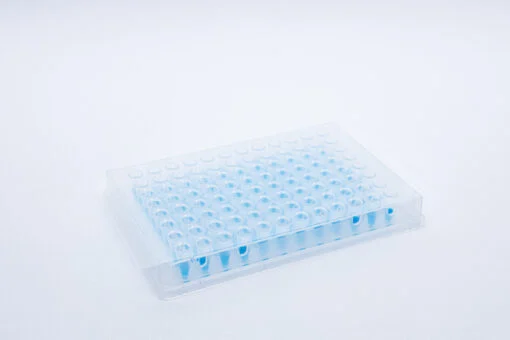
IST-130 QuickSeal qPCR Crystal UltraTM Self Adhesive Sealing Films
Facebook
X
Pinterest
Email
Crystal clear adhesive film which benefits from pressure activated adhesive. This seal is DMSO resistant, peelable; suitable for qPCR and other imaging techniques including crystallization.
Detail
Overview
Crystal clear adhesive film which benefits from pressure activated adhesive. This seal is DMSO resistant, peelable; suitable for qPCR and other imaging techniques including crystallization.
Crystal clear seal specifically developed for optical applications, particularly qPCR
It is non sticky when removed from the packaging; this aids handling when wearing gloves
The adhesive is contained within small capsules, allowing light to pass through to ensure the optical clarity of the seal
When the seal is in position, pressure can be applied to burst the capsules, releasing a strong adhesive only where the seal touches the raised well rims of the plate – the rest of the seal area above the wells remains optically clear
For all adhesive seals, the best sealing results are achieved using our Hand Roller or KAPS 500 Auto Sealer
Other Products
[WM1000] YesBlot™ Western Marker I, 250 μl
Product Info
Document
Product Info
Description
YesBlot™ Western Marker I is a ready-to-use mixture with ten IgG-binding proteins covering a wide range of molecular weights from 15 to 200 kDa in Tris-Glycine buffer. YesBlot™ Western Marker I performs dual functions. First, it contains 4 pre-stained proteins (10, 25, 45 and 70 kDa) for monitoring protein separation during SDS-PAGE, verification of Western transfer efficiency on membranes (nitrocellulose, PVDF, or nylon) and for approximating the protein size. Second, ten IgG-binding proteins can be immuno-detected on film or by CCD imaging. YesBlot™ Western Marker I is compatible for chemiluminescent, fluorescent, chromogenic or other detection systems. In addition, YesBlot™ Western Marker I has two reference bands with enhanced intensity (at 30 kDa and 80 kDa). The marker is supplied in the gel loading buffer and is ready to use. Do NOT heat, dilute, or add reducing agents before loading.
Features
Direct visualization — 10 IgG-binding proteins for direct visualization on Western blots
Pre-stained bands — 4 prestained proteins for monitoring protein separation during electrophoresis and Western blotting transferring efficiency on membrane
Wide range — 10 clear bands from 15 to 200 kDa for size estimation
Quick reference — two enhanced bands (30 and 80 kDa)
Contents
The YesBlot™ Western Marker I contains recombinant IgG binding proteins, prestained recombinant proteins, glycerol and SDS.
Storage
4°C for 3 months -20°C for 24 months
Document
YesBlot™ Western Marker I is a ready-to-use mixture with ten IgG-binding proteins covering a wide range of molecular weights from 15 to 200 kDa in Tris-Glycine buffer. YesBlot™ Western Marker I performs dual functions. First, it contains 4 pre-stained proteins (10, 25, 45 and 70 kDa) for monitoring protein separation during SDS-PAGE, verification of Western transfer efficiency on membranes (nitrocellulose, PVDF, or nylon) and for approximating the protein size. Second, ten IgG-binding proteins can be immuno-detected on film or by CCD imaging. YesBlot™ Western Marker I is compatible for chemiluminescent, fluorescent, chromogenic or other detection systems. In addition, YesBlot™ Western Marker I has two reference bands with enhanced intensity (at 30 kDa and 80 kDa). The marker is supplied in the gel loading buffer and is ready to use. Do NOT heat, dilute, or add reducing agents before loading.
Propargyl-PEG5-acid has a propargyl group at one end and an acid group at the other end. The acid can react with primary amines to form a stable amide bond, activation will be needed. The PEG units enhances solubility of the molecule in aqueous environment. The propargyl group can be linked to azide-containing biomolecules via Click Chemistry. Reagent grade, for research purpose. Please contact us for GMP-grade inquiries.
Document
Propargyl-PEG5-acid has a propargyl group at one end and an acid group at the other end. The acid can react with primary amines to form a stable amide bond, activation will be needed. The PEG units enhances solubility of the molecule in aqueous environment. The propargyl group can be linked to azide-containing biomolecules via Click Chemistry. Reagent grade, for research purpose. Please contact us for GMP-grade inquiries.