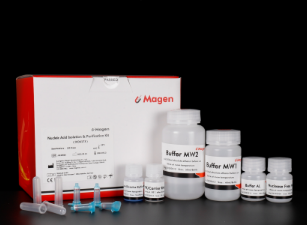
This kit is used for extracting total viral nucleic acid from non-cell/low cell content biological samples such as body fluid, serum, plasma, immersion solution, tissue homogenate supernatant, culture supernatant, etc., the extracted products can be used for clinical in vitro detection.
Detail
Introduction
This kit is used for extracting total viral nucleic acid from non-cell/low cell content biological samples such as body fluid, serum, plasma, immersion solution, tissue homogenate supernatant, culture supernatant, etc., the extracted products can be used for clinical in vitro detection.
Details
Specifications
Features
Specifications
Main Functions
Extract viral RNA/DNA from 200μl plasma/serum samples
Applications
RT-PCR,PCR,NGS
Products
Viral total nucleic acid, body cell total nucleic acid, negative bacterial DNA
Purification method
Mini spin column
Purification technology
Silica technology
Process method
Manual (centrifugation or vacuum)
Sample type
Whole blood, plasma, serum, soaking solution and tissue homogenate supernatant
Sample amount
200μl
Yield
2-10μg
Elution volume
≥30μl
Time per run
≤30 minutes
Liquid carrying volume per column
800μl
Binding yield of column
100μg
Principle
Hipure silica gel column is based on glass fiber filter membrane with high binding force. Under the condition of high concentration of ionizing agent (such as guanidine hydrochloride or guanidine isothiocyanate), the filter membrane can adsorb nucleic acid through hydrogen bond and electrostatic, while protein and other impurities are not adsorbed and removed. The filter membrane adsorbed with nucleic acid is washed to remove the residual protein and salt. Finally, the nucleic acid adsorbed on the filter membrane can be washed out with low salt buffer (such as buffer TE) or water. The obtained nucleic acid has high purity and can be directly used in various downstream experiments.
Advantages
Fast – several samples can be extracted in 20 minutes by column method
High quality – high purity total RNA can be directly used in various sensitive downstream applications
Safe – no phenol chloroform extraction required
Sensitive – DNA/RNA can be recovered at the level of PG
High yield – carrier RNA contained in the product maximize the recovery of trace nucleic acid
Kit Contents
Contents
IVD4173
Purification Times
100 Preps
HiPure Viral Mini Column
100
2ml Collection Tubes
200
PK/Carrier RNA
50 mg
Protease Dissolve Buffer
5 ml
Buffer AL
30 ml
Buffer MW1
44 ml
Buffer MW2
50 ml
RNase Free Water
15 ml
Storage and Stability
This kit is shipped and stored at room temperature and is valid for 12 months.
Experiment Data
Other Products
Propargyl-PEG12-methylamine
Product Info
Document
Product Info
Propargyl-PEG12-methylamine is a propargyl linker that is commonly used as a Click Chemistry reagent for copper-catalyzed reactions with azides. The methylamine group is reactive with carboxylic acids, activated NHS esters, carbonyls (ketone, aldehyde), etc. The PEG spacer helps improve the water solubility of the molecule in aqueous media. Reagent grade, for research use only.
Document
Propargyl-PEG12-methylamine is a propargyl linker that is commonly used as a Click Chemistry reagent for copper-catalyzed reactions with azides. The methylamine group is reactive with carboxylic acids, activated NHS esters, carbonyls (ketone, aldehyde), etc. The PEG spacer helps improve the water solubility of the molecule in aqueous media. Reagent grade, for research use only.
Methylation Specific Bisulfite Seq Library Prep Kit
Product Info
Document
Product Info
Bisulfite seq is a well know technology to detect DNA methylation and several technologies such as WGBS, RRBS, MeDIP-Seq, and MSBS are used for whole genome DNA methylation analysis. DNA methylation is important for regulation of cell development, differentiation and gene expression in molecular biology, genetics and epigenetics. Most methylated cytosines are found at CpG sites, and 70-80% of cytosines are methylated. The number of CpG sites in human genome is around 28 million, which is less than 1% of the genome compared with 4.4% expected.
Whole genome bisulfite sequencing (WGBS) is the most effective method of DNA methylation analysis. The only limitation is the sequencing cost is very high because the whole genome is sequenced including all the non-methylated regions.
Reduced Representation Bisulfite Sequencing (RRBS) is the reduced representation of a smaller fraction of the methylated CpG sites. RRBS combines restriction enzyme digestion and bisulfite sequencing, and enriches the sequencing for methylated CpG sites. It is an efficient technology for estimate the whole genome methylation patterns at the single base level. Although this allows a higher coverage depth and reduces the sequencing cost, the limitation is only 10% of the methylated CpG sites are covered.
Methylated DNA Immunoprecipitation Sequencing (MeDIP-Seq) is another whole genome enrichment technique used for selection of methylated DNA. Using antibodies against 5-methylcytosine, methylated DNA is enriched from whole genomic DNA via immunoprecipitation. 5-methylcytosine antibodies are incubated with fragmented genomic DNA and precipitated, followed by DNA purification and sequencing. There are several drawbacks of MeDIP-Seq: 1. Low resolution (150~200 bp) as opposed to the single base resolution; 2. Non-specific interaction due to antibody specificity and selectivity. 3. Bias towards hypermethylated regions.
The Methylation Specific Bisulfite Seq (MSBS) Library Prep Kit (illumina platform) was developed for construction of NGS libraries for methylated CpG sites using bisulfite treated DNA (20 ng – 500 ng) as input. The kit enriches methylated CpG regions, thus significantly reduce the sequencing cost. The kit estimates the whole genome methylation patterns at the single base level since it is based on a bisulfite-seq technology.
It is known that bisulfite treatment of completed NGS libraries causes tremendous damage to the libraries. By using bisulfite treated DNA as input, the kit overcomes the significant library loss due to the bisulfite conversion. The kit contains a mixture of PCR polymerases that have high-fidelity amplification and uracil tolerance which is ideal for bisulfite treated DNA.
Methylation Specific Bisulfite Seq Library Prep Kit Workflow
Three index types are available for the kit:
Non-index (Cat.# 30101): Libraries do not have index.
Index (Cat.# 30102): Each primer contains a unique barcode sequence of 6 bases to identify the individual library. Library multiplexing capacity is up to 48 samples. Index information can be downloaded here.
Unique dual index (Cat.# 30103): The multiplexing of bisulfite sequencing library is up to 96 samples with unique dual indexes. We used a Four-Base Difference Index System to generate indexes that have at least 4 bases different from each other in the 8-base index. The index primers remove NGS errors including index cross-contamination, index hopping, reads mis-assignment etc. Index information can be downloaded here.
Methylation Specific Bisulfite Seq advantages
Enrichment of methylated CpG sites
Single-base resolution
Low cost for sequencing
Fast
Total time: 1.5 hours
Hands-on time: 10 minutes
Simple workflow
Bisulfite treated DNA as input: From 20 ng to 500 ng
MSBS Library Prep Kit enriches CpG sites
High methylation regions and low methylation regions in human genome.
High methylation region in human genome.
Low methylation region in human genome.
Sequencing setting: Single-end 35 cycles (Read 1, 35 bases) recommended To maximize the methylated CpG enrichment, we recommend to sequence the MSBS libraries with single end 35 cycles (read1, 35 bases). This is because the enriched methylated CpG sites are mainly located around the beginning of read 1 sequences. Shorter single end reads tend to have better methylated CpG enrichment.
Document
Bisulfite seq is a well know technology to detect DNA methylation and several technologies such as WGBS, RRBS, MeDIP-Seq, and MSBS are used for whole genome DNA methylation analysis. DNA methylation is important for regulation of cell development, differentiation and gene expression in molecular biology, genetics and epigenetics. Most methylated cytosines are found at CpG sites, and 70-80% of cytosines are methylated. The number of CpG sites in human genome is around 28 million, which is less than 1% of the genome compared with 4.4% expected.
endo-BCN-PEG2-Acrylate is a PEG linker containing a BCN group and an acrylate group. The BCN group enables copper free click chemitry with azide-tagged molecules. The acrylate group enables Michael addition reactions. The hydrophilic PEG spacer increases solubility in aqueous media. Reagent grade, for research use only.
Document
endo-BCN-PEG2-Acrylate is a PEG linker containing a BCN group and an acrylate group. The BCN group enables copper free click chemitry with azide-tagged molecules. The acrylate group enables Michael addition reactions. The hydrophilic PEG spacer increases solubility in aqueous media. Reagent grade, for research use only.