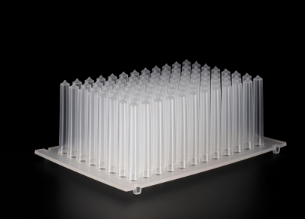
This product is suitable for extracting total viral nucleic acid from cell-free/low-content cell biological samples such as body fluids, serums, plasma, soaking solutions, tissue homogenate supernatant, and culture supernatant. The Purified DNA/RNA is used for RT-PCR and PCR detection.
Detail
Introduction
This product is suitable for extracting total viral nucleic acid from cell-free/low-content cell biological samples such as body fluids, serums, plasma, soaking solutions, tissue homogenate supernatant, and culture supernatant. The Purified DNA/RNA is used for RT-PCR and PCR detection.
Details
Specifications
Features
Specifications
Main Functions
IVD5412 precast kit for kingfisher Flex
Applications
RT-PCR,PCR,NGS
Products
Viral DNA / RNA, body cell DNA / RNA
Purification method
Polydisperse magnetic beads
Purification technology
Magnetic beads technolog
Process method
Manual or automatic
Sample type
Sample amount
200μl
Adaptive instrument
Nucleic acid extractor, pipetting workstation
Principle
This product is based on the purification method of high binding magnetic particles. The sample is lysed and digested under the action of lysate and Protease. DNA/RNA is released into the lysate. After adding magnetic particles and binding solution, DNA/RNA will be adsorbed on the surface of magnetic particles, and impurities such as proteins will be removed without adsorption. The adsorbed particles were washed with washing solution to remove proteins and impurities, washed with ethanol to remove salts, and finally DNA/RNA was eluted by Nuclease Free Water.
Advantages
Kit Contents
Cat.No
Reagent
IVD5412-F-96
PK/Carrier RNA
1x 24 mg/Bottle
Protease Dissolve Buffer Blue
1.8 ml/Bottle
Tip
1
Sample Plate (DW Plate)
500µl Buffer MLB/Well
1
Wash 1 Plate (DW Plate)
500µl Buffer MW1/Well
1
Wash 2 Plate (DW Plate)
500µl Buffer CW/Well
1
Beads Plate (DW Plate)
500µl CW & 20µl MPN/Well
1
Elute Plate (KF Plate)
90µl NFW/Well
1
Storage and Stability
This kit is shipped and stored at room temperature and is valid for 12 months.
Other Products
Opentrons Flex Magnetic Bead Protein Purification Workstation
Product Info
Document
Product Info
For scaling up and fully automating magnetic bead-based protein purification workflows.
With the Flex Protein Purification Workstation, you can automate your small-scale protein purification and proteomics sample processing at the scale you need to increase efficiency, reduce errors, and save hands-on time. This Opentrons Protein Purification Workstation uses magnetic beads for purification of proteins.
Optional add-ons can be purchased at a 10% discount when ordered with the Flex Magnetic Bead Protein Purification Workstation*
Document
For scaling up and fully automating magnetic bead-based protein purification workflows.
With the Flex Protein Purification Workstation, you can automate your small-scale protein purification and proteomics sample processing at the scale you need to increase efficiency, reduce errors, and save hands-on time. This Opentrons Protein Purification Workstation uses magnetic beads for purification of proteins.
Optional add-ons can be purchased at a 10% discount when ordered with the Flex Magnetic Bead Protein Purification Workstation*
The cfDNA Purification Kit (Magnetic Beads) was developed for cell free DNA (cfDNA) enrichment by separating genomic DNA contamination from isolated cfDNA samples.
Many diagnostic technologies for detection of disease signals in cfDNA begin with isolation and purification of DNA from liquid biopsy that include urine, plasma, cerebrospinal fluid. The most widely explored biotechnology is assays used to detect cancer-derived plasma cfDNA. Silica-based magnetic bead cfDNA isolation kits can reliably extract total DNA from plasma, but typically yield a large variation in cfDNA that includes the presence of genomic DNA that often depends on tumor stage, tumor size, or healthy status individuals. Most of the commercial cfDNA isolation kits can’t specifically recover the cfDNA while leaving the high molecular weight genomic DNA behind. The presence of genomic DNA can lead to decreased sensitivity or inconsistent results in downstream applications such as next-generation sequencing (NGS), PCR, QPCR, and digital PCR etc.
Therefore, an additional purification step to enrich cfDNA before downstream methods helps to improve signal from fragments that originate from cancer cells. A proportion of cancer-derived cfDNA fragment signals are below 100 bp and are often not detectable except by qPCR or single-stranded DNA based library preparation for NGS (1, 2, 3). Furthermore only 1% of cancer-derived fragments are found above 400 bp (1, 2). Capture of size-selected fragments between 90-150 bp improved detection of cancer by 2-4 fold (4). Furthermore, TF-bound and protected cfDNA fragments are also being investigated for active cancer-specific signals down to 35-80 bp (5, 6).
This kit uses Dual Solid Phase Reversible Immobilization (SPRI) technology for cfDNA purification. Most Dual SPRI procedures do NOT recover fragments below 100 bp. The kit can be used for the enrichment of cfDNA isolated from liquid biopsies, plasma, serum, and urine. The kit separates cfDNA (50-500 bp) and genomic DNA, and recovers of 90% of the cfDNA without the high molecular weight genomic DNA with high efficiency. Fragments at 500 bp and above may also be retained. Both the 50-500 bp and >500 bp DNA fractions can be used for downstream applications such as single-stranded or double stranded NGS library prep, qPCR, ddPCR, and other methods.
Features
Separation of cfDNA and genomic DNA; Recovery of both types of DNA
Recovery of cfDNA (50-500 bp)
As short as 50 bp can be recovered
Recovery of high molecular weight genomic DNA
Removal of unwanted components and other impurities
Automation friendly
Examples of cfDNA purification. Both cfDNA and genomic DNA can be recovered separately.
The range of recovered small DNA fragments is from 50 to 500 bp. The input DNA are mixtures of sheared small DNA fragments and intact genomic DNA. The ratios of sheared DNA fragments versus genomic DNA are indicated.
Recovery rates of cfDNA and genomic DNA.
Document
Many diagnostic technologies for detection of disease signals in cfDNA begin with isolation and purification of DNA from liquid biopsy that include urine, plasma, cerebrospinal fluid. The most widely explored biotechnology is assays used to detect cancer-derived plasma cfDNA. Silica-based magnetic bead cfDNA isolation kits can reliably extract total DNA from plasma, but typically yield a large variation in cfDNA that includes the presence of genomic DNA that often depends on tumor stage, tumor size, or healthy status individuals. Most of the commercial cfDNA isolation kits can’t specifically recover the cfDNA while leaving the high molecular weight genomic DNA behind. The presence of genomic DNA can lead to decreased sensitivity or inconsistent results in downstream applications such as next-generation sequencing (NGS), PCR, QPCR, and digital PCR etc.
Brevetoxins (PbTx) are a class of cyclic polyether compounds produced by certain algae such as Karenia brevis. K. brevis can produce Brevetoxins in large quantities during an algae bloom which then pose a major health threat and are important to monitor and mitigate. Brevetoxins are the causative agent of Neurotoxic Shellfish Poisoning (NSP).
FDA and EPA safety levels in regulations and guidance – 0.8 mg/kg for clams, mussels, oysters, and whole and roe-on scallops, fresh, frozen, or canned. – National Shellfish Sanitation Program Guide for the Control of Molluscan Shellfish.