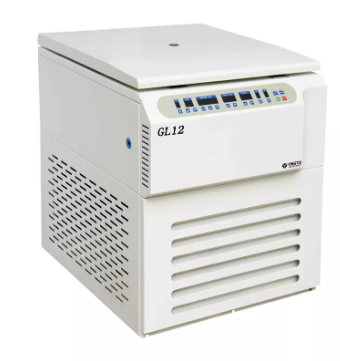
1. Widely used in the field of biochemistry, biological products, pharmaceutical factory and laboratory.
2. Brushless frequency motor for model GL12 which in great torque, free maintenance, no powder pollution, quick in speed up and down.
3. Model GL12 with the digital display which indicates the speed、time and temperature.
4. Micro computer control, there are 10 kinds of program and 10 kinds of acceleration and deceleration for your choice.
5. There are high speed rotors and low speed rotors for your choice.
6. Electric lid lock, compact design, super speed and imbalance protection.
7. The centrifuge body is made of high-quality steel, safe and reliable.
Model: GL12
Brand: Yingtai
Code: 8421199090
Detail
GL12 Technical Parameter:
Max. Speed
12000rpm
Max. RCF
22650×g
Max. Capacity
4×1000ml
Timer
1~9h59min
RPM/RCF Convert
Yes
Noise (dB)
≤ 60
Temperature Range
-20~40℃
Acc/Dec
10 Kinds
Speed Accuracy
±20r/min
Temperature Accuracy
±1℃
Voltage(V/Hz)
AC 220V/110V 50HZ/60HZ
Size (L x W x Hmm)
780×675×830mm
Net Weight(Kg)
260KG
Certificates
CE,ISO & Calibration report are available
Matched Rotors for GL12
Order No.
Rotor No.
Max Speed (rpm)
Max Volume(ml)
Max.RCF(×g)
L12-1
Angle Rotor
12000
6×250/300ml
22650
L12-2
Angle Rotor
8000
6×500ml
11740
L12-3
Swing Rotor
4000
4×1000ml
4060
L12-4
Microplate Rotor
4000
4×4×96well
2940
L12-5
4000
2×4×96well
2490
L12-6
Angle Rotor
10000
4×500ml
16110
Other Products
CloneSizer 100 bp DNA Ladder
Product Info
Document
Product Info
Overview
Ready-to-use
Quantitative
Highly Stable
Precise
Fourteen discrete fragments ranging from 100 bp to 2000 bp in 100 bp increments
Higher intensity reference bands at 500 bp and 1000 bp
2686 bp (pUC19) reference band for easy clone identification
The CloneSizer 100 bp DNA Ladder is prepared to ensure quality and batch-to-batch consistency. Our CloneSizer contains fourteen discrete fragments ranging from 100 bp to 2000 bp in 100 bp increments, double intensity reference bands at 500 and 1000 bp and an additional 2686 bp (pUC19) reference band for easy clone identification.
Contents: 1mL of premixed DNA ladder (0.5µg/10µL) in loading buffer (10mM EDTA, 10% glycerol, 0.015% bromophenol blue, and 0.17% SDS).
CloneSizer 100 bp DNA Ladder (Cat# 11600) – 100 loads
Ladder Properties:
Fourteen discrete fragments ranging from 100 bp to 2000 bp in 100 bp increments
Higher intensity reference bands at 500 bp and 1000 bp
2686 bp (pUC19) reference band for easy clone identification
Fragment
Size (bp)
Mass (ng)
1
2686
72
2
2000
53
3
1500
41
4
1200
42
5
1000
56
6
900
30
7
800
29
8
700
25
9
600
25
10
500
52
11
400
19
12
300
20
13
200
19
14
100
17
Recommended Use:
Mix thoroughly. For best results, load 10µL of DNA ladder per well. For precise mass determination with a densitometer, stain gel after electrophoresis using 0.5µg/mL ethidium bromide for 30-40 minutes. The table above shows the size and mass for each band based on 10µL ladder per well.
Storage:
Stable at room temperature. For longer term storage, -20°C is recommended.
This ladder was standardized using 10µL of DNA per lane on a 0.8 cm thick, 13 x 15 cm, 1.0% agarose gel run in TAE buffer.
Cluster of differentiation 44 (CD44) is a glycoprotein receptor for hyaluronic acid, which plays a fundamental role in cellular adhesion, stromal binding, migration, and cell-cell interactions. Studies have suggested that the CD44-hyaluronate interaction is central to tumor invasiveness. Positive staining with Anti-CD44 is implicated in a multitude of different cancer types, including breast, prostatic, renal cell, colonic, hepatocellular, and genitourinary carcinomas, as well as Non-Hodgkin’s Lymphoma, metastatic melanoma, gastric cancer, and some soft tissue tumors. It has also been demonstrated that there is a positive correlation between tumor progression and increased expression of CD44v, a high molecular weight CD44 isoform that has been described in epithelial cells. Given the expression of CD44 in a wide range of cancers, the most practical application of CD44 immunostaining is its use in discriminating between urothelial transitional cell carcinoma in situ from non-neoplastic changes in the urothelium.
Mastitis is the single most costly disease of dairy cattle resulting in the reduction of milk yield and quality. The inflammation of the utter is mainly caused by infection of various bacteria. Streptococcus dysgalactiae, a Lancefield group C α-hemolytic gram-positive bacteria, is a common pathogen in subclinical and clinical mastitis causing substantial economic losses in dairy herds. Streptococcus dysgalactiae has been isolated from infected mammary glands and teat injuries and is transmitted primarily during milking. However, detection of S. dysgalactiae in other cow tissues such as tonsils, mouth and vagina, and occurrence of S. dysgalactiae mastitis during the non-lactating period in herds, suggests that the organism also behaves as an environmental pathogen.
Storage Conditions and Product Stability All kit components can be stored for 2 years after the date of production without showing any reduction in performance.
All kit components should be stored at -20°C upon arrival. Repeated thawing and freezing (> 2 x) of the Master Mix and Positive Control should be avoided, as this may affect the performance of the assay. If the reagents are to be used only intermittently, they should be frozen in aliquots.