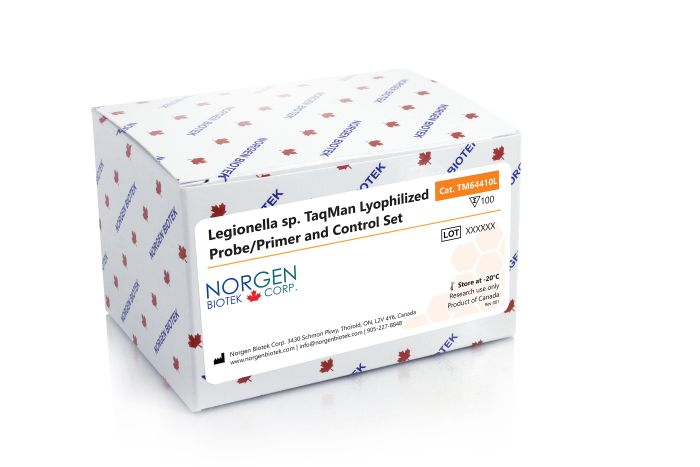
Lyophilized format designed for room temperature shipping
Available in TaqMan format for analysis
Norgen’s Legionella sp. TaqMan PCR Lyophilized Kit is designed for the detection of Legionella sp. specific DNA in a real-time PCR based on the use of TaqMan® technology. The lyophilized format is designed to ship the kit at ambient temperature.
Norgen’s Legionella sp. TaqMan Lyophilized Probe/Primer and Control Set is designed for the detection of Legionella sp. specific DNA in a real-time PCR based on the use of TaqMan® technology. The lyophilized format is designed to ship the kit at ambient temperature.
All kit components should be stored at -20°C upon arrival.
Once reconstituted, repeated thawing and freezing (>2 times) of the Master Mix and Positive Control should be avoided, as this may affect the performance of the assay. If the reagents are to be used only intermittently, they should be frozen in aliquots.
All kit components can be stored for 2 years after the date of production without showing any reduction in performance.
Component
Cat. TM64450L (100 preps)
Cat. TM64410L (100 preps)
MDx TaqMan 2X PCR Master Mix (Lyo)
4 x 350 μL
–
Legionella sp. Primer & Probe Mix (Lyo)
280 μL
280 μL
Legionella sp. Positive Control (Lyo)
150 μL
150 μL
Nuclease-Free Water (Negative Control)
3 x 1.25 mL
1 x 1.25 mL
Product Insert
1
1
Other Products
Integrated Total Dietary Fiber Assay Kit
Product Info
Document
Product Info
K-INTDF
SKU: 700004305
100 assays per kit
Content:
100 assays per kit
Shipping Temperature:
Ambient
Storage Temperature:
Short term stability: 2-8oC, Long term stability: See individual component labels
Stability:
> 2 years under recommended storage conditions
Analyte:
Dietary Fiber
Assay Format:
Enzymatic
Detection Method:
Gravimetric/HPLC
Signal Response:
Increase
Limit of Detection:
0.5 g/100 g
Total Assay Time:
~ 3 h work (over 2 days)
Application examples:
Food ingredients, food products and other materials.
The Integrated Total Dietary Fiber test kit is suitable for the measurement and analysis of Integrated Total Dietary Fiber.
Updated to include resistant, branched maltodextrins as a component in dietary fiber.
K-INTDF – An Integrated Procedure (AOAC Method 2009.01 & 2011.25) for the measurement of Total Dietary Fiber (including resistant starch and non-digestible oligosaccharides). This method combines the key attributes of AOAC Official Methods of Analysis 2002.02, 985.29, 991.43, 2001.03.
Specific dietary fiber fractions are measured as follows:
2. Total High Molecular Weight Dietary Fiber (HMWDF) and SDFS determination (AOAC Method 2009.01)
The enzymes used in these methods are of very high purity; they are effectively devoid of contaminating enzymes active on β-glucan, pectin and arabinoxylan.
Data calculators are located in the Documents tab.
The 16S V2-V3 Library Preparation Kit for Illumina consists of the reagents and components required for library preparation of the 16S V2-V3 amplicon libraries to be used for next-generation sequencing on Illumina platforms. All molecular reagents including primers, enzyme mixes, indexes, and buffers are provided. Instructions for PCR clean up with the AMPure XP Magnetic Beads (supplied by customer) are also included for rapid purification of nucleic acid products generated at two steps of the workflow. The library prep workflow could be used for purified DNA inputs from different sources including stool, soil, water, saliva, plant, urine, skin swab, vaginal swab, cheek swab, nasal swab, plasma/serum, tongue swab, gum swab, and others.
The 16S V2-V3 Library Preparation Kit for Illumina has a streamlined procedure that reduces the handling time such that the library prep procedure can be completed in approximately 4 hours (see diagram below). Input DNA is first subjected to targeted PCR to amplify the V2-V3 region of the DNA encoding 16S rRNA. The post-PCR reaction is then cleaned up using AMPure XP beads. Dual index primers are then added using a limited-cycle PCR. The indexed amplicons flanked by 5′ and 3′ barcoded adaptors are then cleaned using AMPure XP beads. The libraries are then ready for quantification, pooling and sequencing.
Storage Conditions and Product Stability Norgen’s 16S V2-V3 Library Prep Kit for Illumina is shipped as one kit box (for the 24 prep kit) or two sub-component kits (for the 96 prep kit). All kits should be stored at -20°C upon arrival.
All kit components should remain stable for at least 1 year when stored at the specified storage conditions.
Purification and enrichment of intact exosomes from plasma, serum, urine, cell culture media and saliva in less than 30 minutes.
Versatile sample input ranging from 250 µL to 30 mL
Urine Exosome Purification Mini Kit (250 µL – 1 mL urine)
Urine Exosome Purification Midi Kit (2 mL – 10 mL urine)
Urine Exosome Purification Maxi Kit (11 mL – 30 mL urine)
Exosome purification is based on Norgen’s proprietary resin separating matrix through exosomes’ surface proteins.
No precipitation reagents, overnight incubation, protease or coagulant treatments required
No time-consuming ultracentrifugation, filtration or special syringes required
Purify intact exosomes with a size ranging from 40-200 nm depending on sample input type
Purified exosomes are compatible with functional studies.
Purified exosomes are free from any protein-bound cell-free circulating RNA
Purified exosomes are compatible with NanoSight® or Electron Microscopy for assessing the approximate exosome size range and concentration.
Exosomal RNA can be extracted from the purified exosomes using Norgen’s Exosomal RNA Purification technology or any other RNA extraction method.
The Urine Exosome Purification Kits provide a fast, reliable and convenient method to purify and enrich for pure intact exosomes from different urine sample volumes ranging from 250 µL to 30 mL. These kits also allow for the purification of intact extracellular vesicles (EVs) from different urine sample volumes, and these EVs are ready for any downstream application. The purification is based on Norgen’s proprietary resin.
These kits provide a clear advantage over other available methods since they do not require any special instrumentation, ultracentrifugation, precipitation reagents or any protease treatments. More importantly, the purified exosomes will not be contaminated with any other RNA-binding proteins that may contaminate your exosomal RNA, which is essential if studying exosomal RNA gene expression.
NanoSight® Analysis
Exosomes enriched with Norgen’s Urine Exosome Purification Kits can be analyzed using NanoSight® for assessing the approximate exosome size range and concentration.
Exosomal RNA Analysis
Exosomal RNA can be isolated using Norgen’s Exosomal RNA Isolation Kit from exosomes enriched using Norgen’s Urine Exosome Purification Kits for gene expression analysis using RT-qPCR, microarray or NGS and for Biomarker discovery.
Storage Conditions and Product Stability All buffers should be kept tightly sealed and stored at room temperature. These kits are stable for 2 years after the date of shipment.
Important Note Urine samples stored at -70°C, -20°C or at 4°C will develop some precipitation due to the aggregation of some of the highly abundant proteins in urine. Eliminating these precipitates using centrifugation or filtration may cause the loss of exosomes. Furthermore, these precipitates may affect the quality of the purified nucleic acid. We recommend the use of Norgen’s Urine Preservative when collecting urine samples, which is designed for the preservation of nucleic acids and proteins in fresh urine samples at ambient temperatures. The components of the Urine Preservative allow samples to be stored for over 2 years at room temperature with no detected degradation of urine DNA, RNA or proteins. Norgen’s Urine Preservative is available as a liquid format in Norgen’s Urine Preservative Single Dose Ampules, as well as in a dried format in Norgen’s Urine Collection and Preservation Tubes.