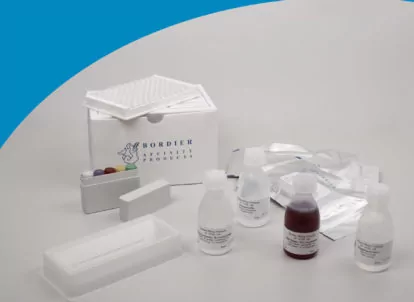
12 x 8 (96 tests) This ELISA kit is intended for the quantitative detection of IgG antibodies against Leishmania infantum in human serum.
Detail
Name of Product
Leishmania infantum – IgG ELISA
Catalog Number
AF 9500
Short Info
This ELISA kit is intended for the quantitative detection of IgG antibodies against Leishmania infantum in human serum.
This product is manufactured by Bordier Affinity Products in Switzerland and distributed in Germany exclusively by Milenia Biotec.
Method/Platform
ELISA in microplate format
Range/Assay Sensivity
pNPP, λ=405 nm
Test Principle
Specific antibodies in the sample bind to Leishmania infantum antigens sensitized on microtiter plates. The presence of parasite specific antibodies is detected with a Protein A – alkaline phosphatase conjugate.
Other Products
DBCO-PEG4-amine
Product Info
Document
Product Info
DBCO-PEG4-amine is a PEG linker which contains DBCO and amine moieties. The DBCO group is commonly used in copper-free Click Chemistry reactions. The amine group is reactive with carboxylic acids, activated NHS esters, carbonyls (ketone, aldehyde), etc. The hydrophilic PEG spacer increases the water solubility of the compound. Reagent grade, for research purpose.
Document
DBCO-PEG4-amine is a PEG linker which contains DBCO and amine moieties. The DBCO group is commonly used in copper-free Click Chemistry reactions. The amine group is reactive with carboxylic acids, activated NHS esters, carbonyls (ketone, aldehyde), etc. The hydrophilic PEG spacer increases the water solubility of the compound. Reagent grade, for research purpose.
[PM5200] ExcelBand™ 3-color Pre-Stained Protein Ladder, Broad Range (3.5-245 kDa), 250 μl x 2
Product Info
Document
Product Info
Description
The PM5200 3-color Pre-Stained Protein Ladder Broad Range is a ready-to-use three-color protein standard with 15 pre-stained proteins covering a wide range of molecular weights from 5 to 245 kDa in Tris-Glycine Buffer (3.5 to 235 kDa in Bis-Tris (MOPS) buffer and Bis-Tris (MES) buffer). Proteins are covalently coupled with different chromophores for easy identification of bands, with three reference proteins carrying enhanced intensity corresponding to a blue band at 20 kDa, green at 40 kDa, and red at 75 kDa, respectively, as separated on SDS-PAGE (Tris-Glycine buffer). The PM5200 3-color Pre-Stained Protein Ladder Broad Range is designed for monitoring protein separation during SDS-polyacrylamide gel electrophoresis, verification of Western transfer efficiency on membranes (PVDF, nylon, or nitrocellulose) and for approximating the size of proteins.
Features
Ready-to-use — Premixed with a loading buffer for direct loading, no need to boil.
Three reference bands — 75 kDa (red), 40 kDa (green), and 20 kDa (blue)
Contents
Approximately 0.1~0.4 mg/ml of each protein in the buffer (20 mM Tris-phosphate (pH 7.5 at 25°C), 2% SDS, 0.2 mM DTT, 3.6 M urea, and 15% (v/v) glycerol).
Quality Control
Under suggested conditions, PM5200 ExcelBand™ 3-color Pre-Stained Protein Ladder Broad Range resolves 15 major bands in SDS-PAGE (Tris-Glycine, MOPS, and MES buffer) and after Western blotting to nitrocellulose membrane.
Storage
4°C for 3 months -20°C for long term storage
Document
The PM5200 3-color Pre-Stained Protein Ladder Broad Range is a ready-to-use three-color protein standard with 15 pre-stained proteins covering a wide range of molecular weights from 5 to 245 kDa in Tris-Glycine Buffer (3.5 to 235 kDa in Bis-Tris (MOPS) buffer and Bis-Tris (MES) buffer). Proteins are covalently coupled with different chromophores for easy identification of bands, with three reference proteins carrying enhanced intensity corresponding to a blue band at 20 kDa, green at 40 kDa, and red at 75 kDa, respectively, as separated on SDS-PAGE (Tris-Glycine buffer). The PM5200 3-color Pre-Stained Protein Ladder Broad Range is designed for monitoring protein separation during SDS-polyacrylamide gel electrophoresis, verification of Western transfer efficiency on membranes (PVDF, nylon, or nitrocellulose) and for approximating the size of proteins.
DBCO-TFP ester is an amine-reactive, labeling reagent used to modify proteins, antibodies, and other amine-containing biopolymers. The highly reactive DBCO group can be used in copper-free click reactions. The TFP ester can react with primary amine groups and is also less susceptible to undergo hydrolysis compared to NHS ester. Reagent grade, for research purpose. Please contact us for GMP-grade inquiries.
Document
DBCO-TFP ester is an amine-reactive, labeling reagent used to modify proteins, antibodies, and other amine-containing biopolymers. The highly reactive DBCO group can be used in copper-free click reactions. The TFP ester can react with primary amine groups and is also less susceptible to undergo hydrolysis compared to NHS ester. Reagent grade, for research purpose. Please contact us for GMP-grade inquiries.