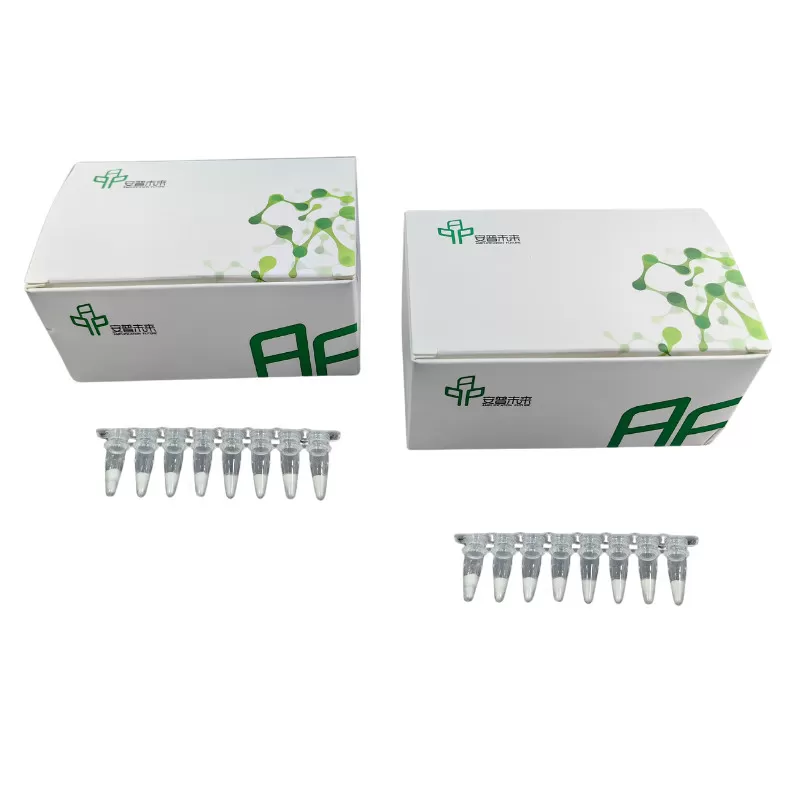
Lyophilized RNA Amplification Kit Below 20 Degree Format Easy And Efficient
Facebook
X
Pinterest
Email
Detail
Product Description
Lyophilized RNA Amplification Kit -20°C Format Easy And Efficient
Product Detail
Kit Storage and term of Validity
Storage term: stored at ≤-20℃,keep away from light, avoid heavy weight and repeated freezing and thawing.
Term of Validity: 14 months
Isothermal nucleic acid Principle Summary
This kit is based on a rapid nucleic acid amplification technology at room temperature and constant temperature: at room temperature and constant temperature (generally 39 ºC~42 ºC), reverse transcriptase uses specific primers and template RNA to synthesize cDNA strands, and binds the auxiliary protein and single strand With the help of the protein, the recombinase and the primer form a complex; perform a homology search and bind the target homology domain, at this time a D-loop region is formed at the homology position and strand exchange begins; accompanied by the recombinase from the complex Upon dissociation, the polymerase also binds to the 3′ end of the primer, initiating chain extension. Relying on the action of nfo enzyme, adding specific molecular probes designed according to the template, and using colloidal gold technology (sandwich method) can detect the final result.
Isothermal nucleic acid Product Features
1/ High sensitivity and specificity, short reaction time.
2/ The reagent form is freeze-dried, stable and easy to operate.
3/ The reaction can be operated by metal bath and water bath pot without purchasing expensive PCR apparatus.
Technical Parameters:
Parameters
Details
Product Name
RNA Isothermal Amplification Kit NFO
Manufacturer
Amp-future
Storage Temperature
-20°C
Kit Components
Enzymes, Buffers ,Reagents
Packaging
48 Tests/box
Detection Limit
500-1000copies/µL
Shipping
ICE
Test Time
5-20mins
Isothermal nucleic acid Applications
Suitable for RNA isothermal rapid amplification kit(NFO type)
Primer: Require pair of nucleotide primers with the length of 25-35 bp.
RNA NFO kit reaction temperature is 39 to 42℃ and time is 5-20 minutes.
Notes
1/ Please avoid nucleic acid contamination and set blank control during reaction due to the high sensitivity of the kit.
2/ Please take out the required quantity of MIRA reaction units for the experiment, and put the rest under storage conditions when performing the experiment.
Other Products
IVD3141 HiPure Stool DNA Kit
Product Info
Document
Product Info
Introduction
With the development of molecular biology, stool, a new non-invasive sample, has been widely used in the research of animal molecular genetics, population ecology, behavioral ecology and some intestinal disease diagnosis. Stool samples includes gut microbial DNA, food residue sample DNA, and alimentary tract exfoliated cell DNA.
The primary problem encountered when using stool sample for molecular biology research is the low content of exfoliated cells in the digestive tract and a certain degree of degradation of genetic material in stool. Another issue in molecular scatology research based on PCR is the presence of a large number of inhibitors in stool that can affect Taq enzyme activity, leading to downstream detection inactivation. These inhibitors include polysaccharides, plant polysaccharides, bile acids, bile salts, bile pigments, digestive juices, mucus, etc. Therefore, selecting appropriate extraction methods to obtain high-quality DNA is the key to successful downstream detection of stool DNA.
At present, the pretreatment methods used in the laboratory, such as phenol/chloroform extraction, cetyltrimethyl bromide (CTAB) lysis, and guanidine isothiocyanate lysis, lack universality in different species, and the success rate of extracting DNA for PCR amplification is also very low. The HiPure Stool DNA Kit provided by Magen Company has opened up a new approach for DNA extraction from stool samples with good universality, high cost-effectiveness, high yield and purification. The reagent kit adopts a unique solution system and inhibitory factor adsorbent, which can efficiently remove various impurities in stool samples. The purified DNA can be directly used for PCR, quantitative PCR and other applications.
This product allows rapid and reliable isolation of high-quality genomic DNA from various stool samples. Up to 100 mg soil samples can be processed in 60 minute. The system combines the reversible nucleic acid binding properties of HiPure matrix with the speed and versatility of spin column technology to eliminate PCR inhibiting compounds such as humic acid from soil samples. Purified DNA is suitable for PCR, restriction digestion, and next-generation sequencing. There are no organic extractions thus reducing plastic waste and hands-on time to allow multiple samples to be processed in parallel.
Details
Specifications
Features
Specifications
Main Functions
Isolation total DNA from 50-100mg stool samples
Applications
PCR, Southern Blot, enzyme digestion and NGS, etc.
Purification method
Mini spin column
Purification technology
Silica technology
Process method
Manual (centrifugation or vacuum)
Sample type
Stool
Sample amount
50-100mg
Yield
3-15μg
Elution volume
≥30μl
Time per run
≤60 minutes
Liquid carrying volume per column
750μl
Binding yield of column
100μg
Principle
Stool sample is homogenized and then treated in a specially formulated buffer containing detergent to lyse bacteria, yeast, and fungal samples. Humic acid, proteins, polysaccharides, and other contaminants are removed using our proprietary Absorber Solution. Binding conditions are then adjusted and the sample is applied to a DNA Mini Column. Two rapid wash steps remove trace contaminants and pure DNA is eluted in low ionic strength buffer. Purified DNA can be directly used in downstream applications without the need for further purification.
Advantages
High purity – unique adsorbent can completely remove inhibitory factors
High concentration – maximum extraction of total DNA from stool samples
High recovery – DNA can be recovered at the level of PG
Good repeatability – silica technology can obtain ideal results every time
Kit Contents
Contents
IVD3141
Purification Times
50 Preps
HiPure DNA Mini Columns II
50
2ml Collection Tubes
50
2ml Bead Tubes
50
Proteinase K
24 mg
Protease Dissolve Buffer
1.8 ml
Buffer SPL
40 ml
Buffer PCI
40 ml
Buffer AL
20 ml
Buffer GW1
22 ml
Buffer GW2
20 ml
Buffer AE
15 ml
Storage and Stability
Proteinase K and Buffer PCI should be stored at 2-8°C upon arrival. However, short-term storage (up to 12 weeks) at room temperature (15-25°C) does not affect their performance. The remaining kit components can be stored at room temperature (15-25°C) and are stable for at least 18 months under these conditions. The entire kit can be stored at 2–8°C, but in this case buffers should be redissolved before use. Make sure that all buffers are at room temperature when used.
Document
With the development of molecular biology, stool, a new non-invasive sample, has been widely used in the research of animal molecular genetics, population ecology, behavioral ecology and some intestinal disease diagnosis. Stool samples includes gut microbial DNA, food residue sample DNA, and alimentary tract exfoliated cell DNA.
Magen’s HiPure columns are prepared by high quality glass fiber filter membrane as raw materials through membrane cutting, membrane release, ring release, ring pressing, gland, weighing and other processes. HiPure nucleic acid adsorption columns have the characteristics of long-term stability and high binding capacity. Experiments show that the highest binding capacity and binding efficiency of HiPure nucleic acid adsorption columns are basically unchanged when stored at room temperature for 4 years.
The series of nucleic acid columns produced by Magen Biotech are based on carefully selected imported glass fiber membranes (GF/B, GF/D, GF/F). Columns production processes such as polypropylene injection molding materials, injection molding process, and downstream membrane packing and compression rings are strictly controlled. This is to ensure that the column has extremely high adsorption capacity and long-term stability. Compared with conventional products on the market, Magen’s columns are with varieties, and binding rate will not change when stored at room temperature for 4 years.
Details
Specifications
Features
Specifications
Recommended application
Small amounts of nucleic acid isolation, viral nucleic acid from cell free samples
Preservation conditions
Room temperature
Stability
Up to 4 years
Filter membrane
High quality glass fiber filter GF/F, 2 layers
Membrane aperture
0.7μm
Maximum binding yield of plasmid
30 μg
Maximum yield of alcohol mediated Binding
100 μg
Single liquid carrying capacity of column
900 μl
Minimum elution volume
80 μl
Withstand centrifugal force
5,000 x g
Centrifuge
Low speed centrifuge, Swing out Rotor, can placed a height of 6.5cm square, (height of HiPure DNA Plate & 1.6ml Collection Plate: height, 6.2cm)
Adsorption Mechanism
Based on the negatively charged DNA skeleton, it has a high affinity for positively charged glass fibers. In high salt and ethanol solutions, DNA/RNA binds to glass fiber and interacts with hydrophilic matrix on silica through hydrogen bond. DNA/RNA is tightly bound. All pollutants can be removed by washing solution. At high salt concentration, nucleic acids selectively bind to silica gel membrane, while other pollutants, mainly proteins, are removed by membrane washing.
Ordering information
CAT.No.
Product Name
Package
C13130
HiPure DNA Plate (2 x GF/F)with 1.6ml Collection Plate
10/Bag
Purchase Guide
Item No.
Product Name
Membrane type/number of layers
Collection tubes
Plasmid DNA binding capacity (Physical adsorption)
Note: GF/B pore size is for 1.0μM glass fiber membrane; GF/F pore size is for 0.7μm glass fiber membrane.
Document
Magen’s HiPure columns are prepared by high quality glass fiber filter membrane as raw materials through membrane cutting, membrane release, ring release, ring pressing, gland, weighing and other processes. HiPure nucleic acid adsorption columns have the characteristics of long-term stability and high binding capacity. Experiments show that the highest binding capacity and binding efficiency of HiPure nucleic acid adsorption columns are basically unchanged when stored at room temperature for 4 years.
[NS1000] FluoroVue™ Nucleic Acid Gel Stain (10,000X), 500 μl
Product Info
Document
Product Info
Description
FluoroVue™ Nucleic Acid Gel Stain (10,000X) is specially designed for in-gel use and is a safer replacement for conventional Ethidium bromide (EtBr), which poses a significant health and safety hazard to its users. It is a fluorescent stain which offers highly sensitive detection of double-stranded or single-stranded DNA and RNA in a convenient manner. FluoroVue™ Nucleic Acid Gel Stain offers high sensitivity that is several times greater than EtBr.
FluoroVue™ Nucleic Acid Gel Stain is compatible with both conventional UV gel-illumination systems as well as harmless long wavelength blue light illumination systems, like B-BOX™. When bound to nucleic acids, FluoroVue™ Nucleic Acid Gel Stain has a fluorescent excitation maximum of 250 and 482 nm, and an emission maximum of 509 nm. Therefore, it can replace EtBr without the need of changing existing lab imaging systems.
Features:
Excellent for in-gel staining
Sensitivity: 0.14 ng (DNA) or 1 ng (total RNA)
A safer alternative to EtBr
Compatibility: suitable to blue or UV light
Increased cloning efficiency (blue light)
Storage
Protected from light 4°C for 12 months -20°C for 24 months
Document
FluoroVue™ Nucleic Acid Gel Stain (10,000X) is specially designed for in-gel use and is a safer replacement for conventional Ethidium bromide (EtBr), which poses a significant health and safety hazard to its users. It is a fluorescent stain which offers highly sensitive detection of double-stranded or single-stranded DNA and RNA in a convenient manner. FluoroVue™ Nucleic Acid Gel Stain offers high sensitivity that is several times greater than EtBr.
FluoroVue™ Nucleic Acid Gel Stain is compatible with both conventional UV gel-illumination systems as well as harmless long wavelength blue light illumination systems, like B-BOX™. When bound to nucleic acids, FluoroVue™ Nucleic Acid Gel Stain has a fluorescent excitation maximum of 250 and 482 nm, and an emission maximum of 509 nm. Therefore, it can replace EtBr without the need of changing existing lab imaging systems.