
m-PEG2-DBCO is a monodisperse PEG reagents which can enable copper-free Click Chemistry through the reaction of DBCO with azide. Reagent grade, for research purpose. Please contact us for GMP-grade inquiries.


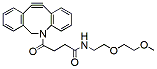
m-PEG2-DBCO is a monodisperse PEG reagents which can enable copper-free Click Chemistry through the reaction of DBCO with azide. Reagent grade, for research purpose. Please contact us for GMP-grade inquiries.

Column accessories
Ordering information
| CAT NO. | PRODUCT NAME | SIZE | PRICE |
| C13200 | 2ml Collection Tubes | 1000/Bag | $70.00 |
| C13201 | 15ml Collection Tubes (15ml Centrifuge Tubes) | 100/Bag | $52.00 |
| C13202 | 50ml Collection Tubes (50ml Centrifuge Tubes) | 100/Bag | $52.00 |
| C13203 | 50ml Collection Tubes C (50ml High Speed Centrifuge Tubes) | 100/Bag | $68.00 |
| C13205 | 1.6ml Collection Plate | 100/Bag | $520.00 |
| C13301 | Vac Connectors | 100/Bag | $46.00 |
| C13302 | Extender Tubes | 50/Bag | $46.00 |
| C13303 | CockStop | 50/Bag | $208.00 |
Column accessories

Character
High flatness sample shelf:
Silicone oil thermal conductive shelf, high-precision processing method of upper and lower clamping, shelf temperature uniformity can reach ±0.5°c
Integrated cavity:
Integrated chamber, the shelf and cold trap are located in the same chamber, the steam conduction is faster and the freeze-drying effect is better
Refrigerating and heating control system:
Using thermally conductive silicone oil with a high temperature range and precise PID control algorithm, the control accuracy can reach ±0.5°C. Sample shelf temperature range: -70°C~ +80°C
Freeze-drying endpoint testing system:
The pressure comparison method is used to determine the freeze-drying end point. The freeze-drying end point test can be automatically performed after the analytical drying stage to ensure that the moisture content of the material reaches the standard requirements.
Vacuum precise control and adjustment system:
The sublimation and analytical drying processes are controlled and adjusted with high precision to make the freeze-drying process warmer and the sample sublimation more reliable.
Pulse backfill system:
Three backfilling modes can be selected: slow, medium and fast, which avoids the problem of effective substances being blown away and lost due to the aeration of granular and flocculent materials after freeze-drying.
Manual automatic mode selection:
Manual mode is used to explore process parameters (strong human intervention), automatic mode is used in the mature stage of the process, one-click operation, simple and convenient
Data recording and analysis system:
Through the PC host computer, all operating parameters and background parameters of the equipment can be recorded in real time, and all parameter action changes and action changes of operating components can be recorded.
Freeze-drying process recipe storage function:
The host can store 60 sets of fixed or user-defined freeze-drying process recipes, and the PC can store >10,000 programs (depending on the computer hard drive)
Eutectic point test function:
The eutectic point temperature of the product can be tested offline and online, and the spectrum can be analyzed manually or automatically (optional)
Remote control system:
The operating status of the device can be monitored remotely, and the device can be monitored in real time via WiFi or the cloud.
Mobile phone monitoring system:
You can monitor the operating status of the equipment with your mobile phone, which is simple and convenient (optional)
Cold trap defrost system:
The hot air defrosting method has high safety performance; the defrosting speed is fast, which solves the inconvenience caused by traditional immersion defrosting.
Parameter
| Model | EX2 | EX5 | EX8 | EX12 |
| Freeze-area | 0.24m² | 0.38m² | 0.96m² | 1.45m² |
| Ice coagulating capacity | 4kg | 9kg | 12kg | 18kg |
| Shelf temperature | 70℃~+80℃ | -65℃~+70℃ | ||
| Cold trap temperature | -70/-90℃ | -70/-90℃ | -70℃/-90℃ | -70℃/-85℃ |
| Cold trap volume | 9L | 15L | 18L | 30L |
| chamber type | single | double | ||
| Shelf size | 275*400 mm | 275*400 mm | 365*465 mm | 365*465 mm |
| Shelf spacing | 100mm(adjustable) | 100mm(adjustable | 70mm(adjustable) | 70mm(adjustable) |
| Sample quantity (4R Cillin bottle) | 558 | 1395 | 2630 | 4230 |
| Shelf heating and cooling method | Thermal conducting silicone oil medium(temperature resistance: -100℃~+600℃) | |||
| Chamber and shelf surface | High vacuum stainless steel tube/KF25-40 | |||
| vacuum line | High vacuum stainless steel tube | KF50 | ||
| External valve port | 6/ | 12/ | 18/ | 一 |
| equipment power | 3.8kw | 5.5kw | 6.5kw | 8kw |
| equipment size | 700*588*1600 mm | 1030*700*1630 mm | 1030*700*1850 mm | 1500*850*1900 mm |
| Capping mode | Hydraulic system gland device/no gland | hydraulic pressure | ||
| Suitable clean room | Suitable | |||
| Vacuum sensor type | Pirani Vacuum sensor/Capacitive vacuum sensor | |||
| Remote control and alarm | Support 2G/4G/GSM/Wi-Fi | |||
| Terminal judgment function | Pressure contrast method | Pressure test/pressure contrast method | ||
| Freeze dryer front door cover | Stainless steel/Plexiglass | Stainless steel | ||
| Inert gas filling | (Optional) Sufficient amount and time for the program to run itself | |||
| User function customization | Can be customized and modified according to user needs | |||
| sterilization method | H2O2/steam sterilization | |||

This product is suitable for rapid extraction of total DNA from tissue, cells, blood, saliva, swabs, blood spots, semen and other clinical samples. DNA can be used directly for PCR, quantitative PCR, Southern Blot, test of virus DNA and so on.
Specifications
| Features | Specifications |
| Main Functions | Isolation total DNA from tissue / blood / body fluid / swab /dry blood spots |
| Applications | PCR, qPCR, southern bolt and virus detection, etc. |
| Purification method | Mini spin column |
| Purification technology | Silica technology |
| Process method | Manual (centrifugation or vacuum) |
| Sample type | Tissue, cell, blood, saliva, swab, blood spot, semen and other clinical samples |
| Sample amount | Solid tissue : 1-10mg, Anticoagulant blood : 200µl |
| Yield | 1 – 15µg |
| Elution volume | ≥20μl |
| Time per run | 30 – 60 minutes |
| Liquid carrying volume per column | 750µl |
| Binding yield of column | 100µg |
This product is based on silica Column purification. The sample is lysed and digested with lysate and protease, DNA is released into the lysate. Transfer to an adsorption column. Nucleic acid is adsorbed on the membrane, while protein is not adsorbed and is removed with filtration. After washing proteins and other impurities, nucleic acid was finally eluted with low-salt buffer (10mm Tris, pH9.0, 0.5mm EDTA).
| Contents | IVD3018 |
| Purification Times | 100 |
| HiPure DNA Mini Columns I | 100 |
| 2ml Collection Tubes | 2 x 100 |
| Buffer ATL | 60 ml |
| Buffer AL | 60 ml |
| Buffer GW1 | 44 ml |
| Buffer GW2 | 50 ml |
| Proteinase K | 60 mg |
| Protease Dissolve Buffer | 5 ml |
| Buffer AE | 15 ml |
Storage and Stability
Proteinase K should be stored at 2–8°C upon arrival. However, short-term storage (up to 12 weeks) at room temperature (15–25°C) does not affect their performance. The remaining kit components can be stored at room temperature (15–25°C) and are stable for at least 18 months under these conditions. The entire kit can be stored at 2–8°C, but in this case buffers should be redissolved before use. Make sure that all buffers are at room temperature when used.
Experiment Data

This product is suitable for rapid extraction of total DNA from tissue, cells, blood, saliva, swabs, blood spots, semen and other clinical samples. DNA can be used directly for PCR, quantitative PCR, Southern Blot, test of virus DNA and so on.