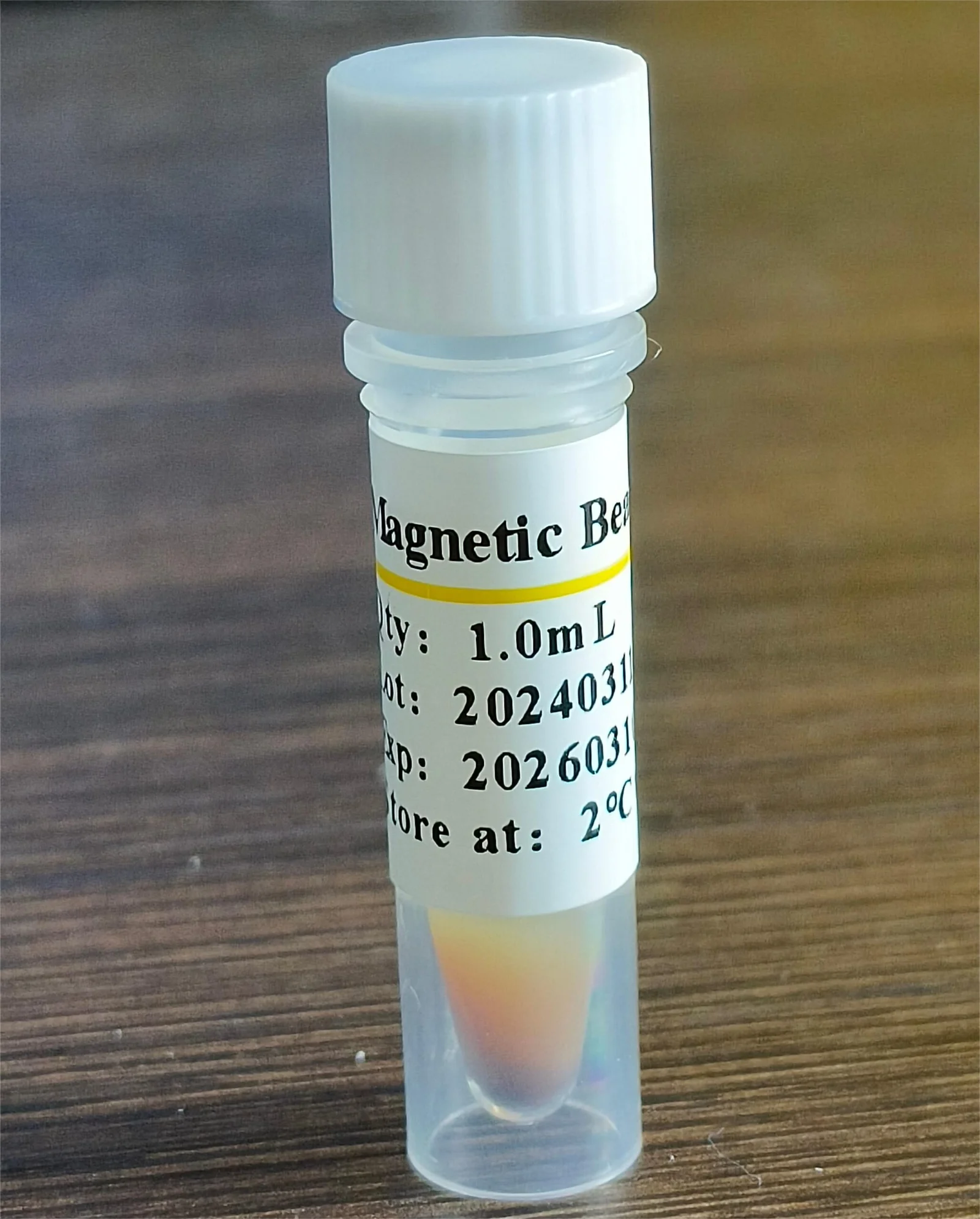
Note: Price not include shipment & duty, contact us to get full quote. Magnetic beads are specially designed for nucleic acid extraction and purification, with good suspension performance. The surface is modified with a large number of carboxyl groups, which can bind the nucleic acid in the sample through hydrophobic, hydrogen bonding and electrostatic interaction under high salt and low pH conditions, without binding with other impurities (such as proteins), and quickly separate nucleic acid from biological samples. The operation is safe and simple. It is beneficial to the automation and high throughput extraction of nucleic acid.
Detail
Description
Product introduction
It is suitable for the extraction and purification of viral nucleic acid and free nucleic acid. It can bind the nucleic acids in solution through hydrophobic, hydrogen bonding and electrostatic interaction under high salt conditions, without binding with other impurities (such as proteins), and quickly separate nucleic acids from biological samples. The operation is safe and simple, which is very conducive to the automatic and high-throughput extraction of short fragments or low abundance nucleic acids.
Product characteristics
Super paramagnetism and high magnetic response, saving operation time and increasing sample recovery efficiency.
Good suspension performance, dispersion and resuspension, which is conducive to efficient nucleic acid binding and recovery.
Good physical and chemical stability to ensure repeatability.
Product information
Other Products
ProteoSpin™ Abundant Serum Protein Depletion Kit
Product Info
Document
Product Info
Overview
Rapid and efficient removal of abundant proteins from serum and plasma samples
Process 10 samples in 30 minutes
Allows for visualization of low abundance proteins
Convenient and affordable spin column protocol
Generic protocol allows for depletion from human and other animal samples
Purification is based on spin column chromatography that uses Norgen’s resin separation matrix
This kit provides a fast and simple procedure for the effective depletion of major serum proteins including albumin, α-antitrypsin, transferrin and haptoglobin from serum and plasma samples. Such abundant proteins usually obscure less abundant proteins in gel electrophresis making them difficult to visualize and recover. The kit reduces sample complexity to allow for convenient investigation of less abundant proteins. In other applications such as mass spectroscopy, fractionating abundant proteins improves the resolution of less abundant proteins. The kit is ‘generic’ in that it is not antibody-based and can thus be used to deplete abundant proteins from any starting material – human or various other animals – making it more versatile, flexible and affordable than other kits. Resulting proteins are ready for a range of applications including 2D gel electrophoresis, SDS-PAGE, Mass Spectrometry, Protein microarrays, DIGE (Difference Gel Electrophoresis) and more.
Storage Conditions All solutions should be kept tightly sealed and stored at room temperature. Once opened, the solutions should be stored at 4°C. This kit is stable for 2 years after the date of shipment.
Fast and easy processing using rapid spin-column format
Isolate high quality mitochondrial DNA
Recovered DNA is compatible with various downstream applications
Over the past several decades, mitochondrial DNA (mtDNA) has played an increasingly important role in forensic analyses of various criminal cases. A few hairs left at a crime scene contain enough mtDNA for extraction. The hair shaft, which protrudes out of the scalp, does not contain any nuclear DNA. It does, however, contain mtDNA. While nuclear DNA is present in only two copies per cell, the small circular mtDNA molecule is present in hundreds to thousands of copies per cell making it very abundant. Mitochondrial DNA is maternally inherited, and all of a woman’s offspring will have the same mtDNA profile. An advantage of this is that a single maternal relative of that person may provide a reference sample for comparison to a sample found at a crime scene.
Norgen’s Hair Mitochondrial DNA Isolation Kit provides a fast, reliable, and simple procedure for isolating mtDNA from hair shafts. Purification is based on spin column chromatography and the DNA is preferentially purified from other components. Typical yields will vary depending on the sample input volume used. The purified DNA is compatible with all downstream applications including PCR and NGS.
Storage Conditions and Product Stability Store DTT at -20°C upon arrival. All other solutions should be kept tightly sealed and stored at room temperature. These reagents should remain stable for at least 1 year in their unopened containers. The kit contains a ready to-use Proteinase K solution, which is dissolved in a specially prepared storage buffer. The Proteinase K is stable for up to 2 years after delivery when stored at room temperature. To prolong the lifetime of Proteinase K, storage at 2–8°C is recommended.
Propargyl-PEG4-acid is a PEG reagent with an alkyne and a terminal carboxylic acid. The carboxylic acid reacts with primary amine groups with the help of activators (e.g. EDC, or HATU). The 4-unit PEG spacer increases hydrophilicity. The alkyne can participate in copper-catalyzed Click Chemistry. Reagent grade, for research purpose. Please contact us for GMP-grade inquiries.
Document
Propargyl-PEG4-acid is a PEG reagent with an alkyne and a terminal carboxylic acid. The carboxylic acid reacts with primary amine groups with the help of activators (e.g. EDC, or HATU). The 4-unit PEG spacer increases hydrophilicity. The alkyne can participate in copper-catalyzed Click Chemistry. Reagent grade, for research purpose. Please contact us for GMP-grade inquiries.