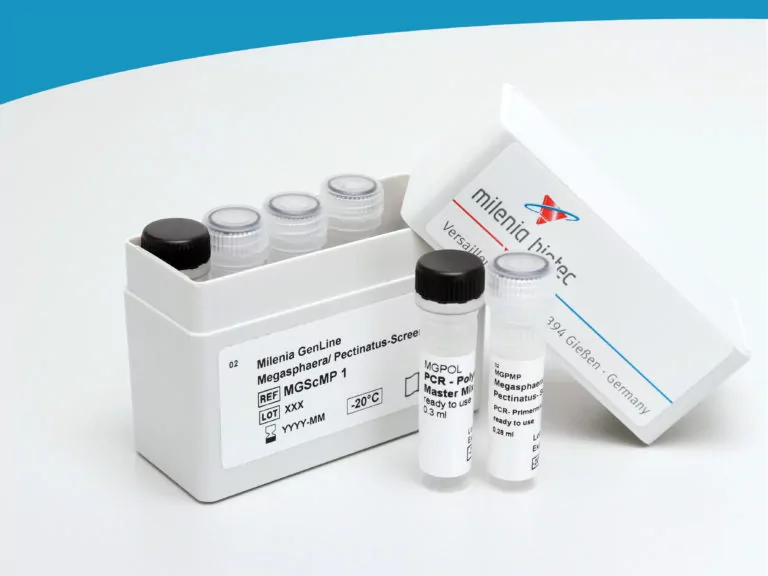
Name of Product Megasphaera/Pectinatus Screen Catalog Number MGScMP 1 Short Info GenLine discovers beer germs in a timely and precise manner
Method/Platform PCR Range/Assay Sensivity 10^4 – 10^5 KBE/mL Test Principle The technological basis for the GenLine tests is the polymerase chain reaction (PCR) combined with lateral flow Tests.
Detail
Name of Product
Megasphaera/Pectinatus Screen
Catalog Number
MGScMP 1
Short Info
GenLine discovers beer germs in a timely and precise manner
Method/Platform
PCR
Range/Assay Sensivity
10^4 – 10^5 KBE/mL
Test Principle
The technological basis for the GenLine tests is the polymerase chain reaction (PCR) combined with lateral flow Tests.
Labelled specific primers are used to amplify specific DNA fragments. In addition to the target gene, a control gene, which is also present in the PCR mixes, is amplified in order to make sure that the PCR process works properly.
The resulting PCR products carry the labels of the incorporated primers.
In a second part of the test, the created PCR products are detected by a lateral flow Test Strip. A “molecular sandwich” is formed and becomes visible as a line on the test Strip.
Brief Instructions
The entire procedure of the test can be divided into 3 different steps.
1.The PCR reagents and the samples are prepared.
2.After the addition of the sample to the PCR reagents, the PCR is started.
3.The resulting PCR products are detected by a simple lateral flow test Strip
Simultaneous concentration, desalting and buffer exchange of total urinary proteins
No molecular weight cutoff allows for isolation of all sizes of proteins and peptides
Purification is based on spin column chromatography that uses Norgen’s resin separation matrix
These kits concentrate urine proteins while simultaneously removing salts, urea, and other urine contaminants. There is no molecular weight cut-off and therefore the columns capture total urinary proteins and peptides of all sizes making them ideal for biomarker discovery work, differential expression of proteins in various diseases, or other diagnostic research. The columns are convenient, rapid and easy to use and thus offer significant time savings over classic dialysis protocols. The resulting high-quality protein sample is concentrated and free from the original sample salts, thus preparing the sample conveniently for downstream proteomic applications including SDS-PAGE, 2D Gels, MALDI-TOF, LC/MS, LC/MS/MS, whole protein mass spectrometry, western blotting, protein microarrays, and more.
ProteoSpin™ Urine Protein Concentration Micro Kit
Each spin column is able to concentrate and desalt up to 200 μg of urine proteins. Twelve samples can be processed in 20 minutes.
ProteoSpin™ Urine Protein Concentration Midi Kit
The ProteoSpin™ Urine Protein Concentration Midi Kit provides a fast and simple procedure for concentrating dilute solutions of urine proteins from 1 to 5 mL inputs of urine. Each mini spin column is able to concentrate and desalt up to 3 mg of urine proteins in 30 minutes.
ProteoSpin™ Urine Protein Concentration Maxi Kit
The ProteoSpin™ Urine Protein Concentration Maxi Kit provides a fast and simple procedure for concentrating dilute solutions of urine proteins from 2 to 20 mL inputs of urine. Each maxi spin column is able to concentrate and desalt up to 4 mg of urine proteins in 45 minutes.
*Yield will depend on the health status of the donor.
Storage Conditions and Product Stability
All solutions should be kept tightly sealed and stored at room temperature. Once opened, the solution should be stored at 4°C. This kit is stable for 2 years after the date of shipment.
Component
Cat. 17400 (25 preps)
Cat. 52300 (10 preps)
Cat. 21600 (4 preps)
Wash Solution C
60 mL
60 mL
130 mL
Binding Buffer A
4 mL
4 mL
8 mL
Elution Buffer C
8 mL
30 mL
30 mL
Protein Neutralizer
4 mL
4 mL
4 mL
Micro Spin Columns
25
–
–
Midi Spin Columns (assembled with collection tubes)
–
10
–
Maxi Spin Columns (assembled with collection tubes)
Solid Phase Reversible Immobilization magnetic beads are often used for DNA purification because they are simple, fast, and effective. The beads are paramagnetic particles coated with carboxyl groups that reversibly bind to nucleic acid. However, Standard SPRI beads can only purify DNA/RNA fragments that are 100 base pairs or longer. DNA/RNA fragments shorter than 100 base pairs are not effectively recovered by SPRI beads. We have developed Magnetic Beads(microRNA & Oligo Purification) to solve the problem.
With our proprietary beads technology, the beads overcomes the hurdle of the short DNA/RNA recovery problem. The magnetic beads is ideal for microRNA purification, oligo purification, short DNA/RNA purification, and removing impurities and unwanted components such as dNTPs, detergents, salts, proteins, and other contaminants effectively. The magnetic bead reagents are RNase-free and can be used for both DNA and RNA applications.
Our magnetic beads are optimized for microRNA purification, oligo purification, and DNA/RNA purification. The fragments can be as short as 20 bases, such as microRNA, tRNA, dsDNA fragments 20 bp or longer, ssDNA fragments 20 nt or longer, RNA fragments 20 nt or longer, DNA/RNA hybrid fragments 20 bp or longer, and oligos and chimeric oligos 20 nt or longer. Purified short DNA and RNA fragments are ideal for applications requiring high-quality fragments, as the fragments are free of impurities and contaminants.
Comparison of short DNA fragments recovery. BioDynami 20 bp DNA ladder (Cat. # 10002) was used as DNA input. Ampure XP beads, BioDynami beads (DNA & RNA purification) and BioDynami beads (microRNA & Oligo purification) were tested. Only BioDynami beads (microRNA & Oligo purification) successfully recovered DNA fragments between 20-100 bp.
Recovery of DNA and RNA oligos with BioDynami magnetic Beads (microRNA & Oligo Purification). 20 nt of DNA oligos and RNA oligos were used as input. Input and recovered oligos were quantified with BioDynami ssDNA Quantification kit (Cat. # 40043) and BioDynami RNA Quantification kit (Cat. # 40044).
Features
Effective purification of short DNA and RNA samples
microRNA
tRNA
dsDNA fragments 20 bp or longer
ssDNA fragments 20 nt or longer
RNA fragments 20 nt or longer
DNA/RNA hybrid fragments 20 bp or longer
Oligo and chimeric oligo 20 nt or longer
Removal of impurities and unwanted reaction components
Compatibility: Works with both manual and automated procedures
Mastitis is the single most costly disease of dairy cattle resulting in the reduction of milk yield and quality. The inflammation of the utter is mainly caused by infection of various bacteria. Streptococcus uberis is a gram-positive bacterium that is known worldwide as an environmental pathogen responsible for a high proportion of cases of mastitis in lactating cows and is also the predominant organism isolated from mammary glands during the non-lactating period. Often it is resistant to treatment and causes persistent high somatic cell counts without clinical mastitis.
Storage Conditions and Product Stability All kit components can be stored for 2 years after the date of production without showing any reduction in performance.
All kit components should be stored at -20°C upon arrival. Repeated thawing and freezing (> 2 x) of the Master Mix and Positive Control should be avoided, as this may affect the performance of the assay. If the reagents are to be used only intermittently, they should be frozen in aliquots.