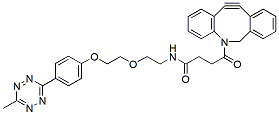
Methyltetrazine-PEG1-DBCO is a TCO reactive reagent with a DBCO group and water-soluble PEG spacer. This reagent can be used to convert azido-containing peptides or proteins into tetrazine-modified peptides or protein without catalyst or axillary reagents. DBCO is commonly used for copper-free Click Chemistry reactions. Reagent grade, for research purpose. Please contact us for GMP-grade inquiries.
Detail
Methyltetrazine-PEG1-DBCO is a TCO reactive reagent with a DBCO group and water-soluble PEG spacer. This reagent can be used to convert azido-containing peptides or proteins into tetrazine-modified peptides or protein without catalyst or axillary reagents. DBCO is commonly used for copper-free Click Chemistry reactions. Reagent grade, for research purpose. Please contact us for GMP-grade inquiries.
Other Products
P1154 HiPure Plasmid EF Mini Kit
Product Info
Document
Product Info
Introduction
The HiPure Plasmid EF Mini Kit combine the power of HiPure technology with Magen’s innovative endotoxin removal technology to deliver high-quality plasmid DNA with low endotoxin levels foruse in eukaryotic transfection, and in vitro experiments. The HiPure plasmid endo-free system uses a specially formulated buffer that prevents endotoxin molecules from binding to the surface of the HiPure matrix. Endotoxin contamination lowers transfection efficiencies for endotoxin sensitive celllines. For gene therapy, endotoxin contamination should be of major concernsince endotoxins have the potential to cause fever, endotoxin shock syndrome, and interfere with in vitro transfection into immune cells.
Details
Specifications
Features
Specifications
Main Functions
Isolation up to 80µg endotoxin-free plasmid DNA from 5-15ml bacterial culture. Recommend for low copy vector, Thoroughly remove RNA
Applications
Cell transfection, animal injection, etc.
Purification method
Mini spin column
Purification technology
Silica technology
Process method
Manual (centrifugation or vacuum)
Sample type
Low copy plasmid vector
Sample amount
5-15ml LB
Yield
10-70μg
Elution volume
≥75μl
Time per run
≤40 minutes
Liquid carrying volume per column
800μl
Binding yield of column
70μg
Principle
The HiPure Plasmid procedure is based on alkaline lysis of bacterial cells followed by adsorption of DNA onto silica in the presence of high salt. The unique silica membrane used in the kit completely replaces glass or silica slurries for plasmid DNA minipreps. The procedure consists of 3 basic steps: Preparation and clearing of a bacterial lysate by alkaline method,then transfer the supernatant to column to bind DNA. After washing proteins and other impurities, nucleic acid was finally eluted with low-salt buffer (10mm Tris, pH9.0, 0.5mm EDTA).
Advantages
High purity – purified plasmid can be directly used in sequencing, enzyme digestion and PCR, etc.
Fast – silica gel column purification is much faster than ion exchange
High yield – up to 70μg plasmid can be binded in one column
Low endotoxin content – the obtained plasmid can be directly used in cell transfection and animal injection
Kit Contents
Contents
P115402
P115403
Purification Times
50 Preps
250 Preps
RNase A
5 mg
20 mg
Buffer P1
30 ml
140 ml
Buffer P2
30 ml
140 ml
Buffer LEN3
15 ml
70 ml
Buffer LN4
50 ml
250 ml
Buffer LN5
30 ml
140 ml
Buffer PW1
30 ml
140 ml
Buffer PW2
12 ml
50 ml
Elution Buffer
15 ml
30 ml
HiPure DNA Mini Columns III
50
250
2 ml Collection Tubes
50
250
Storage and Stability
The kit components can be stored dry at room temperature (15–25°C) and are stable for at least 18 months under these conditions. If any precipitates form in the buffers, warm at 37℃ to dissolve. After addition of RNase A,Buffer P1 is stable for 6 months when stored at 2–8°C.
The HiPure Plasmid EF Mini Kit combine the power of HiPure technology with Magen’s innovative endotoxin removal technology to deliver high-quality plasmid DNA with low endotoxin levels foruse in eukaryotic transfection, and in vitro experiments. The HiPure plasmid endo-free system uses a specially formulated buffer that prevents endotoxin molecules from binding to the surface of the HiPure matrix. Endotoxin contamination lowers transfection efficiencies for endotoxin sensitive celllines. For gene therapy, endotoxin contamination should be of major concernsince endotoxins have the potential to cause fever, endotoxin shock syndrome, and interfere with in vitro transfection into immune cells.
NGS FFPE DNA Library Prep Kit (illumina and MGI Platforms)
Product Info
Document
Product Info
The NGS FFPE DNA Library Prep Kit (illumina and MGI Platforms) was developed for the construction of high quality FFPE DNA libraries using 10 ng to 400 ng of input DNA isolated from formalin-fixed, paraffin-embedded (FFPE) samples. The DNA damage caused by fixation makes it difficult to construct high quality libraries. Our kit has been optimized to repair damaged DNA in the reactions. Multiplexing of the NGS FFPE DNA Library is possible.
NGS FFPE DNA Library Prep Kit Workflow
FFPE samples are a great resource for biomedical research. However, the methods for fixation and condition of storage significantly damage the DNA in the samples. Thus, the extraction of high quality DNA from FFPE samples is often a challenge. Low yield and low quality of FFPE DNA usually are common because of the limited tissue material and the DNA degradation.
As a result, it is usually difficult to construct high quality NGS libraries from low amount and low quality of FFPE DNA. In order to address this issue, we have developed the NGS FFPE DNA Library Prep Kit to make high quality libraries from the low input of FFPE DNA samples.
Three index types are available for the NGS FFPE DNA Library Prep Kit of the illumina platform:
Non-index (Cat.# 30035): Libraries do not have index.
Index (Cat.# 30037): Each of our index primers contains a unique barcode DNA (6 bases long) that can be used to identify individual library. Multiplexing of libraries is up to 48 samples. Index information can be downloaded here.
Unique dual index (Cat.# 30039): FFPE DNA library multiplexing is possible with 96 samples based on the unique dual indexing system. Our unique Four–Base Difference Index System allows us to make indexes that have at least 4 bases different from each other in the 8-base index sequence. Our unique dual indexing primers can effectively remove NGS errors including index hopping, de-multiplexing errors, index cross-contamination, mis-assignments etc. The unique dual index primer set includes 96 pre-mixed unique pairs of i5 and i7 index primers. Index information can be downloaded here.
Indexes are available for the MGI platform kits (Cat.# 34037).
Kit advantages:
Fast and simple protocol
Making libraries in just 1.5 hours
10 minutes of hands-on time
Easy procedure
Ready-to-use master mix to reduce the tedious mixing
Less reaction components to simplify the reaction setup
Less magnetic beads needed for the purification steps: saving more than 50% of the expensive beads
Low input FFPE DNA: From 10 ng to 400 ng
Comparison of library conversion efficiency under the same condition. Input DNA amount is 25 ng.
Comparison of library yield under the same condition. Input DNA amount is 25 ng.
Document
The NGS FFPE DNA Library Prep Kit (illumina and MGI Platforms) was developed for the construction of high quality FFPE DNA libraries using 10 ng to 400 ng of input DNA isolated from formalin-fixed, paraffin-embedded (FFPE) samples. The DNA damage caused by fixation makes it difficult to construct high quality libraries. Our kit has been optimized to repair damaged DNA in the reactions. Multiplexing of the NGS FFPE DNA Library is possible.
For cultivations of yeasts , moulds and acidophilic bacteria.
Principle:
Peptone and yeast extract powder provides carbon and nitrogen sources and trace elements; lactose are fermentable sugars; sodium chloride maintains osmotic equilibrium; the 3rd bile salts and crystal violet inhibiting gram-positive bacteria, especially against Gram positive bacteria and fecal streptococci; neutral red as pH indicator.
Formulation(per liter):
Peptone 5g
Tryptone 5g
Glucose 20g
Final pH 5.7 ± 0.1
How to use:
1.Suspend 30g in 1 L of distilled water , stirring heated to boiling until completely dissolved, dispensing flask, 121 autoclave for 15min.
2.Diluted and treated samples.
Quality control:
Item
The name and number of strain
Growth
Colony Color
1
Aspergillus niger ATCC16404
Good
Spore surface growth
2
Candida albicans ATCC10231
Good
Cloudy broth
3
Escherichia coli ATCC25922
Inhibition
—
Storage: Keep container tightly closed, store in a cool, dry place, away from bright light. Storage period of 3 years.