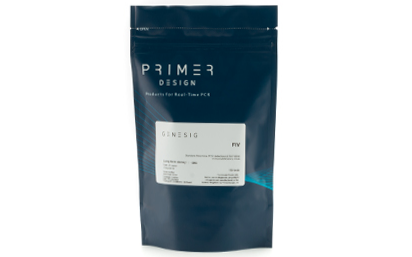
Primer and probe mix (150 reactions) Reverse Transcription, target specific primers (RNA genome viruses only) Copy number standard curve (sufficient for multiple standard curves) Internal extraction control – Read through VIC channel* Endogenous control (150 tests) RNAse/DNAse free water *alternative fluorophores available on request
Nucleic acid testing (NAT) is the method of choice for detection and quantification of a wide range of micro organisms. Primerdesign manufactures and supplies high quality quantitative real-time PCR kits for the detection and simultaneous quantification of numerous significant pathogens . A copy number standard curve is provided for quantification and an the internal extraction template (DNA or RNA), controls for the quality of the nucleic acid extraction and eliminates false negative results.
The kit is designed with the broadest possible detection profile to ensure that all clinically relevant strains and subtypes are detected. Target sequences are selected by working with data from key opinion leaders in the field. Multiple sequence alignments and unprecedented real-time PCR expertise in design and validation ensure the best possible kit. Details of the target and priming specificity are included in the individual handbooks above.
Packaged, optimised and ready to use. Expect Better Data.
Other Products
Raffinose/D-Galactose Assay Kit
Product Info
Document
Product Info
K-RAFGA
SKU: 700004331
120 assays per kit
Content:
120 assays per kit
Shipping Temperature:
Ambient
Storage Temperature:
Short term stability: 2-8oC, Long term stability: See individual component labels
Stability:
> 2 years under recommended storage conditions
Analyte:
D-Galactose, Raffinose
Assay Format:
Spectrophotometer
Detection Method:
Absorbance
Wavelength (nm):
340
Signal Response:
Increase
Linear Range:
4 to 83 µg of D-galactose per assay (i.e. approx. 12 to 250 µg of raffinose per assay)
Limit of Detection:
21 mg/L
Reaction Time (min):
~ 60 min
Application examples:
Cereal flours, soybean flour, by-products of sucrose manufacture and other materials.
Method recognition:
Used and accepted in food analysis
The Raffinose/D-Galactose test kit allows for the specific and rapid measurement of raffinose and D-galactose in plant materials and food products.
Note for Content: The number of manual tests per kit can be doubled if all volumes are halved. This can be readily accommodated using the MegaQuantTM Wave Spectrophotometer (D-MQWAVE).
Floor Type High Speed & Low Speed Universal Refrigerated Centrifuge
Product Info
Document
Product Info
GL20 Technical Parameter:
Max. Speed
21000rpm
Max. RCF
30910×g
Max. Capacity
4×800ml
Time Range
1~9h59min
RPM/RCF Convert
Yes
Noise (dB)
≤ 60
Temperature
-20℃~40℃
Acc/Dec
10 Kinds
Speed Accuracy
±20r/min
Temperature Accuracy
±1℃
Voltage(V/Hz)
AC 220V/110V 50HZ/60HZ
Size (W x D x Hmm)
680×540×830mm
Net Weight(Kg)
170KG
Certificates
CE,ISO & Calibration report are available
Matched Rotors for GL20
Order No
Rotor
Rotor Max Speed(r/min)
Volume(ml)
RCF(×g)
G20-1
Swing Rotor
4000
4×800ml
3450
G20-2
Microplate rotor
4000
4×4×96 well
2940
G20-3
Microplate rotor
4000
2×4×96 well
3210
G20-4
Microplate rotor
4000
2×3×48 well
2300
G20-5
Swing rotor
4000
4×40×7ml vacuum tube
3270
G20-6
4000
4×40×5ml vacuum tube
2890
G20-7
4000
4×28×10ml vacuum tube
3130
G20-8
Swing Rotor
4000
Fat bottle
3830
G20-9
Fixed Rotor
16000
4×8PCR
15760
G20-10
Fixed Rotor
15000
6×8PCR
21420
G20-11
Fixed Rotor
16000
8×8PCR
17480
G20-12
Fixed Rotor
15000
12×8PCR
22930
G20-13
Fixed Rotor
15000
40×0.5ml
22920
G20-14
Fixed Rotor
21000
12×1.5ml
30910
G20-15
Fixed Rotor
16000
24×1.5ml
23440
G20-16
Fixed Rotor
14000
30×1.5ml
20800
G20-17
Fixed Rotor
13000
48×1.5ml
17930
G20-18
Fixed Rotor
16000
16×5ml
22020
G20-19
Fixed Rotor
16000
6×10ml
21500
G20-20
Fixed Rotor
15000
12×10ml
22680
G20-21
Fixed Rotor
13000
16×10ml
19490
G20-22
Fixed Rotor
13000
8×15ml
17790
G20-23
Fixed Rotor
11000
12×15ml
14330
G20-24
Fixed Rotor
5000
24×15ml
3500
G20-25
Fixed Rotor
5000
30×15ml
3830
G20-26
Fixed Rotor
14000
6×30ml
19060
G20-27
Fixed Rotor
13000
6×50ml(conical)
18840
G20-28
Fixed Rotor
13000
6×50ml(round)
18730
G20-29
Fixed Rotor
5000
12×50ml
3860
G20-30
Fixed Rotor
4000
24×50ml
2970
G20-31
Fixed Rotor
13000
4×85ml
18940
G20-32
Fixed Rotor
12000
4×100ml
14850
G20-33
Fixed Rotor
10000
6×100ml
11380
G20-34
Fixed Rotor
4000
12×100ml
2970
G20-35
Fixed Rotor
12000
24 capillaries
15800
G20-36
Swing Rotor
15000
4×5ml
19920
G20-37
Vertical rotor
16000
16×5ml
16450
G20-38
Vertical rotor
14000
8×30ml
19750
Document
Features
1. Brushless frequency motor, in great torque, free maintenance, no powder pollution, quick in speed up and down.
2.Imported compressors fluorine free,double cycle cooling, cold and hot alternating easily, free environment pollution and precise in temperature control
3.Microprocessor control, digital display which indicates the temperature, speed, time, RCF in operation, speed raising and reducing quickly, operate simply. Running parameter can be edited.
4. 10 kinds of program stored in the memory, 10 kinds of accelerating and decelerating speed for your choice.
5. Automatically electric lid lock, over speed, over temperature protection and imbalance protection.
[PM5000] ExcelBand™ 3-color Pre-Stained Protein Ladder, Regular Range (9-180 kDa), 250 μl x 2
Product Info
Document
Product Info
Description
The PM5000 ExcelBand™ 3-color Pre-Stained Protein Ladder Regular Range is a ready-to-use three-color protein standard with 13 pre-stained proteins covering a wide range of molecular weights from 10 to 180 kDa in Tris-Glycine Buffer (9 to 170 kDa in Bis-Tris (MOPS) buffer and 10 to 170 kDa Bis-Tris (MES) buffer). Proteins are covalently coupled with different chromophores for easy identification of bands, with three reference proteins carrying enhanced intensity corresponding to a blue band at 20 kDa, green at 40 kDa, and red at 75 kDa, respectively, as separated on SDS-PAGE (Tris-Glycine buffer). The PM5000 ExcelBand™ 3-color Pre-Stained Protein Ladder Regular Range is designed for monitoring protein separation during SDS-polyacrylamide gel electrophoresis, verification of Western transfer efficiency on membranes (PVDF, nylon, or nitrocellulose) and for approximating the size of proteins.
Features
Ready-to-use — Premixed with a loading buffer for direct loading, no need to boil.
Three reference bands — 75 kDa (red), 40 kDa (green), and 20 kDa (blue)
Contents
Approximately 0.1~0.4 mg/ml of each protein in the buffer (20 mM Tris-phosphate (pH 7.5 at 25°C), 2% SDS, 0.2 mM DTT, 3.6 M urea, and 15% (v/v) glycerol).
Quality Control
Under suggested conditions, PM5000 ExcelBand™ 3-color Pre-Stained Protein Ladder Regular Range resolves 13 major bands in SDS-PAGE (Tris-Glycine, MOPS, and MES buffer) and after Western blotting to nitrocellulose membrane.
Storage
4°C for 3 months -20°C for long term storage
Document
The PM5000 ExcelBand™ 3-color Pre-Stained Protein Ladder Regular Range is a ready-to-use three-color protein standard with 13 pre-stained proteins covering a wide range of molecular weights from 10 to 180 kDa in Tris-Glycine Buffer (9 to 170 kDa in Bis-Tris (MOPS) buffer and 10 to 170 kDa Bis-Tris (MES) buffer). Proteins are covalently coupled with different chromophores for easy identification of bands, with three reference proteins carrying enhanced intensity corresponding to a blue band at 20 kDa, green at 40 kDa, and red at 75 kDa, respectively, as separated on SDS-PAGE (Tris-Glycine buffer). The PM5000 ExcelBand™ 3-color Pre-Stained Protein Ladder Regular Range is designed for monitoring protein separation during SDS-polyacrylamide gel electrophoresis, verification of Western transfer efficiency on membranes (PVDF, nylon, or nitrocellulose) and for approximating the size of proteins.