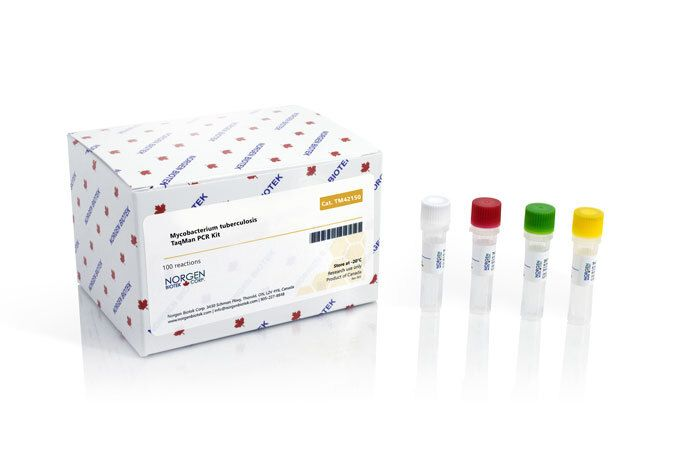
CE-IVD marked version available for in vitro diagnostic use
Available in TaqMan format for analysis
Mycobacterium tuberculosis is a pathogenic bacterial species belonging to the genus Mycobacterium, and is the causative agent of tuberculosis. Tuberculosis (TB) is a multifaceted disease and challenging public health problem in both industrialized and developing countries. According to the WHO, 8.8 million active cases of TB are diagnosed each year and of these, almost 2 million die. Once thought to be under control or even close to extinction, TB infection levels are rising and the threat is compounded by new, virulent and drug-resistant strains. Although most cases occur in the developing world (22 countries accounting for 80% of all global cases), increasing population mobility combined with facility of transmission means that no country is immune from the resurgence of TB. TB control programs are currently facing a number of constraints. Worldwide, fewer than 25% of all tuberculosis cases are detected. Of utmost concern is the absence of a timely and accurate test for the diagnosis of mycobacterial disease. Early diagnosis is crucial for the prevention of further spread of the disease.
Storage Conditions and Product Stability All kit components can be stored for 2 years after the date of production without showing any reduction in performance.
All kit components should be stored at -20°C upon arrival.
Free-circulating nucleic acids, such as tumor-specific extracellular nucleic acid fragments and mRNAs in the blood or fetal nucleic acids in maternal blood, are present in serum or plasma usually as short fragments, <1000bp(Nucleic Acid). The HiPure Circulating Nucleic acid Micro Kit enables efficient purification of these circulating nucleic acids from human plasma, serum, or urine. Samples can be either fresh or frozen (provided that they have not been frozen and thawed more than once). Free-circulating cell-free DNA, RNA or viral nucleic acids are eluted in Nuclease Free Water, ready for use in amplification reactions or storage at -30 to -15°C. Purified nucleic acids are free of proteins, nucleases, and other impurities.
Details
Specifications
Features
Specifications
Main Functions
Isolation circulating DNA from 0.6ml plasma,serum, body fluids
Applications
qPCR, liquid or solid chip analysis, hybridization and SNP detection, etc.
Purification method
Mini spin column
Purification technology
Silica technology
Process method
Manual (centrifugation or vacuum)
Sample type
Serum, plasma and other cell-free fluid samples
Sample amount
0.6ml
Elution volume
≥30μl
Time per run
≤40 minutes
Liquid carrying volume per column
800μl
Binding yield of column
100μg
Principle
This product is based onsilica column purification. The sample is lysed and digested with lysate andprotease, DNA is released into the lysate. Transfer to an adsorption plate andfilter column. Nucleic acid is adsorbed on the membrane, while protein is notadsorbed and is removed with filtration. After washing proteins and otherimpurities, Nucleic acid was finally eluted with low-salt buffer.
Advantages
High yield – most optimal process, free DNA (>50bp) can be obtained to the maximum extent
High concentration – low elution volume, ensuring high nucleic acid concentration
High purity – low alcohol binding method, completely removing inhibitor and protein pollution
High recovery – DNA can be recoveredat the level of PG by silica gel column purification
Kit Contents
Contents
D318002
D318003
Purification Times
50 Preps
250 Preps
Buffer ACL
40 ml
200 ml
Buffer DCW1
22 ml
110 ml
Buffer DCW2*
20 ml
2 x 50 ml
Proteinase K
34 mg
180 mg
Protease Dissolve Buffer
1.8 ml
10 ml
Carrier RNA
110 μg
310 μg
Nuclease Free Water
10 ml
30 ml
HiPure CFDNA Mini Columns
50
250
2 ml Collection Tubes
100
5 x 100
Storage and Stability
Proteinase K, Carrier RNAshould be stored at 2-8°C upon arrival. However, short-term storage (up to 12weeks) at room temperature (15-25°C) does not affect their performance. Theremaining kit components can be stored dry at room temperature (15-25°C) andare stable for at least 18 months under these conditions. The entire kit can bestored at 2-8°C, but in this case buffers should be redissolved before use.Make sure that all buffers are at room temperature when used.
Document
Free-circulating nucleic acids, such as tumor-specific extracellular nucleic acid fragments and mRNAs in the blood or fetal nucleic acids in maternal blood, are present in serum or plasma usually as short fragments,
Isolate all sizes of circulating and exosomal RNA, including microRNA
Versatile plasma/serum input ranges
No phenol extractions
No carrier RNA
Bind and elute all RNA irrespective of size or GC content, without bias
Concentrate circulating RNA and exosomal RNA into a flexible elution volume
High quality, purified RNA is suitable for a variety of downstream applications, including Small RNA Sequencing. Find out more information on Norgen’s NGS services
Compatible with Streck Cell-Free RNA BCT® Tubes
Purification is based on spin column chromatography that uses Norgen’s proprietary resin separation matrix
These kits provide a fast, reliable and convenient method to purify and concentrate high quality, high purity and inhibitor-free cell-free circulating and exosomal RNA using a convenient spin column method. These kits can purify RNA from fresh or frozen serum or plasma samples prepared from blood collected on either EDTA or Citrate. Plasma samples prepared from blood collected on heparin should not be used, as heparin can significantly interfere with many downstream applications such as RT-PCR. The purified plasma/serum RNA is fully compatible with all downstream applications including PCR, qPCR, methylation-sensitive reverse transcription qPCR, reverse transcription PCR, Northern blotting, RNase protection and primer extension, expression array assays, and NGS.
Background
Plasma/Serum cell-free circulating RNA or exosomal RNA has the potential to provide biomarkers for certain cancers and disease states. Exosomes are 40 – 150 nm membrane vesicles, which are secreted by most cell types. Exosomes can be found in saliva, blood, urine, amniotic fluid and malignant ascitic fluids, among other biological fluids. Evidence has been accumulating recently that these vesicles act as cellular messengers, conveying information to distant cells and tissues within the body. These exosomes may play a functional role in mediating adaptive immune responses to infectious agents and tumours, tissue repair, neural communication and transfer of pathogenic proteins. For this reason exosomal RNAs may serve as biomarkers for various diseases including cancer. As the RNA molecules encapsulated within exosomes are protected from degradation by RNAses they can be efficiently recovered from biological fluids, such as plasma or serum.
Plasma/Serum RNA Purification Mini Kit
This kit can purify RNA from fresh or frozen serum or plasma samples prepared from blood collected on either EDTA or Citrate, from volumes ranging from 50 µL to 200 µL. The purified plasma/serum RNA is eluted in a flexible final volume of 10 µL to 25 µL.
Plasma/Serum RNA Purification Midi Kit
This utilizes a two column method, and can purify RNA from fresh or frozen serum or plasma samples prepared from blood collected on either EDTA or Citrate, from volumes ranging from 250 µL to 1.5 mL. The first column will handle the large volume input of bodily fluids that is followed by a concentration on a mini column for a final elution of 50 µL to 100 µL.
Plasma/Serum RNA Purification Maxi Kit
This kit can purify RNA from fresh or frozen serum or plasma samples prepared from blood collected on either EDTA or Citrate, from volumes ranging from 2 mL to 5 mL. The first column will handle the large volume input of bodily fluids that is followed by a concentration on a mini column for a final elution of 50 µL to 100 µL.
*This kit is suitable for the isolation of RNA from fresh or frozen serum or plasma prepared from blood collected on either EDTA or Citrate. Plasma samples prepared from blood collected on heparin should not be used as heparin can significantly interfere with many downstream applications such as RT-PCR.
**Please check page 7 for Average Plasma/Serum Yields and Common RNA Quantification Methods.
Storage Conditions and Product Stability
All solutions should be kept tightly sealed and stored at room temperature. This kit is stable for 2 years after the date of shipment. It is recommended to warm Lysis Buffer A for 20 minutes at 60°C if any salt precipitation is observed.