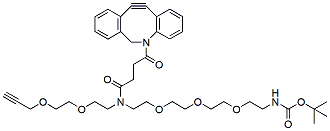
N-(Propargyl-PEG2)-DBCO-PEG3-N-Boc enables formation of triazole linkage with azide-bearing compound via copper catalyzed Click Chemistry. Under mild acidic conditions, t-Boc group can be removed to yield the free amine. The propargyl group can be linked to azide-containing biomolecules via Click Chemistry. Reagent grade, for research purpose.
Detail
N-(Propargyl-PEG2)-DBCO-PEG3-N-Boc enables formation of triazole linkage with azide-bearing compound via copper catalyzed Click Chemistry. Under mild acidic conditions, t-Boc group can be removed to yield the free amine. The propargyl group can be linked to azide-containing biomolecules via Click Chemistry. Reagent grade, for research purpose.
Norgen’s TaqMan 2x PCR Master Mix is a ready-to-use TaqMan 2x PCR Master Mix solution that contains a PCR internal control which can be detected by HEX/VIC channel in a real-time PCR machine. By detecting the internal control users can validate the DNA template quality, thereby preventing any false negatives in the PCR results. The user needs only to add template, target TaqMan primer/probe mix and water to set up the TaqMan real-time PCR.
PCR Control: TaqMan 2x PCR Master Mix contains PCR control primers/probe (HEX/VIC) and PCR control template. The PCR control reaction in the TaqMan 2x PCR Master Mix is optimized to not interfere with target amplification. The fluorescence of the target probe should not be HEX/VIC.
Details
Reagents Supplied – Cat # 28341
TaqMan 2x RT-PCR Master Mix (3 Vials, 100 Reactions) – Sufficient reagent for 100 x 20 µL reactions
Storage Conditions and Product Stability Norgen’s TaqMan 2x PCR and 2x RT-PCR Master Mixes should be stored at -20ºC. For everyday use an aliquot can be stored at 4ºC for up to three months. The Master Mix is stable for multiple freeze-thaw cycles. When stored at the proper temperature this reagent is stable for at least 1 year.
NGS Library Quantification Standards With PCR Primers (Ion Torrent Platform)
Product Info
Document
Product Info
The NGS Library Quantification Standards with PCR Primers (for Ion Torrent platform) were developed for quantifying the library concentration for ion torrent sequencing platform. Quantification of the library of the fully ligated libraries is important for the quality of the sequencing outcome. Optimal library concentration can increase sequencing yield. Poor library concentration results in bad emPCR, which can lead to low sequencing capacity.
QPCR is the best method for library quantification. Our reagent only amplifies library molecules that will be used for subsequent emPCR, and is optimized for amplification of various samples. Our reagent is compatible with commercial SYBR Green based QPCR reagents. Quantification of library concentration is achieved by comparison with a standard curve generated from DNA Standards.
The kit comprises DNA Standards (six 10-fold dilutions) and a primer mix.
NGS Library Quantification Standards with PCR Primers (Ion Torrent platform): real time quantitative PCR curve of the standards.
Document
The NGS Library Quantification Standards with PCR Primers (for Ion Torrent platform) were developed for quantifying the library concentration for ion torrent sequencing platform. Quantification of the library of the fully ligated libraries is important for the quality of the sequencing outcome. Optimal library concentration can increase sequencing yield. Poor library concentration results in bad emPCR, which can lead to low sequencing capacity.
Round well with ‘V’ bottom for maximum liquid extraction
High uniformity from well to well
Raised well rims for reliable closing with heat sealing.
Easy and reliable stacking
Good centrifugation stability up to 6,000 × g for faster protocols and improved sample quality
Manufactured under DNase/ RNase free environment without slip agents, plasticizers or biocides – Materials which could have a negative effect on bioassays
Pure, virgin polypropylene guarantees good extractible performance, high resistance to chemicals, good mechanical stress and working with temperature extremes
Autoclavable (121 °C, 20 min)
Document
Working volume of 0.36ml Round well with ‘V’ bottom for maximum liquid extraction High uniformity from well to well Raised well rims for reliable closing with heat sealing. Easy and reliable stacking Good centrifugation stability up to 6,000 × g for faster protocols and improved sample quality Manufactured under DNase/ RNase free environment without slip agents, plasticizers or biocides – Materials which could have a negative effect on bioassays Pure, virgin polypropylene guarantees good extractible performance, high resistance to chemicals, good mechanical stress and working with temperature extremes Autoclavable (121 °C, 20 min)