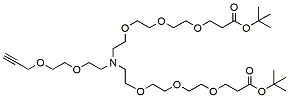
N-(Propargyl-PEG2)-N-bis(PEG3-t-butyl ester) is a 3-arm PEG reagent with a propargyl groups and two t-butyl ester groups. The propargyl group can react with azides via copper catalyzed Click Chemistry reaction to yield a stable triazole linkage. The t-butyl ester groups can be deprotected under acidic conditions. Reagent grade, for research purpose. Please contact us for GMP-grade inquiries.
Detail
N-(Propargyl-PEG2)-N-bis(PEG3-t-butyl ester) is a 3-arm PEG reagent with a propargyl groups and two t-butyl ester groups. The propargyl group can react with azides via copper catalyzed Click Chemistry reaction to yield a stable triazole linkage. The t-butyl ester groups can be deprotected under acidic conditions. Reagent grade, for research purpose. Please contact us for GMP-grade inquiries.
Other Products
High Purity DNA Purification Kit Fast Extract Isolate Nucleic Acids
Product Info
Document
Product Info
High Purity DNA Purification Kit
,
12 Months DNA Purification Kit
,
Nucleic Acid dna isolation kit
Product Description
Rapid Nucleic Acid Release Reagent (DNA) – Type II
High Purity DNA Purification Kit Fast Extract Isolate Nucleic Acids
Product parameters:
Reagent component (WLD8201-ES,2Tubes/box)
Component
Specification
Quantity
LD-1
800μL=0.8mL
1 Tube
LD-2
200μL=1.2mL
1 Tube
Product features and advantages:
Product features
Simplicity
The operation is simple, and the DNA template for amplification can be obtained in just one step (conventional 5min)
Security
Non-toxic environmental protection, room temperature transport and storage
Universality
The lysate can be used for isothermal nucleic acid amplification
Product application:
It is used for pre-processing and nucleic acid release of swab samples and plant tissue samples, rapidly cracking all kinds of common samples without purification; The sample lysate can be directly used as a template for amplification reaction.
Tips: Its reverse combined with our constant temperature amplification reagent for nucleic acid detection.
Sample processing type
Liquid sample
Samples of plants or tissues
Serum, blood, saliva, ascites and other samples, swab leach solution
Brain, muscle, viscera, leaves, fruit and other samples, take liquid supernatant
Propargyl-PEG7-NHS ester contains a propargyl group and an NHS ester. As an amine reactive reagent, this product can be used for derivatizing peptides, antibodies, amine coated surfaces etc. In the presence of copper catalyst, propargyl group reacts with azide to yield a stable triazole linkage. The PEG units help increase the hydrophilicity of the reagent. Reagent grade, for research purpose. Please contact us for GMP-grade inquiries.
Document
Propargyl-PEG7-NHS ester contains a propargyl group and an NHS ester. As an amine reactive reagent, this product can be used for derivatizing peptides, antibodies, amine coated surfaces etc. In the presence of copper catalyst, propargyl group reacts with azide to yield a stable triazole linkage. The PEG units help increase the hydrophilicity of the reagent. Reagent grade, for research purpose. Please contact us for GMP-grade inquiries.
PACE (PCR Allelic Competitive Extension) genotyping chemistry is a homogeneous, PCR-based allele-specific technology for the analysis of DNA sequence variants, most commonly SNPs (Single Nucleotide Polymorphisms) and Indels (insertion / deletions).
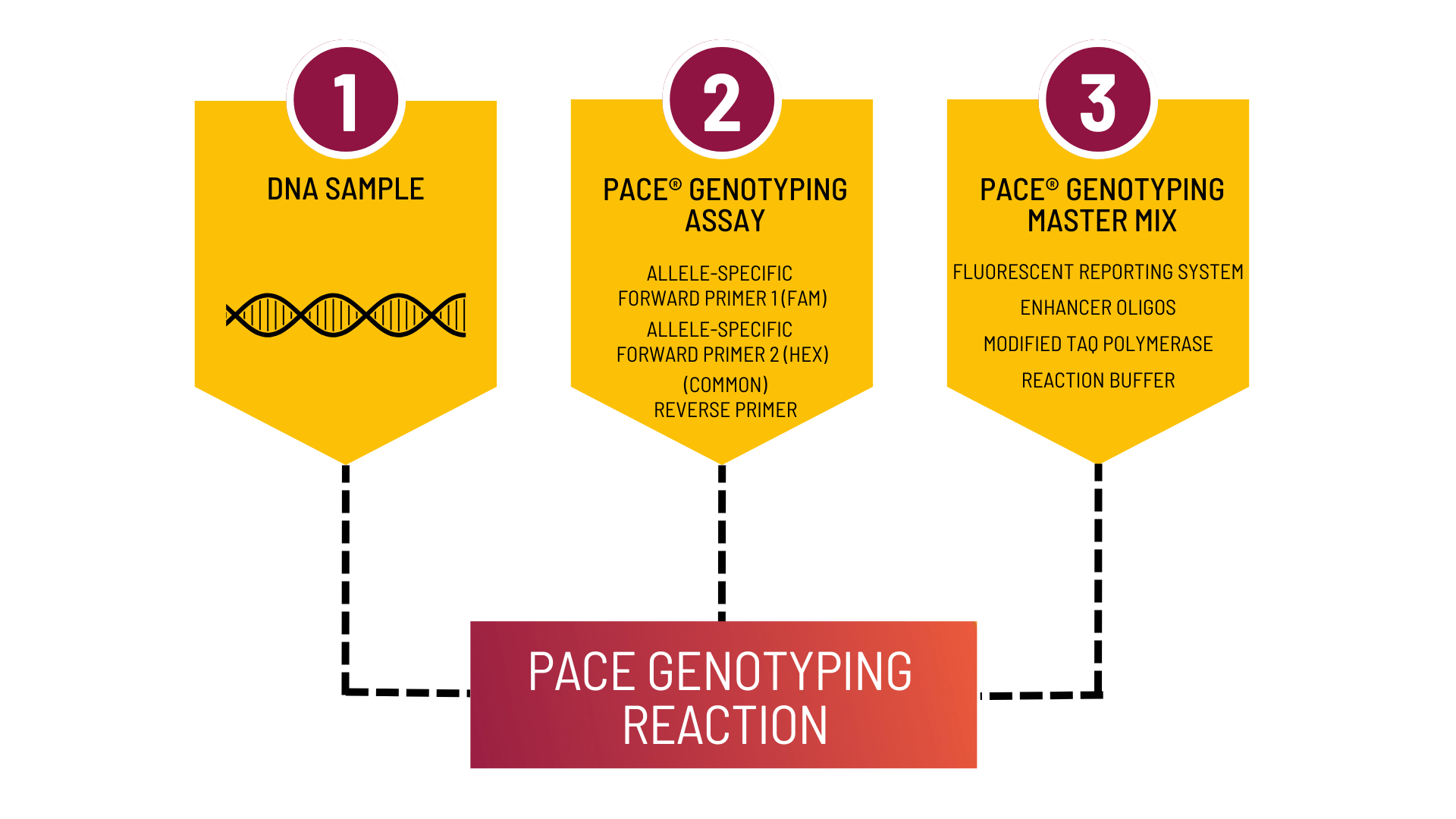
PACE genotyping chemistry is comprised of two parts:
PACE Genotyping Assay: two allele-specific forward primers and one common, reverse primer. The allele-specific forward primers each have different 3′ terminal bases reflecting the target variant, and a unique 5’ tail sequence which is incorporated as part of the fluorescent signal mechanism.
PACE Genotyping Master Mix: containing all remaining components required for PCR and the generation of fluorescent signals. PACE Genotyping Master Mix contains a novel, universal, fluorescent reporting cassette to produce machine-readable fluorescent signals (FAM and HEX) corresponding to the assay genotypes.
When combined with sample DNA, these components create a PACE Genotyping Reaction, as illustrated in the figure below.
We have extensive knowledge and experience in assay design, especially when it comes to allele-specific PCR. PACE Genotyping Assays are available to purchase either Validated and Unvalidated. Validated assays require customer DNA to validate and optimise, for guaranteed performance. Unvalidated assays are designed in silico and supplied untested.
REQUIRED COMPONENTS
qPCR machine or Thermocycler + Fluorescent plate reader
PCR plate or equivalent and appropriate optically clear seal
Template DNA
PCR-grade water
PACE Genotyping Master Mix or PACE 2.0 Genotyping Master Mix
STEPS TO YOUR PACE GENOTYPING ASSAY DESIGN
Place your order on this page. Our support team will contact you by email.
Fill out an Assay Design Template form with all the information we need to process your custom PACE Genotyping Assay order. We will email you a copy of the template when we first contact you, or your can download a copy here.
Using the information you provide us, we will create your PACE Genotyping Assay designs, order the oligos, and send you design sequences.
Once we receive the oligos, we assemble the assay(s) and then ship an aliquot to you (unvalidated) or test on your DNA samples before shipping the aliquot to you (validated).