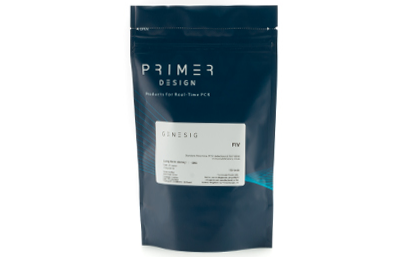
Primer and probe mix (150 reactions) Reverse Transcription, target specific primers (RNA genome viruses only) Copy number standard curve (sufficient for multiple standard curves) Internal extraction control – Read through VIC channel* Endogenous control (150 tests) RNAse/DNAse free water *alternative fluorophores available on request
Nucleic acid testing (NAT) is the method of choice for detection and quantification of a wide range of micro organisms. Primerdesign manufactures and supplies high quality quantitative real-time PCR kits for the detection and simultaneous quantification of numerous significant pathogens . A copy number standard curve is provided for quantification and an the internal extraction template (DNA or RNA), controls for the quality of the nucleic acid extraction and eliminates false negative results.
The kit is designed with the broadest possible detection profile to ensure that all clinically relevant strains and subtypes are detected. Target sequences are selected by working with data from key opinion leaders in the field. Multiple sequence alignments and unprecedented real-time PCR expertise in design and validation ensure the best possible kit. Details of the target and priming specificity are included in the individual handbooks above.
Packaged, optimised and ready to use. Expect Better Data.
Other Products
Next[PM1500] ExcelBand™ All Blue Regular Range Protein Marker (9-180 kDa), 250 μl x 2Next
Product Info
Document
Product Info
Description
The PM1500 ExcelBand™ All Blue Regular Range Protein Marker is a blue protein standard with 10 pre-stained proteins covering a wide range of molecular weights from 10 to 180 kDa in Tris-Glycine buffer (9 to 170 kDa in Bis-Tris (MOPS) buffer and Bis-Tris (MES) buffer). Proteins are covalently coupled with a blue chromophore, and two reference bands (at 25 kDa and 72 kDa, respectively) are enhanced in intensity when separated on SDS-PAGE (Tris-Glycine buffer).
The PM1500 ExcelBand™ All Blue Regular Range Protein Marker is designed for monitoring protein separation during SDS-polyacrylamide gel electrophoresis, verification of Western transfer efficiency on membranes (PVDF, nylon, or nitrocellulose) and for approximating the size of proteins.
Features
Ready-to-use — Premixed with a loading buffer for direct loading, no need to boil.
Two enhanced bands — 72 kDa and 25 kDa
Contents
Approximately 0.1~0.5 mg/ml of each protein in the buffer (20 mM Tris-phosphate (pH 7.5 at 25°C), 2% SDS, 0.2 mM DTT, 3.6 M urea, and 15% (v/v) glycerol).
Quality Control
Under suggested conditions, PM1500 ExcelBand™ All Blue Regular Range Protein Marker resolves 10 major bands in SDS-PAGE (Tris-Glycine buffer, MOPS, and MES buffer) and after Western blotting to nitrocellulose membrane.
Storage
4°C for 3 months -20°C for long term storage
Document
The PM1500 ExcelBand™ All Blue Regular Range Protein Marker is a blue protein standard with 10 pre-stained proteins covering a wide range of molecular weights from 10 to 180 kDa in Tris-Glycine buffer (9 to 170 kDa in Bis-Tris (MOPS) buffer and Bis-Tris (MES) buffer). Proteins are covalently coupled with a blue chromophore, and two reference bands (at 25 kDa and 72 kDa, respectively) are enhanced in intensity when separated on SDS-PAGE (Tris-Glycine buffer).
The PM1500 ExcelBand™ All Blue Regular Range Protein Marker is designed for monitoring protein separation during SDS-polyacrylamide gel electrophoresis, verification of Western transfer efficiency on membranes (PVDF, nylon, or nitrocellulose) and for approximating the size of proteins.
Goat Anti-Rabbit (GAR) Conjugated Colloidal Gold for Lateral Flow (1mL of 10OD)
Product image shows functional testing of Goat Anti Rabbit 40nm colloidal gold on a lateral flow test.
Our products are produced in a state-of-the-art manufacturing facility that enable rapid turnaround times while ensuring batch to batch consistency and reliability.
Document
Goat Anti-Rabbit (GAR) Conjugated Colloidal Gold for Lateral Flow (1mL of 10OD)
Product image shows functional testing of Goat Anti Rabbit 40nm colloidal gold on a lateral flow test.
Our products are produced in a state-of-the-art manufacturing facility that enable rapid turnaround times while ensuring batch to batch consistency and reliability.
The kit is developed for RNA quantification. The RNA Quantification HS kit includes HS Dye, HS Dilution Buffer, and two RNA Standards. Simply dilute the HS Dye with the HS Dilution Buffer, add RNA sample, then read the concentration using the Qubit Fluorometer. The assay is accurate for RNA concentrations from 250 pg/µL to 100 ng/µL (Figure 1). The RNA Quantification High Sensitivity Kit has several advantages over traditional RNA quantitation such as stability, sensitivity, and contaminant tolerance.
Features
Optimized condition for using with the Qubit Fluorometer
Uses the Qubit RNA High Sensitivity assay setting
Cuts costs by 60%
The performance of the BioDynami RNA Quantification HS kit is nearly identical to that of Thermo Fisher’s Qubit RNA HS kit (figure below).
Common contaminants such as detergents, solvents, salts, free nucleotides, or protein are well tolerated in the assay (Table 1).
Qubit is a registered trademark of Thermo Fisher Scientific.
Document
The kit is developed for RNA quantification. The RNA Quantification HS kit includes HS Dye, HS Dilution Buffer, and two RNA Standards. Simply dilute the HS Dye with the HS Dilution Buffer, add RNA sample, then read the concentration using the Qubit Fluorometer. The assay is accurate for RNA concentrations from 250 pg/µL to 100 ng/µL (Figure 1). The RNA Quantification High Sensitivity Kit has several advantages over traditional RNA quantitation such as stability, sensitivity, and contaminant tolerance.