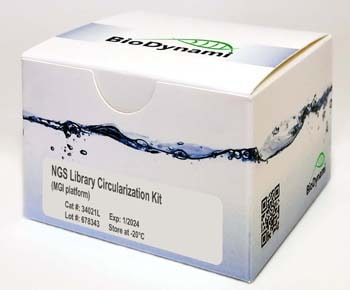
The NGS Library Circularization Kit (MGI Platform) was developed for preparation of single-stranded circular DNA libraries for next generation sequencing (MGI platform).
Detail
The NGS Library Circularization Kit (MGI Platform) was developed for preparation of single-stranded circular DNA libraries for next generation sequencing (MGI platform).
The kit uses linear dsDNA libraries (MGI platform) as input and enriches the circularized single-stranded DNA libraries. The circularization kit has a higher library circularization efficiency (25%) as compared to other vendors (7-15%).
NGS Library Circularization Kit workflow
Comparison of Library Circularization Efficiency
Kit features
Fast protocol
Total protocol time is around 1 hour
Hands-on time is only ~10 minutes
Guaranteed high library circularization efficiency as compared to other kits
Input DNA amount: 100-300 ng
Other Products
ProteoSpin™ Total Protein Concentration, Detergent Clean-Up and Endotoxin Removal Kits
Product Info
Document
Product Info
Overview
Columns bind proteins of interest while endotoxins flow through
Reduce endotoxin levels to less than 0.01 EU/µg of protein
Proteins are desalted
Greater than 95% protein recovery
Concentrate protein samples and remove detergents at the same time
Effectively remove a wide range of detergents including SDS, Triton® X-100, CHAPS, NP-40, and Tween 20
Purification is based on spin column chromatography that uses Norgen’s resin separation matrix
The ProteoSpin™ Total Protein Concentration, Detergent Clean-Up and Endotoxin Removal Kits are designed for the rapid removal of endotoxins from previously purified proteins or peptides, with protein recoveries of > 95% being achieved. Endotoxins, also known as lipopolysaccharides, are cell-membrane components of Gram-negative bacteria such as E. coli. Endotoxins liberated by Gram-negative bacteria are frequent contaminations of protein solutions derived from bioprocesses. Due to the high toxicity of endotoxins in vivo and in vitro, their removal from protein preparations is often necessary prior to the use of the protein in downstream applications. These kits efficiently reduce endotoxin levels to ≤ 0.01 EU/mg of protein, using spin column chromatography based on Norgen’s proprietary resin as the separation matrix. These kits are highly efficient in removing many different salts commonly used in the laboratory including, but not limited to, MgCl2, NaCl, KCl, CaCl2, LiCl and CsCl. The purified protein samples can be used in a number of downstream applications including sequencing, cloning, and in vitro and in vivo introduction into cells and organisms for various purposes. The simultaneous removal of salts while concentrating a dilute protein solution makes the kit a convenient method for preparing proteins before running many downstream applications such as SDS-PAGE, isoelectric focusing, X-ray crystallography, NMR spectroscopy, mass spectroscopy and other applications.
Mini Kit
The ProteoSpin™ Total Protein Concentration, Detergent Clean-Up and Endotoxin Removal Mini Kit is designed for the rapid removal of endotoxins from up to 200 μg of previously purified proteins or peptides, with protein recoveries of > 95% being achieved.
Maxi Kit
The ProteoSpin™ Total Protein Concentration, Detergent Clean-Up and Endotoxin Removal Maxi Kit is designed for the rapid removal of endotoxins from up to 4 mg of previously purified proteins or peptides, with protein recoveries of > 95% being achieved.
Including Triton® X-100, CHAPS, NP-40 and Tween 20
Elution Volume
2-4 mL
Time to Complete 10 Purifications
30-40 minutes
Storage Conditions All solutions should be kept tightly sealed and stored at room temperature. This kit is stable for 2 years after the date of shipment.
Component
Cat. 22800 (25 preps)
Cat. 22200 (4 preps)
Binding Buffer J
8 mL
8 mL
Binding Buffer N
4 mL
20 mL
Wash Solution M
50 mL
130 mL
Wash Solution CIP
20 mL
60 mL
Wash Solution N
30 mL
130 mL
Wash Solution NIP
20 mL
60 mL
Elution Buffer G
6 mL
20 mL
Endotoxin Removal Solution
1.5 mL
1.5 mL
Protein Neutralizer EF
2 mL
2 mL
Maxi Spin Columns (assembled with Collection Tubes)
–
4
Mini Spin Columns
25
–
Collection Tubes
25
–
Maxi Spin Columns (assembled with Collection Tubes)
An adapter for Cerillo’s Alto plate reader. This adapter allows the Alto plate reader to fit perfectly on the deck of the Opentrons Flex or OT-2 to allow for pipetting directly into the reader.
Document
An adapter for Cerillo’s Alto plate reader. This adapter allows the Alto plate reader to fit perfectly on the deck of the Opentrons Flex or OT-2 to allow for pipetting directly into the reader.
200 µL filtered pipette tips for the Opentrons Flex, provided sterile in racks or blister packs (refills). Tips are clear, non-conducting polypropylene tips, free of human DNA, PCR inhibitors, RNase/DNase, pyrogens, and endotoxins. Opentrons Flex Tips and Racks are autoclavable.
Document
200 µL filtered pipette tips for the Opentrons Flex, provided sterile in racks or blister packs (refills). Tips are clear, non-conducting polypropylene tips, free of human DNA, PCR inhibitors, RNase/DNase, pyrogens, and endotoxins. Opentrons Flex Tips and Racks are autoclavable.