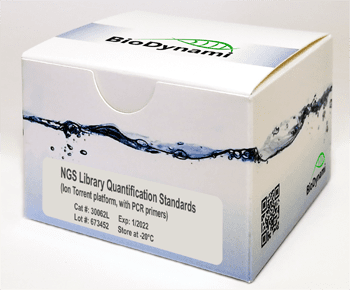
NGS Library Quantification Standards With PCR Primers (Ion Torrent Platform)
Facebook
X
Pinterest
Email
The NGS Library Quantification Standards with PCR Primers (for Ion Torrent platform) were developed for quantifying the library concentration for ion torrent sequencing platform. Quantification of the library of the fully ligated libraries is important for the quality of the sequencing outcome. Optimal library concentration can increase sequencing yield. Poor library concentration results in bad emPCR, which can lead to low sequencing capacity.
Detail
The NGS Library Quantification Standards with PCR Primers (for Ion Torrent platform) were developed for quantifying the library concentration for ion torrent sequencing platform. Quantification of the library of the fully ligated libraries is important for the quality of the sequencing outcome. Optimal library concentration can increase sequencing yield. Poor library concentration results in bad emPCR, which can lead to low sequencing capacity.
QPCR is the best method for library quantification. Our reagent only amplifies library molecules that will be used for subsequent emPCR, and is optimized for amplification of various samples. Our reagent is compatible with commercial SYBR Green based QPCR reagents. Quantification of library concentration is achieved by comparison with a standard curve generated from DNA Standards.
The kit comprises DNA Standards (six 10-fold dilutions) and a primer mix.
NGS Library Quantification Standards with PCR Primers (Ion Torrent platform): real time quantitative PCR curve of the standards.
Other Products
[PM2600] ExcelBand™ 3-color High Range Protein Marker (9-245 kDa), 250 μl x 2
Product Info
Document
Product Info
Description
The PM2600 ExcelBand™ 3-color High Range Protein Marker is a ready-to-use three-color protein standard with 12 pre-stained proteins covering a wide range of molecular weights from 10 to 245 kDa in Tris-Glycine Buffer (9 to 235 kDa in Bis-Tris (MOPS) buffer and 10 to 235 kDa in Bis-Tris (MES) buffer). Proteins are covalently coupled with a blue chromophore except for two reference bands (one green and one red band at 25 kDa and 75 kDa respectively) when separated on SDS-PAGE (Tris-Glycine buffer). The PM2600 3-color High Range Protein Marker is designed for monitoring protein separation during SDS-polyacrylamide gel electrophoresis, verification of Western transfer efficiency on membranes (PVDF, nylon, or nitrocellulose) and for approximating the size of proteins.
Features
Ready-to-use — Premixed with a loading buffer for direct loading, no need to boil.
Two reference bands — 75 kDa (red) and 25 kDa (green)
Contents
Approximately 0.1~0.4 mg/ml of each protein in the buffer (20 mM Tris-phosphate (pH 7.5 at 25°C), 2% SDS, 0.2 mM DTT, 3.6 M urea, and 15% (v/v) glycerol).
Quality Control
Under suggested conditions, PM2600 ExcelBand™ 3-color High Range Protein Marker resolves 12 major bands in 15% SDS-PAGE (Tris-Glycine buffer, MOPS, and MES buffer) and after Western blotting to nitrocellulose membrane.
Storage
4°C for 3 months -20°C for long term storage
Document
The PM2600 ExcelBand™ 3-color High Range Protein Marker is a ready-to-use three-color protein standard with 12 pre-stained proteins covering a wide range of molecular weights from 10 to 245 kDa in Tris-Glycine Buffer (9 to 235 kDa in Bis-Tris (MOPS) buffer and 10 to 235 kDa in Bis-Tris (MES) buffer). Proteins are covalently coupled with a blue chromophore except for two reference bands (one green and one red band at 25 kDa and 75 kDa respectively) when separated on SDS-PAGE (Tris-Glycine buffer). The PM2600 3-color High Range Protein Marker is designed for monitoring protein separation during SDS-polyacrylamide gel electrophoresis, verification of Western transfer efficiency on membranes (PVDF, nylon, or nitrocellulose) and for approximating the size of proteins.
Neisseria gonorrhoeae is a Gram-negative coccus of the Neisseria genus. N. gonorrhoeae is usually seen in pairs infecting human cells. It has a circular DNA genome of approximately 1Mbp encoding over 2000 genes. N. gonorrhoeae is transmitted by sexual contact and usually causes infection in cells of the mucous membrane of the male urethra or the endocervix and urethra in females. During infection, polysaccharides are released from the bacteria that stimulate host cell production of tumour necrosis factors that cause an inflammatory response.
There is no vaccine against N. gonorrhoeae infection and antibiotic resistance is beginning to increase, therefore treatment includes a course of antibiotics that will be effective against resistant strains. Complications in males caused by the infection can result in prostatitis or orchitis if the bacteria spread. In females, invasion of the fallopian tubes or ovaries can result in salpingitis or ovaritis respectively, with any of these infections possibly resulting in sterility.
Storage Conditions and Product Stability All kit components can be stored for 2 years after the date of production without showing any reduction in performance.
All kit components should be stored at -20°C upon arrival. Repeated thawing and freezing (> 2 x) of the Master Mix and Positive Control should be avoided, as this may affect the performance of the assay. If the reagents are to be used only intermittently, they should be frozen in aliquots.
Rapid spin column purification of genomic DNA from viable yeast cells, fungal spores or mycelium, and bacteria including Gram-positive
Bead tubes (provided) allow for effective mechanical homogenization
Purified DNA is of high quality and integrity and compatible with any sensitive downstream applications such as PCR, qPCR, RFLP and more
These kits provide fast and reliable procedures for the purification of genomic DNA from viable yeast cells, fungal spores or mycelium, and bacteria including Gram-positive. Genomic DNA is efficiently extracted from the cells by a combination of heat treatment, detergents and Bead Tubes (provided). An optional lyticase treatment allows for improved DNA yields with certain fungal and yeast species. Recovered genomic DNA is of excellent yield and purity for any downstream application including PCR, qPCR, Restriction Fragment Length Polymorphism (RFLP), Amplified Fragment Length Polymorphism (AFLP), sequencing, SNP analysis and more.
Fungi/Yeast Genomic DNA Isolation Kit (Spin Column)
This kit provides rapid spin column purification of genomic DNA from viable yeast cells, fungal spores or mycelium, and bacteria including Gram-positive. Preparation time for a single sample is less then 30 minutes, and each kit contains sufficient materials for 50 preparations.
Fungi/Yeast Genomic DNA Isolation 96-Well Kit (HT)
Norgen’s Fungi/Yeast Genomic DNA Isolation 96-Well Kit provides a fast, reliable and simple procedure for high throughput isolation of DNA from viable yeast cells, fungal spores or mycelium and Gram-positive bacteria. The purification could be performed on either a vacuum manifold or using centrifugation. Complete 96 purifications in 40 minutes.
Maximum Amount of Starting Material: Fungi (Wet weight) Yeast or Gram-positive bacterial culture
50 mg 0.5 mL – 1 mL
Time to Complete 96 Purifications
40 minutes
Storage Conditions and Product Stability All solutions should be kept tightly sealed and stored at room temperature. These reagents should remain stable for at least 2 years in their unopened containers.