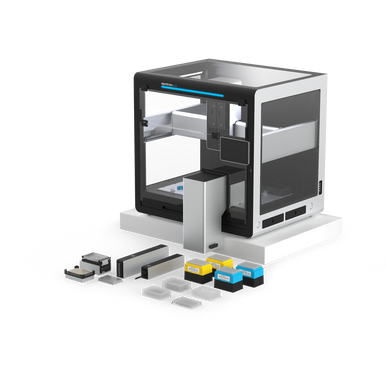
Opentrons Flex Magnetic Bead Protein Purification Workstation
Facebook
X
Pinterest
Email
For scaling up and fully automating magnetic bead-based protein purification workflows.
With the Flex Protein Purification Workstation, you can automate your small-scale protein purification and proteomics sample processing at the scale you need to increase efficiency, reduce errors, and save hands-on time. This Opentrons Protein Purification Workstation uses magnetic beads for purification of proteins.
Optional add-ons can be purchased at a 10% discount when ordered with the Flex Magnetic Bead Protein Purification Workstation*
Detail
For scaling up and fully automating magnetic bead-based protein purification workflows.
With the Flex Protein Purification Workstation, you can automate your small-scale protein purification and proteomics sample processing at the scale you need to increase efficiency, reduce errors, and save hands-on time. This Opentrons Protein Purification Workstation uses magnetic beads for purification of proteins.
Optional add-ons can be purchased at a 10% discount when ordered with the Flex Magnetic Bead Protein Purification Workstation*
Nucleic acid testing (NAT) is the method of choice for detection and quantification of a wide range of micro organisms. Primerdesign manufactures and supplies high quality quantitative real-time PCR kits for the detection and simultaneous quantification of numerous significant pathogens . A copy number standard curve is provided for quantification and an the internal extraction template (DNA or RNA), controls for the quality of the nucleic acid extraction and eliminates false negative results.
The kit is designed with the broadest possible detection profile to ensure that all clinically relevant strains and subtypes are detected. Target sequences are selected by working with data from key opinion leaders in the field. Multiple sequence alignments and unprecedented real-time PCR expertise in design and validation ensure the best possible kit. Details of the target and priming specificity are included in the individual handbooks above.
Packaged, optimised and ready to use. Expect Better Data.
Document
Primer and probe mix (150 reactions) Reverse Transcription, target specific primers (RNA genome viruses only) Copy number standard curve (sufficient for multiple standard curves) Internal extraction control – Read through VIC channel* Endogenous control (150 tests) RNAse/DNAse free water *alternative fluorophores available on request
Plasmid DNA is ready for various downstream applications including restriction digestion, bacterial transformation, sequencing and more
Available in 4 formats: MiniPrep, MiniPrep (Magnetic Bead System), 96-Well MiniPrep (Magnetic Bead System), and MaxiPrep
These kits are designed for the rapid preparation of plasmid DNA from Escherichia coli.
Plasmid MiniPrep Kit
This kit is designed for the rapid preparation of plasmid DNA from small cultures of Escherichia coli using convenient spin columns. The plasmid DNA is preferentially purified from other cellular components such as genomic DNA and RNA. This kit is able to purify plasmids up to 13,000 bp in size, and the typical purification yield is up to 20 μg from 1.5 mL of bacterial culture. Purified DNA is of excellent quality for transformation, restriction enzyme digestion, sequencing and more. Also available in a 96-well format.
Plasmid MiniPrep Kit (Magnetic Bead System and High Throughput Magnetic Bead System)
Norgen’s Plasmid MiniPrep Kit (Magnetic Bead System) is designed for the rapid preparation of plasmid DNA from small batch cultures of Escherichia coli. Norgen’s magnetic beads bind DNA under optimized salt concentrations and release the bound DNA under low salt and slightly alkali conditions. The plasmid DNA is preferentially purified from other cellular components such as genomic DNA and RNA. The purified plasmids are fully digestible with all restriction enzymes tested, and are completely compatible with real-time PCR and NGS.
Norgen’s Plasmid MiniPrep Kit (Magnetic Bead System) is also available in a 96-well (HT) format for high throughput applications. Purification with the 96-well plates can be integrated with a robotic automation system.
Plasmid MaxiPrep Kit
This kit is designed for the rapid spin column preparation of plasmid DNA from up to 100 mL of Escherichia coli cultures. The kit allows for the isolation of plasmid DNA with final endotoxin levels of 0.1 EU/µg of DNA or less. The kit is able to purify plasmids up to 13,000 bp in size, and typical yields from a 100 mL culture for a high copy number plasmid are between 0.4 and 1.0 mg. The purified DNA is fully digestible with all restriction enzymes tested, and is completely compatible with manual or automated sequencing to achieve 95-100% accuracy.
All solutions should be kept tightly sealed and stored at room temperature. This kit is stable for 1 year after the of shipment. The RNase should be stored at -20°C upon arrival. The Resuspension Solution AZ should be stored at 4°C upon addition of RNase enzyme.
Component
Cat. 13300 (50 preps)
Cat. 46400 (250 preps)
Cat. 46500 (4 preps)
Cat. 46600 (20 preps)
Cat. 60300 (50 preps)
Cat. 63000 (192 preps)
Resuspension Solution AZ
12 mL
60 mL
20 mL
100 mL
12 mL
2 x 20 mL
Lysis Buffer N
40 mL
80 mL
40 mL
2 x 80 mL
40 mL
2 x 40 mL
Buffer TN
20 mL
130 mL
55 mL
2 x 130 mL
20 mL
1 x 55 mL 1 x 20 mL
Wash Solution E
12 mL
2 x 18 mL
–
–
–
–
Elution Buffer K
8 mL
30 mL
–
–
8 mL
2 x 8 mL
Wash Solution J
–
–
25 mL
3 x 25 mL
–
–
Elution Buffer J
–
–
24 mL
120 mL
–
–
RNase A
1 vial
1 vial
1 vial
1 vial
1 vial
1 vial
Magnetic Bead Suspension
–
–
–
–
1 x 1.1 mL
4 x 1.1 mL
Spin Columns
50
250
–
–
–
–
Collection Tubes
50
250
–
–
–
–
DNA Maxi Spin Columns with Collection Tubes (Clear ring in column)
–
–
4
20
–
–
Maxi Spin Filter Columns with Collection Tubes (Grey ring in column)
Brucella abortus is an intracellular, blood-borne parasite. It is a Gram-negative coccobacillus that causes an infectious and contagious disease called Brucellosis. The disease primarily affects cattle but it can also be transmitted to humans from infected animals and consuming their products. The disease can lead to great economic loss especially in the dairy and agricultural industry. The Brucella abortus genome contains two DNA chromosomes in a circular confirmation; the first chromosome is approximately 2.1 Mb and the second chromosome is approximately 1.2Mb. Unusually it does not contain any plasmids or genomic islands that relate to pathogenicity and lacks many other genes that code for common virulence factors including capsules, fimbriae, exotoxins, cytolysins, resistance forms, or antigenic variation. The most common mode of transmission to humans is through the ingestion of unpasteurized milk and cheese products as the bacteria are present in the milk glands of infected female cows. In cattle transmission can also be through ingestion but in addition, the bacteria can persist in the reproductive tracts of males, namely seminal vesicles, ampullae, testicles, and epididymides, allowing sexual transmission. In humans the bacteria enter macrophages by phagocytosis and then live in compartments of vacuolar space along the endoplasmic reticulum. They persist by inhibiting host apoptosis and go onto form chronic disease causing lesions in the liver, spleen, bone marrow and kidneys. In cattle the bacteria additionally infect the trophoblast epithelial cells, which provide nutrition to the embryo. The trophoblast cells eventually lyse, releasing further bacteria into the blood stream of the embryo. The B. abortus cells in the blood stream go on to colonize the placenta and fetus in pregnant female cows, resulting in abortion of the fetus. Abortion can also result from insufficient anti-Brucella activity in the amniotic fluid. In humans, the disease can be either acute or chronic and some of the symptoms include fluctuating fever, chills, sweating, headache, muscle pain and weight loss. Once a person becomes infected they are prescribed a combination of tetracycline and streptomycin for 3-6 weeks. In cattle, additional symptoms include arthritic joints and retained after-birth.
Document
Exceptional value for money Rapid detection of all clinically relevant subtypes Positive copy number standard curve for quantification Highly specific detection profile High priming efficiency Broad dynamic detection range (>6 logs) Sensitive to < 100 copies of target
Accurate controls to confirm findings