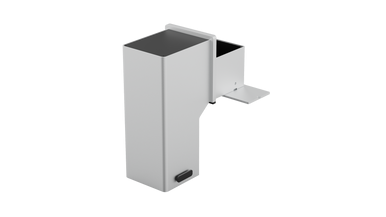
The Opentrons Flex Waste Chute GEN1 occupies position D3 and is used to accept waste such as tips, tip racks, and plates in high volumes. The gripper will pick up the consumable and dispose it into the chute based on your workflow needs. The waste chute is neccesary for all high-throughput workflows and can be paired with the Opentrons Flex Deck Expansion Set to maximize the throughput capabilities of the Opentrons Flex. The following consumables can disposed of into the waste chute:
– NEST 2 mL Deep Well Plate, V Bottom
– Opentrons Tough 0.2 mL 96-Well PCR Plate, Full Skirt
– NEST 96 well Plate Flat
– All Opentrons Flex tip racks
Detail
The Opentrons Flex Waste Chute GEN1 occupies position D3 and is used to accept waste such as tips, tip racks, and plates in high volumes. The gripper will pick up the consumable and dispose it into the chute based on your workflow needs. The waste chute is neccesary for all high-throughput workflows and can be paired with the Opentrons Flex Deck Expansion Set to maximize the throughput capabilities of the Opentrons Flex. The following consumables can disposed of into the waste chute:
– NEST 2 mL Deep Well Plate, V Bottom
– Opentrons Tough 0.2 mL 96-Well PCR Plate, Full Skirt
– NEST 96 well Plate Flat
– All Opentrons Flex tip racks
Other Products
D5001 MagPure Gel Pure DNA Kit
Product Info
Document
Product Info
Introduction
A highly efficient, easily automated agarose gel or PCR purification system that delivers superior quality DNA with no salt carryover. Requiring no centrifugation or filtration. The Kit can be easily used in manual and automated 96 or 384-well formats.
Details
Specifications
Features
Specifications
Main Functions
Recover DNA fragments >100bp from agarose gel(<0.3g), purification of DNA from PCR, enzymatic reaction solution or crude gDNA
The Kit method contains magnetic particles in an optimized binding buffer to selectively bind DNA fragments (>100bp) and larger to paramagnetic beads. Excess primers, nucleotides, salts, and enzymes can be removed using a simple washing procedure.
Advantages
High recovery efficiency – up to 80% DNA recovery
General – recover DNA from gel or enzyme-driven reaction solutions such as PCR
Kit Contents
Contents
D500101
D500102
D500103
Purification Times
50 Preps
500 Preps
5000 Preps
Buffer GDP
30 ml
250 ml
3 x 900 ml
MagPure Particles
1.6 ml
15 ml
3 x 50 ml
Buffer DW1
20 ml
180 ml
2 x 800 ml
Elution Buffer(10mmTris, pH8.5)
10 ml
60 ml
500 ml
Storage and Stability
MagPure Particles should be stored at 2-8°C upon arrival. However, short-term storage (up to 24 weeks) at room temperature (15-25°C) does not affect their performance. The remaining kit components can be stored at room temperature (15-25°C) and are stable for at least 18 months under these conditions.
Experiment Data
Document
A highly efficient, easily automated agarose gel or PCR purification system that delivers superior quality DNA with no salt carryover. Requiring no centrifugation or filtration. The Kit can be easily used in manual and automated 96 or 384-well formats.
NGS Low Input DNA Library Prep Kit (illumina and MGI Platforms)
Product Info
Document
Product Info
The NGS Low Input DNA Library Prep Kit (illumina and MGI Platforms) was developed for construction of high quality NGS libraries with low input DNA amount from 1 ng to 400 ng. The kit allows scientist to study samples with limited DNA such as tumor samples, patient samples, and other specially collected samples (FACS sorting etc.). The kit has high library conversion efficiency with as little as 1 ng DNA input. The fast and simple 1.5-hour protocol makes libraries with even coverage and low GC-bias based our unique chemistry for DNA end-polishing and ligation.
The kit needs double strand DNA fragments (blunt and/or sticky) as input DNA for NGS library preparation, and is compatible with DNA fragments generated from both enzymatic approach (for example, BioDynami DNA fragmentation enzymes, Cat.# 40061 and Cat.# 40062) and mechanical approaches such as sonication and nebulization etc.
NGS Low Input DNA Library Prep Kit Workflow
Three index types are available for the NGS Low Input DNA Library Prep Kit of illumina platform:
Non-index (Cat.# 30022): Libraries do not have index.
Index (Cat.# 30024): Each of our index primers contains a unique barcode sequence with 6 bases that can be used to identify the low input DNA libraries. Library multiplexing up to 48 samples is possible. Index information can be downloaded here.
Unique dual index (Cat.# 30025): Library multiplexing up to 96 low input DNA libraries is possible with unique dual indexes with our Four-Base Difference Index System. The system allows us to make indexes for the libraries that have at least 4 bases different from each other in the 8-base barcode length. Our unique dual index primers can reduce sequencing errors such as de-multiplexing errors, amplification errors, mis-assignment of reads, index cross-contamination, and also index hopping. The kit includes 96 pre-mixed unique pairs of index primers. Index information can be downloaded here.
Indexes are available for the MGI platform kits (Cat.# 34024).
Kit advantages:
Fast protocol
The hands-on time is only 10 minutes
The total protocol time is around 1.5 hours
Simple procedure
Ready-to-use master mix makes it simple for reaction setup
Less reaction components
Less magnetic beads required for cleanup steps: Save the cost more than 50%
Low input DNA amount: Starts from 1 ng of DNA
Comparison of library conversion efficiency under the same NGS library preparation condition. Input DNA amounts are 1 ng and 10 ng, respectively. DNA was mechanical sheared with Covaris before library prep. BioDynami kit: NGS Low Input DNA Library Prep Kit (Cat. #30022).
Comparison of library yield under the same NGS library prep condition. Input DNA amounts are 1 ng, 10 ng, and 100 ng. DNA was mechanical sheared with Covaris before library prep. BioDynami kit (Cat. #30022). PCR cycle numbers were indicated.
Document
The NGS Low Input DNA Library Prep Kit (illumina and MGI Platforms) was developed for construction of high quality NGS libraries with low input DNA amount from 1 ng to 400 ng. The kit allows scientist to study samples with limited DNA such as tumor samples, patient samples, and other specially collected samples (FACS sorting etc.). The kit has high library conversion efficiency with as little as 1 ng DNA input. The fast and simple 1.5-hour protocol makes libraries with even coverage and low GC-bias based our unique chemistry for DNA end-polishing and ligation.