
This H14 filter is a replacement for use with the OT-2 HEPA Module GEN1. The HEPA Module enables you to run sensitive contamination-prone applications on the OT-2.

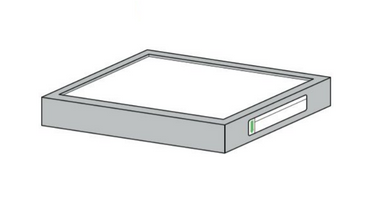
This H14 filter is a replacement for use with the OT-2 HEPA Module GEN1. The HEPA Module enables you to run sensitive contamination-prone applications on the OT-2.

Norgen’s Urine Total RNA Purification Maxi Kit Dx (Slurry Format) provides a fast, reliable and simple procedure for isolating total RNA from urine for subsequent in vitro diagnostic use. Purification is based on the use of Norgen’s proprietary resin as the separation matrix, and the kit purifies all sizes of RNA, from large mRNA and ribosomal RNA down to small RNAs.
This kit is designed to be used with any downstream application employing enzymatic amplification or other enzymatic modifications of RNA followed by signal detection or amplification. Any diagnostic results generated using the RNA isolated with Urine Total RNA Purification Maxi Kit Dx (Slurry Format) in conjunction with an in vitro diagnostic assay should be interpreted with regard to other clinical or laboratory findings.
To minimize irregularities in diagnostic results, suitable controls for downstream applications should be used.
Norgen’s Urine Total RNA Purification Maxi Kit Dx (Slurry Format) is intended for use by professional users such as technicians, physicians and biologists experienced and trained in molecular biological techniques including RNA isolation.
Norgen’s Urine Total RNA Purification Maxi Kit Dx (Slurry Format) does not provide a diagnostic result. It is the sole responsibility of the user to use and validate the kit in conjunction with a downstream in vitro diagnostic assay.
Figure 1 / 1

Click for expanded view
| Kit Specifications | |
| Volume of Urine Processed | 5 – 10 mL |
| Size of RNA Purified | All sizes, including < 200 nt |
| Time to Complete 10 Purifications | < 30 minutes |
| Average Yield | Variable depending on specimen |
Storage Conditions and Product Stability
All solutions should be kept tightly sealed and stored at room temperature. This kit is stable until the expiration date specified on the label.
| Component | Cat. Dx29600 (50 preps) |
|---|---|
| RNA Lysis Solution | 3 x 90 mL |
| RNA Wash Solution | 24 mL |
| RNA Elution Solution | 6 mL |
| Mini Filter Spin Columns | 50 |
| Collection Tubes | 50 |
| Elution Tubes (1.7 mL) | 50 |
| Product Insert | 1 |
Everything you need to run a trial PACE® allele-specific PCR Genotyping Reaction on your existing lab equipment. Each PACE Trial Kit includes Test DNA samples, PACE Genotyping Assays, PACE Master Mix and a comprehensive PACE Genotyping Trial Kit Manual.
Anyone who wants to try PACE genotyping reagents in their lab for the first time with a set of validated DNA samples, SNP assays and PACE Master Mix.
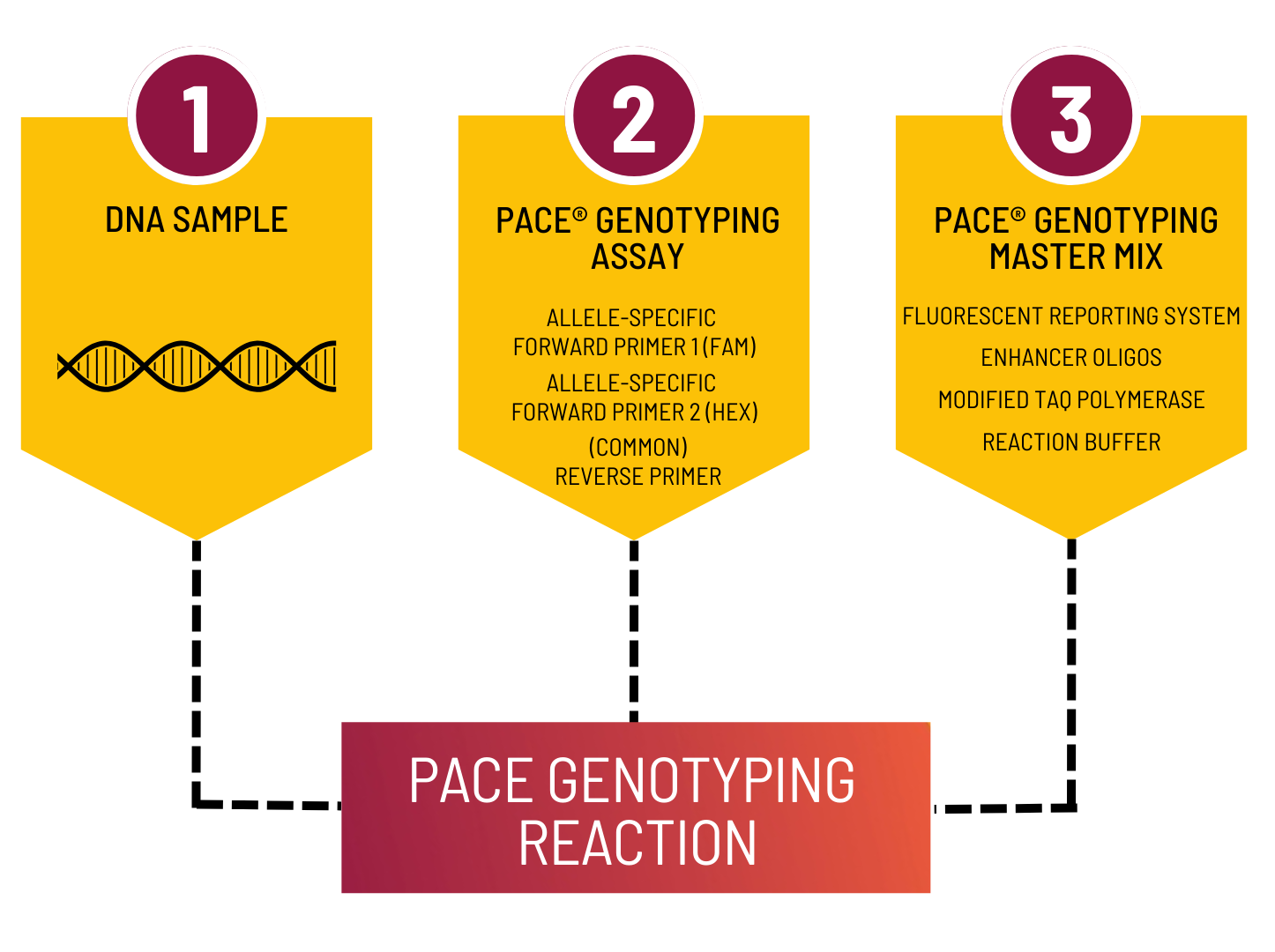
Step 1. Dispense each of the three trial DNA samples (DNA 1, 2 and 3) plus water (No Template Control) in triplicate onto a PCR plate using the suggested volumes.
Step 2. Combine appropriate volumes of PACE Genotyping Master Mix with PACE Genotyping Assay in a tube, as directed, then mix.
Step 3. Dispense the combined mixtures into each of the wells containing DNA using volumes indicated. Each test now contains a complete PACE Genotyping Reaction.
Step 4. Seal your PCR plate with an optically clear seal and centrifuge to ensure all components are at the bottom of the wells.
Step 5.Thermally cycle the reaction plate using the thermal cycling conditions provided.
Step 6. Read the plate and compare data produced with the expected results provided in the manual. Simple!
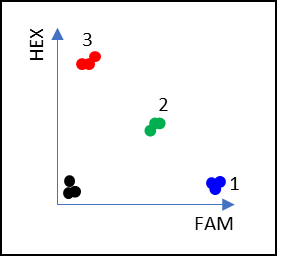
More information on the PACE genotyping chemistry and how it works can be found here: www.3crbio.com/#pace. PACE allele-specific PCR is used for the detection of SNPs, Indels and other sequence variants.

These kits are able to isolate all sizes of circulating and exosomal RNA, including microRNA, without the use of phenol or chloroform. The slurry format provides an advantage over other available kits in that it does not require extension tubes for the purification of free-circulating and exosomal RNA from large sample volumes. RNA can be isolated from either fresh or frozen samples using this kit. This kit is suitable for the isolation of RNA from serum or plasma prepared from blood collected only on either EDTA or citrate. Plasma samples prepared from blood collected on heparin should not be used as heparin can significantly interfere with many downstream applications including RT-PCR. The purified plasma/serum free-circulating and exosomal RNA is eluted in an elution solution that is compatible with PCR, qPCR, methylation-sensitive reverse transcription qPCR, reverse transcription PCR, Northern blotting, RNase protection and primer extension, expression array assays, and NGS.
Free-circulating plasma and serum RNA can serve as both tumor- and fetal-specific markers for cancer detection and prenatal diagnosis. As well, free-circulating RNAs have the potential to provide biomarkers for other disease states. Free-circulating RNA in plasma or serum are usually present as short fragments of less than 1000nt, and free-circulating miRNA (21nt) can also be found in plasma and serum.
Plasma/Serum Circulating and Exosomal RNA Purification Kit (Slurry)
Norgen’s Plasma/Serum Circulating and Exosomal RNA Purification Kit (Slurry Format) provides a fast, reliable and simple procedure for isolating circulating RNA and exosomal RNA from plasma and serum samples ranging from 0.25 mL to 5 mL.
Plasma/Serum Circulating and Exosomal RNA Purification Mini Kit (Mini Slurry)
Norgen’s Plasma/Serum Circulating and Exosomal RNA Purification Mini Kit (Slurry Format) provides a fast, reliable and simple procedure for isolating circulating and exosomal RNA from plasma and serum samples ranging from 0.25 mL to 2 mL.
Plasma/Serum Circulating and Exosomal RNA Purification 96-Well Kit (High Throughput Slurry)
Norgen’s Plasma/Serum Circulating and Exosomal RNA Purification 96-Well Kit (Slurry Format) provides a high throughput method for isolating circulating and exosomal RNA from plasma and serum samples using either a vacuum manifold or centrifugation.
Plasma/Serum Circulating and Exosomal RNA Purification Maxi Kit (Maxi Slurry)
Norgen’s Plasma/Serum Circulating and Exosomal RNA Purification Maxi Kit (Slurry Format) provides a fast, reliable and simple procedure for isolating circulating RNA and exosomal RNA from various amounts of plasma/serum ranging from 2 mL to 5 mL.
Figure 1 / 5
Click for expanded view
| Kit Specifications – 96-well | |
| Minimum Plasma/Serum Input | 0.25 mL |
| Maximum Plasma/Serum Input | 2 mL |
| Size of RNA Purified | All sizes, including microRNA |
| Time to Complete Purification | < 1 hour |
Cat.29500 Storage Conditions and Product Stability
All solutions should be kept tightly sealed and stored at room temperature. This kit is stable for 2 years after the date of shipment.
| Component | Cat. 51000 (50 preps) | Cat. 29500 (96 preps) | Cat. 42800 (50 preps) | Cat. 50900 (25 preps) |
|---|---|---|---|---|
| Slurry C1 | – | – | – | 6 mL |
| Slurry C2 | 12 mL | – | 12 mL | – |
| Slurry C3 | – | 20 mL | – | – |
| Lysis Buffer A | 2 x 130 mL | 4 x 100 mL | 2 x 130 mL | 2 x 130 mL |
| Wash Solution A | 38 mL | 2 x 38 mL | 38 mL | 18 mL |
| Elution Solution A | 6 mL | 20 mL | 6 mL | 6 mL |
| Mini Filter Spin Columns | 50 | – | 50 | 25 |
| 96-Well Filter Plate | – | 1 | – | – |
| Adhesive Tape | – | 1 | – | – |
| Collection Tubes | 50 | – | 50 | 25 |
| 96-Well Collection Plate | – | 1 | – | – |
| Elution Tubes (1.7 mL) | 50 | – | 50 | 25 |
| 96-Well Elution Plate | – | 1 | – | – |
| Product Insert | 1 | 1 | 1 | 1 |