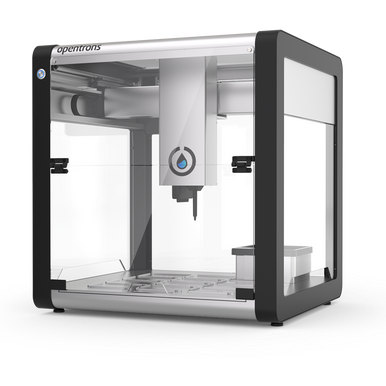
The Opentrons® OT-2 is a high-precision, open-source liquid handler designed to be easy for scientists to use and flexible enough to automate many application workflows. This robot and its accompanying automation platform are used to automate hundreds of protocols and workflows in genomics, proteomics, cell-based assays, and drug discovery.
The OT-2 has a user-friendly, plug and play graphical interface to design protocols compatible with any ANSI/SBS compliant or automation friendly labware. The base model includes an Opentrons GEN2 Single-Channel Pipette; you can also use up to two pipettes at the same time. Additional pipettes can be purchased separately and are easily interchangeable by the user. Consumables and other labware are sold separately.
Detail
The Opentrons® OT-2 is a high-precision, open-source liquid handler designed to be easy for scientists to use and flexible enough to automate many application workflows. This robot and its accompanying automation platform are used to automate hundreds of protocols and workflows in genomics, proteomics, cell-based assays, and drug discovery.
The OT-2 has a user-friendly, plug and play graphical interface to design protocols compatible with any ANSI/SBS compliant or automation friendly labware. The base model includes an Opentrons GEN2 Single-Channel Pipette; you can also use up to two pipettes at the same time. Additional pipettes can be purchased separately and are easily interchangeable by the user. Consumables and other labware are sold separately.
Other Products
81 Tube Lab Freezer Box with attached Lid (pack of 10)
【Material】The vial storage box is made of durable cardboard with waterproof coating and cardboard dividers;chemically resistant to alcohols and mild organic
【Temperature Range】These freezer boxes are stable from -196°C to 121°C
【Applications】The freezer box is suitable for iquid nitrogen freezing (vapor phase)
【Capacity】Size: Height of 2 inch, Holds 0.5ml, 1.5ml, 2.0ml tubes
【Excellent Cusomer Service】We are dedicated in providing the best products and services to customers. If you have any problem, please feel free to contact us. We will help you solve the problem as soon as possible.
Document
【Material】The vial storage box is made of durable cardboard with waterproof coating and cardboard dividers;chemically resistant to alcohols and mild organic 【Temperature Range】These freezer boxes are stable from -196°C to 121°C 【Applications】The freezer box is suitable for iquid nitrogen freezing (vapor phase) 【Capacity】Size: Height of 2 inch, Holds 0.5ml, 1.5ml, 2.0ml tubes 【Excellent Cusomer Service】We are dedicated in providing the best products and services to customers. If you have any problem, please feel free to contact us. We will help you solve the problem as soon as possible.
HiPure Gel Pure DNA Kit uses proprietary chemistry and HiPure technology to recover DNA fragments between 60bp-10kbp with yields exceeding 80%. DNA is suitable for ligations, PCR, sequencing, restriction digestion, or various labeling reactions. In addition, this kit can be also used to recover DNA directly from enzymatic reactions such as PCR and enzyme digestion reactions.
Details
Specifications
Features
Specifications
Main Functions
Recover DNA fragments >100bp from agarose gel(<0.5g), purification of DNA from PCR, enzymatic reaction solution or crude gDNA
Applications
PCR, NGS, labeling, ligation and enzyme digestion, etc.
Purification method
Mini spin column
Purification technology
Silica technology
Process method
Manual (centrifugation or vacuum)
Sample type
Agarose gel, PCR products, enzyme products
Sample amount
Agarose gel: ≤500mg
Recovery
≥80%
Elution volume
≥15μl
Time per run
≤20 minutes(1-24 samples)
Liquid carrying volume per column
800µl
Binding yield of column
35µg
Principle
The HiPure system uses a simple bind-wash-elute procedure. Gel slices are dissolved in a buffer containing a pH indicator, allowing easy determination of the optimal pH for DNA binding, and the mixture is applied to the column. Nucleic acids adsorb to the silica-gel membrane in the high-salt conditions provided by the buffer. Impurities are washed away and pure DNA is eluted with a small volume of low-salt buffer provided or water, ready to use in subsequent applications.
Advantages
High recovery efficiency – ≥80% DNA recovery
General – recover DNA from gel or enzyme-driven reaction solutions such as PCR
Fast – isolation can be completed in 10-15 minutes by column gel method
Great cost-effectiveness performance
Kit Contents
Contents
D211102
D211103
Purification Times
100 Preps
250 Preps
Buffer GDP
120 ml
250 ml
Buffer DW2
50 ml
2 x 50 ml
Elution Buffer
20 ml
30 ml
HiPure DNA Mini Columns II
100
250
2 ml Collection Tubes
100
250
Storage and Stability
The Kit should be stored dry at room temperature (15-25°C) and are stable for at least 18 months under these conditions. If any precipitates form in the buffers, warm at 37℃ to dissolve.
Experiment Data
Document
HiPure Gel Pure DNA Kit uses proprietary chemistry and HiPure technology to recover DNA fragments between 60bp-10kbp with yields exceeding 80%. DNA is suitable for ligations, PCR, sequencing, restriction digestion, or various labeling reactions. In addition, this kit can be also used to recover DNA directly from enzymatic reactions such as PCR and enzyme digestion reactions.
Propargyl-PEG4-alcohol is a Click Chemistry reagent that can react with azide-bearing compounds or biomolecules; copper is needed as a catalyst. The PEG units help increase the solubility of the molecule in aqueous media. Reagent grade, for research purpose. Please contact us for GMP-grade inquiries.
Document
Propargyl-PEG4-alcohol is a Click Chemistry reagent that can react with azide-bearing compounds or biomolecules; copper is needed as a catalyst. The PEG units help increase the solubility of the molecule in aqueous media. Reagent grade, for research purpose. Please contact us for GMP-grade inquiries.