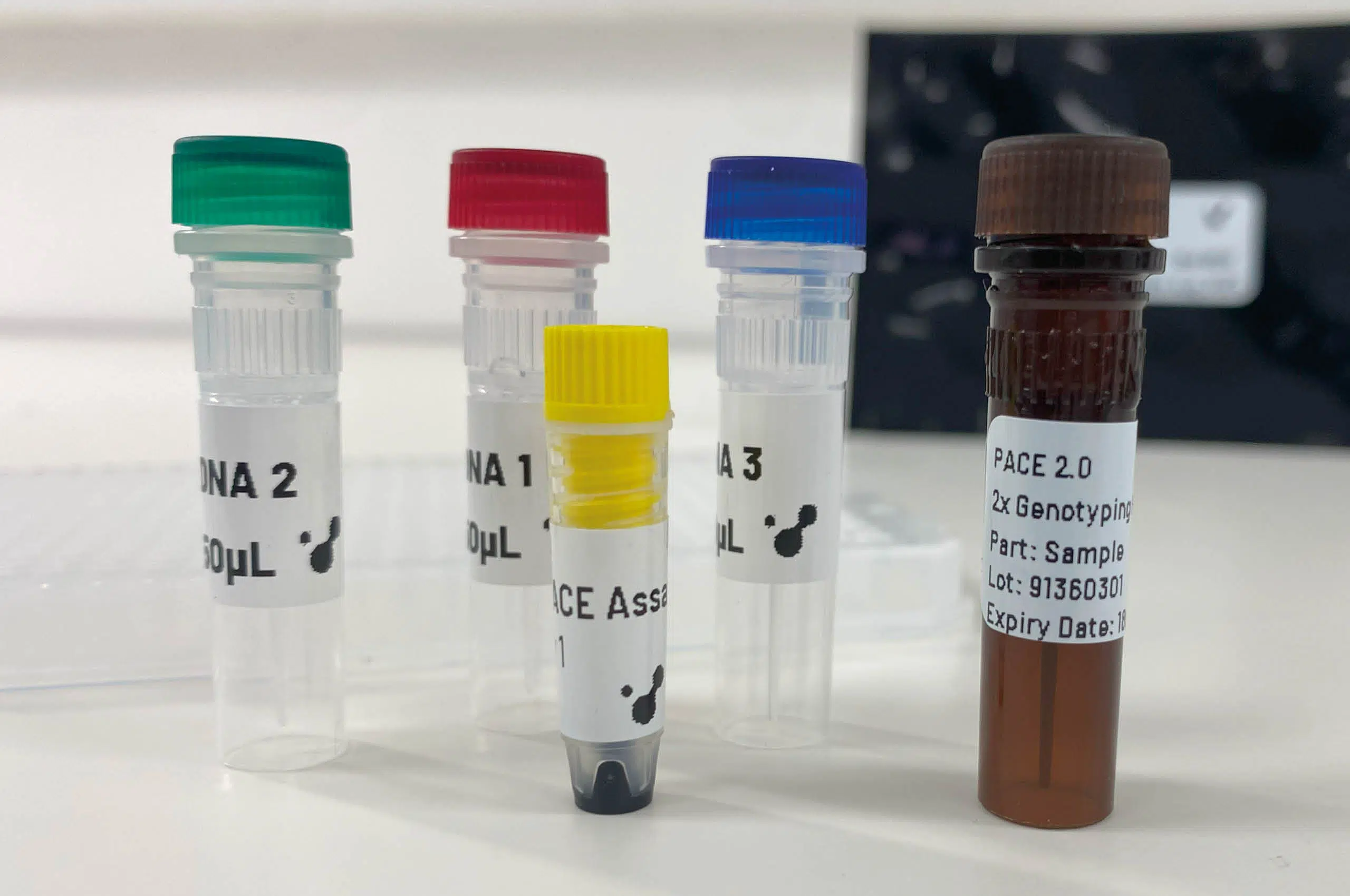
PACE Multiplex Master Mix is an advanced and versatile extension of our PACE 2.0 Genotyping Master Mix, formulated for the simultaneous detection of up to four targets in one reaction well. For example, two bi-allelic SNPs, or one reference gene and a further three genes of interest.
PACE Multiplex genotyping assay designs are available from 3CR Bioscience through our free PACE assay design service; once designed, users can purchase assay primers independently or through 3CR Bioscience using our partial or full-assay validation service.
Users will require a plate reader capable of reading FAM, HEX, ATTO 590, ATTO 647N and reference dye ATTO 680 (wavelengths in the PACE Multiplex Master Mix User Guide). PACE Multiplex Master Mix is supplied at 2x concentration for convenience and with or without ATTO 680 reference dye at a range of levels to ensure compatibility with your qPCR machine or reader.
Other Products
t-Boc-N-Amido-PEG3-propargyl
Product Info
Document
Product Info
t-Boc-N-Amido-PEG3-propargyl enables formation of triazole linkage with azide-bearing compound via copper catalyzed Click Chemistry. Under mild acidic conditions, t-Boc group can be removed to yield the free amine. Reagent grade, for research purpose. Please contact us for GMP-grade inquiries.
Document
t-Boc-N-Amido-PEG3-propargyl enables formation of triazole linkage with azide-bearing compound via copper catalyzed Click Chemistry. Under mild acidic conditions, t-Boc group can be removed to yield the free amine. Reagent grade, for research purpose. Please contact us for GMP-grade inquiries.
Gel images of different ranges of library size selection. Sheared human genomic DNA was used as input.
.
Library size selection is an enrichment of a specific range of library sizes for NGS library preparations. The NGS library preparation is related to the quality of the sequencing data. Precise NGS library size selection can increase sequencing efficiency, improve data quality, and reduce costs.
There are two types of sequencing technologies: short-read sequencing and long-read sequencing. Short-read sequencing uses DNA libraries that contain small insert DNA fragments of similar sizes, usually several hundred base pairs. The sequencing efficiency can be improved if the DNA size selection is in the right range. Cat.# 20104S and 20104L are the best kits for NGS library size selection of illumina paired-end 100 (PE100) sequencing with 100-200 bp library inserts; Cat.# 20105S and 20105L are the best kits for NGS library size selection of illumina paired-end 150 (PE150) sequencing with 150-300 bp library inserts; and Cat.# 20106S and 20106L are the best kits for NGS library size selection of illumina paired-end 300 (PE300) sequencing with 300-600 bp library inserts.
Long-read sequencing uses a large DNA fragment as input and makes very long reads. Usually, library size selection is preferred to remove smaller fragments. Cat.# 20110S and 20110L are the best kits for long-read sequencing size selection with DNA sizes >5 kb, and Cat.# 20111S and 20111L are the best kits for long-read sequencing size selection with DNA sizes >10 kb.
The magnetic beads, or SPRI (Solid Phase Reversible Immobilization) beads, is well used for the purification of DNA due to their reversible DNA binding. The NGS library can be size-selected by the magnetic beads or SPRI beads. The properties of the magnetic beads can be changed for a specific range of DNA binding. The contaminants and other unwanted components in the libraries can also be removed during size selection.
Specific ranges of NGS libraries can be selected using magnetic beads with different buffer compositions. The first DNA-beads binding step, also called the right-side clean-up, removes large NGS library fragments. The large NGS library fragments that bind to the beads are discarded with the beads pellet. The desired NGS library fragments in the supernatant are transferred to a new well, and new beads are added to the supernatant for the second beads-DNA binding, also called the left-side clean-up. After the rinsing step, the NGS library fragments with the dual selection are eluted in water or an appropriate buffer. The magnetic beads method has great advantages over time-consuming column purification and tedious gel-based purification.
NGS library size selection with dual clean-ups.
.
Library size selection for long-read sequencing only requires a single clean-up. In this case, only the large library fragments are bound to the beads, while other small library fragments are discarded with the supernatant. The selected larger library fragments are eluted in water or an appropriate buffer after the rinsing step.
NGS library size selection with single clean-up for >5 kb and >10 kb libraries.
The Bisulfite Sequencing Library Prep Kit (illumina platform) was developed for construction of NGS libraries using bisulfite treated DNA (50 ng – 500 ng) as input. DNA methylation is an epigenetic mechanism known to play a critical role in gene regulation and genomic imprinting by blocking transcription factor access to promoters and enhancers. Bisulfite sequencing is a popular technique in biomedical research based on C to T conversion under the treatment of sodium bisulfite.
Recently, NGS became a powerful tool to identify the DNA methylation status at the whole genome level with single-base resolution. However, it is well known that bisulfite treatment of the NGS libraries causes tremendous damage to the libraries.
Bisulfite-Seq kit comparison
In the case of the regular bisulfite seq library preparation (library prep before bisulfite conversion), the DNA shearing equipment and the expensive methylated adaptors are required. In addition, the subsequent bisulfite conversion causes tremendous DNA damage to the constructed libraries.
BioDynami has developed a unique library prep technology to solve the problems. The technology uses bisulfite treated DNA as input to avoid the significant library loss caused by bisulfite conversion. Furthermore, DNA shearing step and expensive methylated adaptors are not required with our kit. The DNA polymerase in the kit has high-fidelity amplification ability and uracil tolerance which is ideal for amplification of bisulfite sequencing libraries. The final library is strand specific.
Bisulfite Sequencing Library Prep Kit Workflow
Three index types are available for the kit:
Non-index (Cat.# 30091): Libraries do not have index.
Index (Cat.# 30092): Each primer contains a unique barcode sequence of 6 bases to identify the individual library. Library multiplexing capacity is up to 48 samples. Index information can be downloaded here.
Unique dual index (Cat.# 30093): The multiplexing of bisulfite sequencing library is up to 96 samples with unique dual indexes. We used a Four-Base Difference Index System to generate indexes that have at least 4 bases different from each other in the 8-base index. The index primers remove NGS errors including index cross-contamination, index hopping, reads mis-assignment etc. Index information can be downloaded here.
Kit advantages
Easy and Quick protocol
Easy: Hands-on time only 10 minutes
Quick: Total protocol time around 1.5 hours
Simple workflow: Less steps
Directional library
Save magnetic beads more than 50%
Guaranteed high Bisulfite sequencing library conversion efficiency
Bisulfite treated DNA as input: From 50 ng to 500 ng
Document
The Bisulfite Sequencing Library Prep Kit (illumina platform) was developed for construction of NGS libraries using bisulfite treated DNA (50 ng – 500 ng) as input. DNA methylation is an epigenetic mechanism known to play a critical role in gene regulation and genomic imprinting by blocking transcription factor access to promoters and enhancers. Bisulfite sequencing is a popular technique in biomedical research based on C to T conversion under the treatment of sodium bisulfite.