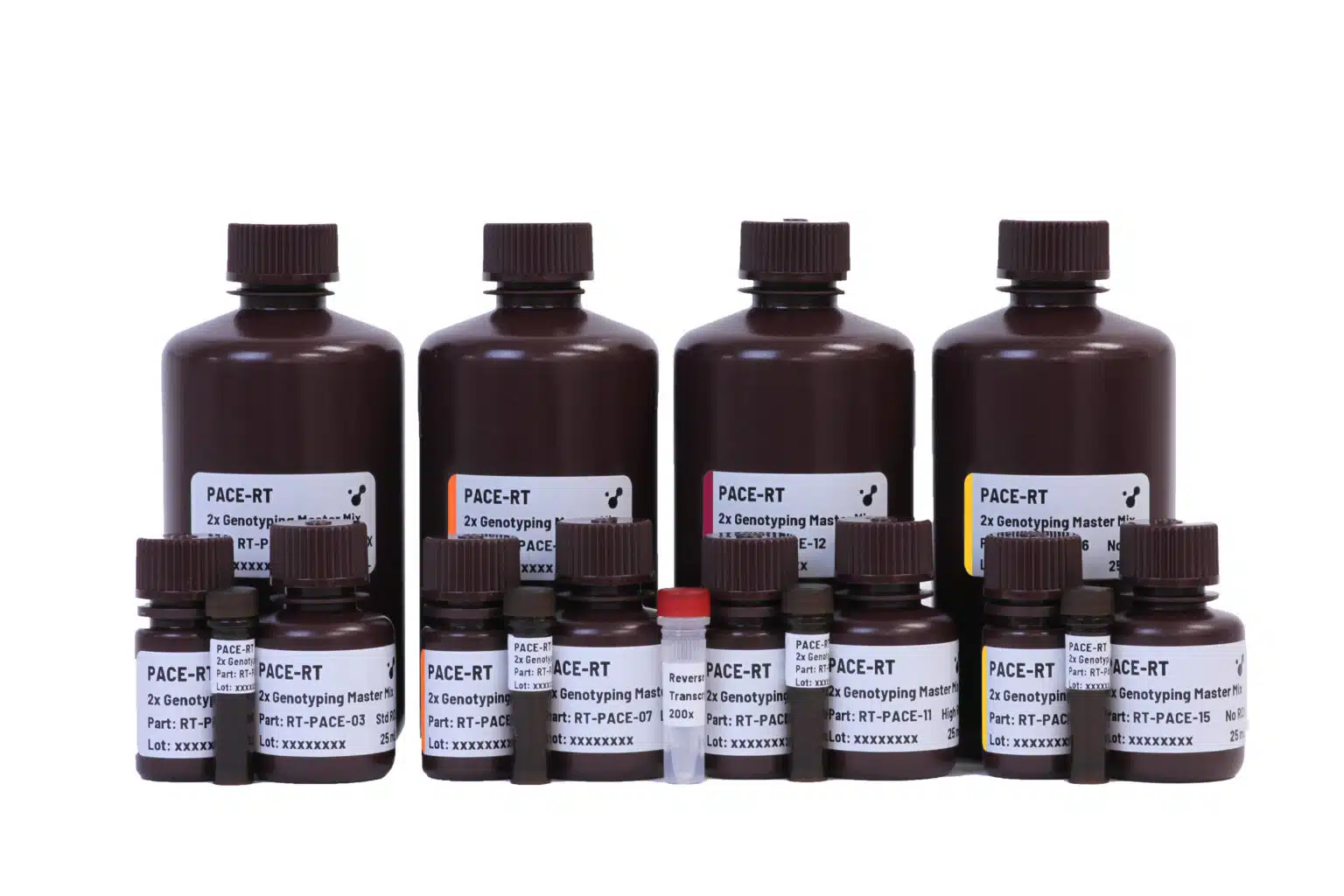
Genotype directly from RNA samples. RNA reverse transcription and cDNA PCR genotyping simultaneously in a single, one-step reaction.
Detail
About
PACE OneStep RT-PCR Master Mix combines reverse transcription (RT) and PCR in a single reaction. This advanced master mix simplifies workflows by eliminating the need for separate reactions for reverse transcription of RNA to cDNA, and PCR amplification from the newly generated cDNA. PACE OneStep RT-PCR Master Mix is highly efficient and sensitive, enabling detection of low-abundance RNA targets, particularly useful for applications such as gene expression analysis and viral RNA detection. PACE OneStep RT-PCR Master Mix demonstrates robust performance across a wide range of RNA templates and can be employed for both routine and challenging samples.
Other Products
[PM2610] ExcelBand™ Enhanced 3-color High Range Protein Marker (9-245 kDa), 250 μl x 2
Product Info
Document
Product Info
Description
The PM2610/PM2611 ExcelBand™ Enhanced 3-color High Range Protein Marker is a ready to use three-color protein standard with 12 pre-stained proteins covering a wide range of molecular weights from 10 to 245 kDa in Tris-Glycine buffer (9 to 235 kDa in BisTris (MOPS) buffer and 10-235 kDa in Bis-Tris (MES) buffer). Proteins are covalently coupled with different chromophores for easy identification of bands, with two reference proteins carrying enhanced intensity corresponding to a green at 25 kDa and red at 75 kDa, respectively, as separated on SDS-PAGE (Tris-Glycine buffer). The ExcelBand™ Enhanced 3-color High Range Protein Marker is designed for monitoring protein separation during SDS-polyacrylamide gel electrophoresis, verification of Western transfer efficiency on membranes (PVDF, nylon, or nitrocellulose) and for approximating the size of proteins.
Features
Ready-to-use — Premixed with a loading buffer for direct loading, no need to boil.
Two reference bands — 75 kDa (red) and 25 kDa (green)
Contents
Approximately 0.2~0.6 mg/ml of each protein in the buffer (20 mM Tris-phosphate (pH 7.5 at 25°C), 2 % SDS, 3.6 M Urea, and 15 % (v/v) Glycerol).
Quality Control
Under suggested conditions, the PM2610/PM2611 Enhanced 3-color High Range Protein Marker resolves 12 major bands in 15% SDS-PAGE (Tris-Glycine buffer, MOPS, and MES buffer) and after Western blotting to nitrocellulose membrane.
Storage
4°C for 3 months -20°C for long term storage
Document
The PM2610/PM2611 ExcelBand™ Enhanced 3-color High Range Protein Marker is a ready to use three-color protein standard with 12 pre-stained proteins covering a wide range of molecular weights from 10 to 245 kDa in Tris-Glycine buffer (9 to 235 kDa in BisTris (MOPS) buffer and 10-235 kDa in Bis-Tris (MES) buffer). Proteins are covalently coupled with different chromophores for easy identification of bands, with two reference proteins carrying enhanced intensity corresponding to a green at 25 kDa and red at 75 kDa, respectively, as separated on SDS-PAGE (Tris-Glycine buffer). The ExcelBand™ Enhanced 3-color High Range Protein Marker is designed for monitoring protein separation during SDS-polyacrylamide gel electrophoresis, verification of Western transfer efficiency on membranes (PVDF, nylon, or nitrocellulose) and for approximating the size of proteins.
30nm Colloidal Gold for Lateral Flow is a highly stable and uniform 30 nm gold nanoparticles can be supplied in a range from 1 OD to 100 OD. The quality and performance of a conjugate is critical to successful lateral flow test manufacturing. Our products are made in Austin TX and produced in a state-of-the-art manufacturing facility that enable rapid turnaround times while ensuring batch to batch consistency and reliability.
Bulk pricing and manufacturing supply contracts available.
Functionally Tested in Lateral Flow
Specifications 1OD 30nm Gold (1L)
Number of particles/mL
1.3-2 x 10¹¹
Gold Concentration (mg/mL)
4.2-4.7 x 10⁻²
Molar Concentration (moles/liter)
2.2-3.3 x 10⁻¹⁰
Particle Diameter
30 nm /-1.5
Document
Number of particles/mL 1.3-2 x 10¹¹ • Gold Concentration (mg/mL) 4.2-4.7 x 10⁻² • Molar Concentration (moles/liter) 2.2-3.3 x 10⁻¹⁰ • Particle Diameter 30 nm /-1.5
E. coli O157:H7 is a rod-shaped, gram negative bacterium. It is an enterohemorrhagic strain of the common E. coli bacterium and infection by the O157:H7 strain is commonly associated with hemorrhagic colitis. E. coli O157:H7 is recognized by its somatic (cell wall) antigen (O157) and its flagella antigen (H7). In addition, E. coli O157:H7 is known to produce Shiga-like toxins, which cause severe symptoms. While most patients can recover from the infection, up to 15% of the patients may develop hemolytic uremic syndrome, a type of kidney failure that could be fatal. Infection of E. coli O157:H7 usually results from consumption of poorly prepared food including undercooked meat (particularly ground beef), untreated water or raw unpasteurized milk.
E.coli O157:H7 TaqMan PCR Kit, 100 reactions
Ready to use format, including Master Mix for the target and PCR control to monitor for PCR inhibition and validate the quality
Specific Primer and Probe mix for the pathogen/virus/viroid of interest
Primer and Probe mix
Positive and negative control to confirm the integrity of the kit reagents
E.coli O157:H7 TaqMan PCR Probe/Primer Set and Controls, 100 reactions
Specific Primer/Probe mix and Positive Control for the pathogen/virus/viroid of interest
Nuclease-free water
Can be used together with Norgen’s PCR Master Mix (#28007) or customer supplied master mix
For research use only and NOT intended for in vitro diagnostics.
Storage Conditions and Product Stability All kit components can be stored for 2 years after the date of production without showing any reduction in performance.
All kit components should be stored at -20°C upon arrival.