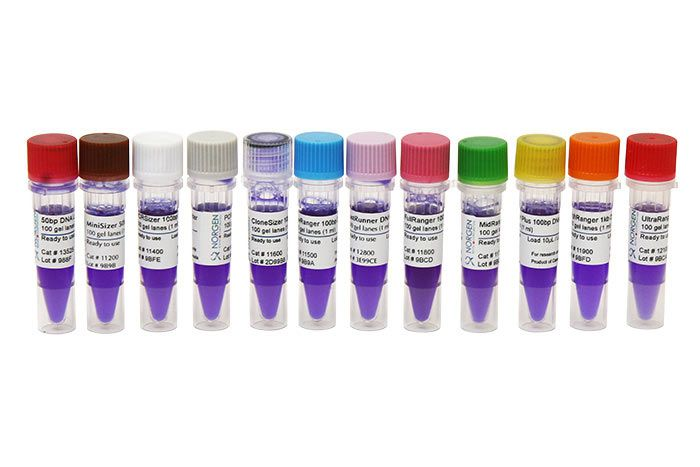
The Norgen PCRSizer 100 bp DNA Ladder is prepared to ensure quality and batch-to-batch consistency. Our PCRSizer contains ten discrete fragments ranging from 100 bp to 1000 bp in 100 bp increments with a higher intensity reference band at 500 bp. This Ladder is ideal for PCR product size confirmation.
Contents: 1mL of premixed DNA ladder (0.5µg/10µL) in loading buffer (10mM EDTA, 10% glycerol, 0.015% bromophenol blue, and 0.17% SDS).
PCR Sizer 100 bp DNA Ladder (Cat# 11400) – 100 loads
Ladder Properties: • Ten discrete bands, ranging from 100 bp to 1,000 bp • Higher intensity band at 500 bp for easy reference
Fragment
Size (bp)
Mass (ng)
1
1000
78
2
900
70
3
800
62
4
700
55
5
600
47
6
500
78
7
400
31
8
300
24
9
200
31
10
100
24
Recommended Use:
Mix thoroughly. For best results, load 10µL of DNA ladder per well. For precise mass determination with a densitometer, stain gel after electrophoresis using 0.5µg/mL ethidium bromide for 30-40 minutes. The table above shows the size and mass for each band based on 10µL ladder per well.
Storage:
Stable at room temperature. For longer term storage, -20°C is recommended.
This ladder was standardized using 10µL of DNA per lane on a 0.8 cm thick, 13 x 15 cm, 1.0% agarose gel run in TAE buffer.
Other Products
Lyophilized RNA Amplification Kit Below 20 Degree Format Easy And Efficient
Product Info
Document
Product Info
Product Description
Lyophilized RNA Amplification Kit -20°C Format Easy And Efficient
Product Detail
Kit Storage and term of Validity
Storage term: stored at ≤-20℃,keep away from light, avoid heavy weight and repeated freezing and thawing.
Term of Validity: 14 months
Isothermal nucleic acid Principle Summary
This kit is based on a rapid nucleic acid amplification technology at room temperature and constant temperature: at room temperature and constant temperature (generally 39 ºC~42 ºC), reverse transcriptase uses specific primers and template RNA to synthesize cDNA strands, and binds the auxiliary protein and single strand With the help of the protein, the recombinase and the primer form a complex; perform a homology search and bind the target homology domain, at this time a D-loop region is formed at the homology position and strand exchange begins; accompanied by the recombinase from the complex Upon dissociation, the polymerase also binds to the 3′ end of the primer, initiating chain extension. Relying on the action of nfo enzyme, adding specific molecular probes designed according to the template, and using colloidal gold technology (sandwich method) can detect the final result.
Isothermal nucleic acid Product Features
1/ High sensitivity and specificity, short reaction time.
2/ The reagent form is freeze-dried, stable and easy to operate.
3/ The reaction can be operated by metal bath and water bath pot without purchasing expensive PCR apparatus.
Technical Parameters:
Parameters
Details
Product Name
RNA Isothermal Amplification Kit NFO
Manufacturer
Amp-future
Storage Temperature
-20°C
Kit Components
Enzymes, Buffers ,Reagents
Packaging
48 Tests/box
Detection Limit
500-1000copies/µL
Shipping
ICE
Test Time
5-20mins
Isothermal nucleic acid Applications
Suitable for RNA isothermal rapid amplification kit(NFO type)
Primer: Require pair of nucleotide primers with the length of 25-35 bp.
RNA NFO kit reaction temperature is 39 to 42℃ and time is 5-20 minutes.
Notes
1/ Please avoid nucleic acid contamination and set blank control during reaction due to the high sensitivity of the kit.
2/ Please take out the required quantity of MIRA reaction units for the experiment, and put the rest under storage conditions when performing the experiment.
Collagen is a fundamental component of the extracellular matrix, and the predominant protein in animals, constituting around 30% of total protein mass. A glycoprotein, it is well known for its triple helical structure. This is formed from three polypeptide α-chains with Gly-X-Y repeating residues (Gly for Glycine, X for proline, and Y for hydroxyproline).
Types of Collagen
Over 28 types of collagens have been identified, with Type I collagen being the most abundant. It’s prevalent in ligaments, tendons, skin, and bone tissue. Its mature, insoluble form grants it remarkable strength, making it vital for the mobility of organisms. Collagen also has biochemical functions, influencing cell growth, proliferation, and differentiation.
This version of the kit is designed to detect and measure INSOLUBLE forms of collagen. Chose our Sircol 2.0 collagen kit if you need to analyse SOLUBLE collagen.
Applications of Collagen
Collagen, with its diverse properties, finds utility in various industries. It plays a role in medicine for wound healing and has an expanding role in tissue engineering and cell culture for biomedical purposes. It’s gaining popularity in the cosmetic industry for skin rejuvenation and is used in chemical formulations and the food industry as a functional food supplement and additive.
How does the Sircol assay detect collagen?
Sircol dye reagent contains Sirius Red – a linear anionic dye with sulphonic acid side chain groups. Under assay conditions the Sircol dye binds the basic groups of soluble collagen molecules. Maximal binding occurs in collagens possessing intact triple helix organisation as the highly ordered Gly-X-Yn helical structure of tropocollagen further contributes to dye binding. This results in a high degree of dye-collagen specificity. Affinity is progressively reduced during heat denaturation 4ºC due to the unwinding of the triple helix and formation of random chains.
Overview of the Sircol assay process:
Step 1. Samples being assayed for insoluble collagen must first undergo a 2-3 hour pre-treatment with Sircol Fragmentation reagent. This converts insoluble collagen into water-soluble gelatin can then be assayed.
Step 2. Addition of Sircol Dye Reagent to these pre-treated insoluble collagen samples results in the formation of a denatured collagen-dye complex. This complex then precipitates during the dye incubation period and is subsequently isolated by centrifugation, followed by washing to remove unbound dye. The Denatured collagen-bound dye is then eluted and measured spectrophotometrically.
Step 3. The insoluble collagen content of unknown samples is quantified by comparison against a calibration curve prepared using a the denatured collagen standard supplied with the kit.
Assay range
100 – 1000 µg/ml
Limit of Detection
100µg/ml
Detection Method
Colorimetric Detection (556nm) (Endpoint)
Measurements per kit
110 in total (allows a maximum of 46 samples to be run in duplicate alongside a standard curve).
Suitable Samples
The assay can be used to assess the rate of production of newly laid down collagen fibres during periods of rapid growth, development, tissue repair, remodeling and wound healing. Sources of material includes tissues, bone and calcified tissue.
*Insoluble collagens must be converted into soluble form prior to assay. Instructions and regents are provided with the kit., depending on sample this will require prior salt/acid/acid-pepsin extraction.
**non-mammalian collagens may result in a reduced limit of detection. We recommend use of an assay standard matched to the species under assay.
Many customers have found that the straightforward sample processing and analysis of Sircol make it a good alternative to conventional hydroxyproline analysis.
Precautions
This kit is designed for research use only. Not for use in diagnostic procedures. Kit requires access to a centrifuge, water bath / heated block, as well as a spectrophotometer/colorimeter capable of absorbance detection at 556nm. Specific sample preparation protocols may require customer to provide further reagents, consult assay manual for further information.
Sircol Insoluble Collagen kit contents:
1. Sircol Dye Reagent (1x110ml)
2. Denatured Collagen Reference Standard (1x5ml, 1.0mg/ml)
3. Acid-Salt Wash Reagent (1x20ml)
4. Fragmentation Reagent (1x110ml)
5. Alkali Reagent (1x110ml)
6. 2ml screw-cap tubes for preparation of samples.
7. Assay kit manual
NB: Additional reagents may be required for sample preparation prior to assay. Consult manual or contact us for further details.
Document
As collagens mature, they become increasingly crosslinked and insoluble – characteristics necessary for key biophysical role that collagen plays in living organisms. Biocolor’s Sircol™ INSOLUBLE Collagen Kit is a dye-binding assay designed for accurate quantification and measurement such collagens. It is ideal for analyzing crosslinked / insoluble collagens from sources such as tissues, bone, and calcified tissue.