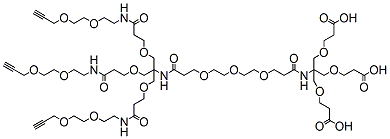
PEG3-(Amino-Tri-(Propargyl-PEG2-ethoxymethyl)-methane)-(Amino-Tri-(carboxyethoxymethyl)-methane) is reactive with azide-bearing compounds or biomolecules via copper catalyzed azide-alkyne Click Chemistry to yield a stable triazole linkage. The terminal carboxylic acid groups can react with primary amino groups in the presence of activators (e.g. HATU) to form a stable amide bond.
Detail
PEG3-(Amino-Tri-(Propargyl-PEG2-ethoxymethyl)-methane)-(Amino-Tri-(carboxyethoxymethyl)-methane) is reactive with azide-bearing compounds or biomolecules via copper catalyzed azide-alkyne Click Chemistry to yield a stable triazole linkage. The terminal carboxylic acid groups can react with primary amino groups in the presence of activators (e.g. HATU) to form a stable amide bond.
Other Products
3CR Bio 8-CHANNEL HANDHELD CAPPER/DECAPPER
Product Info
Document
Product Info
A handheld 8-tube screw cap tube capper/decapper. Securely seal or unscrew an 8-cap row in just 10 seconds, or an entire rack of 96 tubes in 2 minutes.
About
8-Channel Handheld Capper/Decapper – Saving you Time and Effort
The 8-Channel Handheld Capper/Decapper is a versatile tool designed to increase throughput and save you time and effort. Capable of consistently capping and de-capping multiple tubes simultaneously, this innovative device ensures smooth and efficient lab operations. Its lightweight, ergonomic design reduces operator strain and seamlessly transitions from manual to automated systems, making it an indispensable addition to any laboratory.
Speed and Efficiency
With the ability to securely seal an 8-cap row in just 10 seconds or an entire rack of 96 tubes in 2 minutes, the 8-Channel Handheld Capper/Decapper significantly enhances manual processing throughput. The device guarantees consistent sealing across each tube. Its automatic column-type cap removal and capping performance streamline workflows, ensuring quick and reliable operation. This not only saves valuable time but also reduces the risk of repetitive strain injuries for lab personnel.
Ergonomic and Portable
Designed with user comfort in mind, the 8-Channel Handheld Capper/Decapper is lightweight and ergonomically crafted for effortless screw cap processing. It’s neat, compact design and low-force, dual-button cap ejection system makes it ideal for various laboratory environments. Its included storage stand ensures secure and convenient storage and when not in use.
Convenient Charging and Compatibility
The tool features magnetic contact charging, offering long battery life and fast charging times. Ready to use whenever you are, it efficiently caps, de-caps, or recaps tubes by column or row. Interchangeable cap driver cassettes allow for easy processing of different screw cap tube types and SBS rack formats.
Request a Demo or Speak to an Expert
Experience the efficiency and convenience of the 8-Channel Handheld Capper/Decapper in your lab. Visit our website to request a demo or speak to one of our experts to learn more about how this innovative tool can enhance your laboratory’s operations.
Document
A handheld 8-tube screw cap tube capper/decapper. Securely seal or unscrew an 8-cap row in just 10 seconds, or an entire rack of 96 tubes in 2 minutes.
Nucleic acid testing (NAT) is the method of choice for detection and quantification of a wide range of micro organisms. Primerdesign manufactures and supplies high quality quantitative real-time PCR kits for the detection and simultaneous quantification of numerous significant pathogens . A copy number standard curve is provided for quantification and an the internal extraction template (DNA or RNA), controls for the quality of the nucleic acid extraction and eliminates false negative results.
The kit is designed with the broadest possible detection profile to ensure that all clinically relevant strains and subtypes are detected. Target sequences are selected by working with data from key opinion leaders in the field. Multiple sequence alignments and unprecedented real-time PCR expertise in design and validation ensure the best possible kit.
Details of the target and priming specificity are included in the individual handbooks above.
Packaged, optimised and ready to use. Expect Better Data.
Document
Exceptional value for money Rapid detection of all clinically relevant subtypes Positive copy number standard curve for quantification Highly specific detection profile High priming efficiency Broad dynamic detection range (>6 logs) Sensitive to < 100 copies of target
CE-IVD marked version available for in vitro diagnostic use
Available in TaqMan format for analysis
Herpes Simplex Virus 2 (HSV-2) is a member of the herpes virus family, Herpesviridae. HSV-2 has a relatively large double-stranded DNA genome. HSVs are primarily transmitted by sexual intercourse, direct contact with lesions or perinatally. Most HSV positive cases are characterised by lesions on the skins and mucous membranes of the mouth and genitals. HSV infection can be either primary or a recurrence of a previous infection. More than 90% of the primary HSV infections are asymptomatic. Primary infection with HSV-1 can lead to gingivostomatitis, eczema herpeticum, keratoconjunctivitis and encephalitis. The primary symptoms of a secondary infection are skin lesions in the nose, mouth and genital regions. The infection is contagious, mainly during an epidemic.
HSV-2 TaqMan PCR Kit, 100 reactions
Ready to use format, including Master Mix for the target and PCR control to monitor for PCR inhibition and validate the quality
Specific Primer and Probe mix for the pathogen/virus/viroid of interest
Primer and Probe mix
Positive and negative control to confirm the integrity of the kit reagents
HSV-2 TaqMan PCR Probe/Primer Set and Controls, 100 reactions
Specific Primer/Probe mix and Positive Control for the pathogen/virus/viroid of interest
Nuclease-free water
Can be used together with Norgen’s PCR Master Mix (#28007) or customer supplied master mix
Storage Conditions and Product Stability All kit components can be stored for 2 years after the date of production without showing any reduction in performance.
All kit components should be stored at -20°C upon arrival. Repeated thawing and freezing (> 2 x) of the Master Mix and Positive Control should be avoided, as this may affect the performance of the assay. If the reagents are to be used only intermittently, they should be frozen in aliquots.