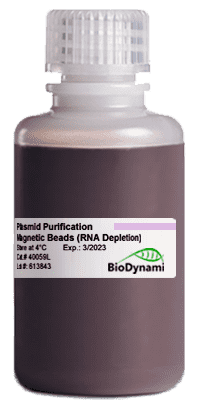
Plasmid Purification Magnetic Beads (RNA Depletion)
Facebook
X
Pinterest
Email
Plasmid isolation from bacterial cultures is one of the most popular techniques in biomedical research and pharmaceutical industries. However, it is common that the isolated plasmid DNA is usually contaminated with varied degrees of host RNA. Plasmid purification is necessary to reduce the impact on downstream applications by removing RNA contamination.
Detail
Plasmid Purification Magnetic Beads (RNA Depletion)
Plasmid isolation from bacterial cultures is one of the most popular techniques in biomedical research and pharmaceutical industries. However, it is common that the isolated plasmid DNA is usually contaminated with varied degrees of host RNA. Plasmid purification is necessary to reduce the impact on downstream applications by removing RNA contamination.
We have developed a simple reagent to completely remove RNA contamination in the isolated plasmid samples using Solid Phase Reversible Immobilization (SPRI) beads. SPRI beads consist of paramagnetic particles coated with carboxyl groups that reversibly bind DNA. Our Plasmid Purification Magnetic Beads (RNA Depletion) combines BioDynami’s proprietary chemistries with the reversible DNA-binding properties of SPRI magnetic beads. The reagent removes RNA and recovers the plasmid in the same step. Moreover, unwanted components such as salts, dNTPs, proteins, enzymes, and other impurities can also be removed simultaneously.
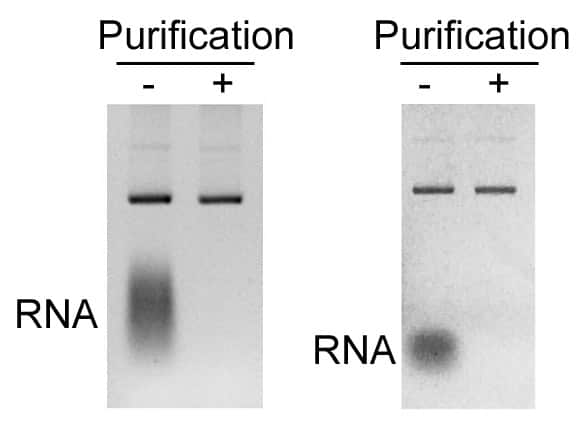
Plasmid can be used for downstream applications such as enzymatic digestion, transformation, transfection and molecular cloning etc. The beads can be an effective and inexpensive reagent for bacterial RNA depletion for routine plasmid purification.
Features
Effective depletion of bacterial RNA by RNase
High recovery rate of plasmid DNA by magnetic beads
Removal of unwanted components and impurities
Simple and fast beads-based protocol
Other Products
Propargyl-PEG7-alcohol
Product Info
Document
Product Info
Propargyl-PEG7-alcohol is a propargyl linker that can react with azide compounds or biomolecules via copper catalyzed Click Chemistry. Reagent grade, for research purpose. Please contact us for GMP-grade inquiries.
Document
Propargyl-PEG7-alcohol is a propargyl linker that can react with azide compounds or biomolecules via copper catalyzed Click Chemistry. Reagent grade, for research purpose. Please contact us for GMP-grade inquiries.
These kits provide a fast, reliable and convenient method to purify and concentrate high quality, high purity and inhibitor-free cell-free circulating and exosomal RNA using a convenient spin column method. These kits can purify RNA from fresh or frozen serum or plasma samples prepared from blood collected on either EDTA or Citrate. Plasma samples prepared from blood collected on heparin should not be used, as heparin can significantly interfere with many downstream applications such as RT-PCR. The purified plasma/serum RNA is fully compatible with all downstream applications including PCR, qPCR, methylation-sensitive reverse transcription qPCR, reverse transcription PCR, Northern blotting, RNase protection and primer extension, expression array assays, and NGS. The EXTRAClean columns undergo stringent processing and rigorous quality control measures to minimize contamination traces, ensuring optimal results for sensitive applications such as NGS.
Background
Cell-free circulating RNA, including exosomal RNA in plasma or serum, has the potential to provide biomarkers for certain cancers and disease states, and includes tumor-specific extracellular RNA in the blood. Exosomes are 40 – 100 nm membrane vesicles, which are secreted by most cell types. Exosomes can be found in saliva, blood, urine, amniotic fluid and malignant ascitic fluids, among other biological fluids. Evidence has been accumulating recently that these vesicles act as cellular messengers, conveying information to distant cells and tissues within the body. The exosomes contain cell-specific proteins, lipids and RNAs, which are transported to other cells, where they can alter function and/or physiology. These exosomes may play a functional role in mediating adaptive immune responses to infectious agents and tumours, tissue repair, neural communication and transfer of pathogenic proteins. Recent work has demonstrated the presence of distinct subsets of microRNAs within exosomes which depend upon the tumour cell type from which they are secreted. For this reason, exosomal RNAs may serve as biomarkers for various diseases including cancer. As the RNA molecules encapsulated within exosomes are protected from degradation by RNAses, they can be efficiently recovered from biological fluids, such as plasma or serum.
EXTRAClean Plasma/Serum RNA Purification Mini Kit
This kit can purify RNA from fresh or frozen serum or plasma samples prepared from blood collected on either EDTA or Citrate, from volumes ranging from 50 μL to 200 μL. The purified plasma/serum RNA is eluted in a flexible final volume of 10 μL to 25 μL.
EXTRAClean Plasma/Serum RNA Purification Midi Kit
This utilizes a two-column method, and can purify RNA from fresh or frozen serum or plasma samples prepared from blood collected on either EDTA or Citrate, from volumes ranging from 250 μL to 1.5 mL. The first column will handle the large volume input of bodily fluids that is followed by a concentration on a mini column for a final elution of 50 μL to 100 μL.
EXTRAClean Plasma/Serum RNA Purification Maxi Kit
This kit can purify RNA from fresh or frozen serum or plasma samples prepared from blood collected on either EDTA or Citrate, from volumes ranging from 2 mL to 5 mL. The first column will handle the large volume input of bodily fluids that is followed by a concentration on a mini column for a final elution of 50 μL to 100 μL.
All sizes, including miRNA and small RNA (<200 nt)
Average Yields¥
Variable depending on specimen
† This kit is suitable for the isolation of RNA from fresh or frozen serum or plasma prepared from blood collected on either EDTA or Citrate. Plasma samples prepared from blood collected on heparin should not be used as heparin can significantly interfere with many downstream applications such as RT-PCR
¥ Please check page 6 for Average Plasma/Serum Yields and Common RNA Quantification Methods
Storage Conditions and Product Stability All solutions should be kept tightly sealed and stored at room temperature. This kit is stable for 2 years after the date of shipment. It is recommended to warm Lysis Buffer A for 20 minutes at 60°C if any salt precipitation is observed.
CE-IVD marked version available for in vitro diagnostic use
Available in TaqMan format for analysis
The Zika Virus (ZIKV) is an emerging mosquito-borne virus that was first identified in Uganda in 1947 in Rhesus monkeys through monitoring of sylvatic yellow fever. During large outbreaks in French Polynesia and Brazil, national health authorities reported potential neurological and auto-immune complications of ZIKV disease. Agencies investigating the Zika outbreaks are finding an increasing body of evidence about the link between ZIKV and microcephaly. Infection with ZIKV may be suspected based on symptoms and recent history (e.g. residence or travel to an area where ZIKV is known to be present). Zika virus diagnosis can only be confirmed by laboratory testing for the presence of ZIKV RNA in the blood or other body fluids, such as urine or saliva.
ZIKV TaqMan RT-PCR Kit, 100 reactions
Ready to use format, including Master Mix for the target and PCR control to monitor for PCR inhibition and validate the quality
Specific Primer and Probe mix for the pathogen/virus/viroid of interest
Primer and Probe mix
Positive and negative control to confirm the integrity of the kit reagents
ZIKV TaqMan RT-PCR Probe/Primer Set and Controls, 100 reactions
Specific Primer/Probe mix and Positive Control for the pathogen/virus/viroid of interest
Nuclease-free water
Can be used together with Norgen’s RT-PCR Master Mix (#28113) or customer supplied master mix