[PM2500] ExcelBand™ 3-color Regular Range Protein Marker (9-180 kDa), 250 μl x 2
Facebook
X
Pinterest
Email
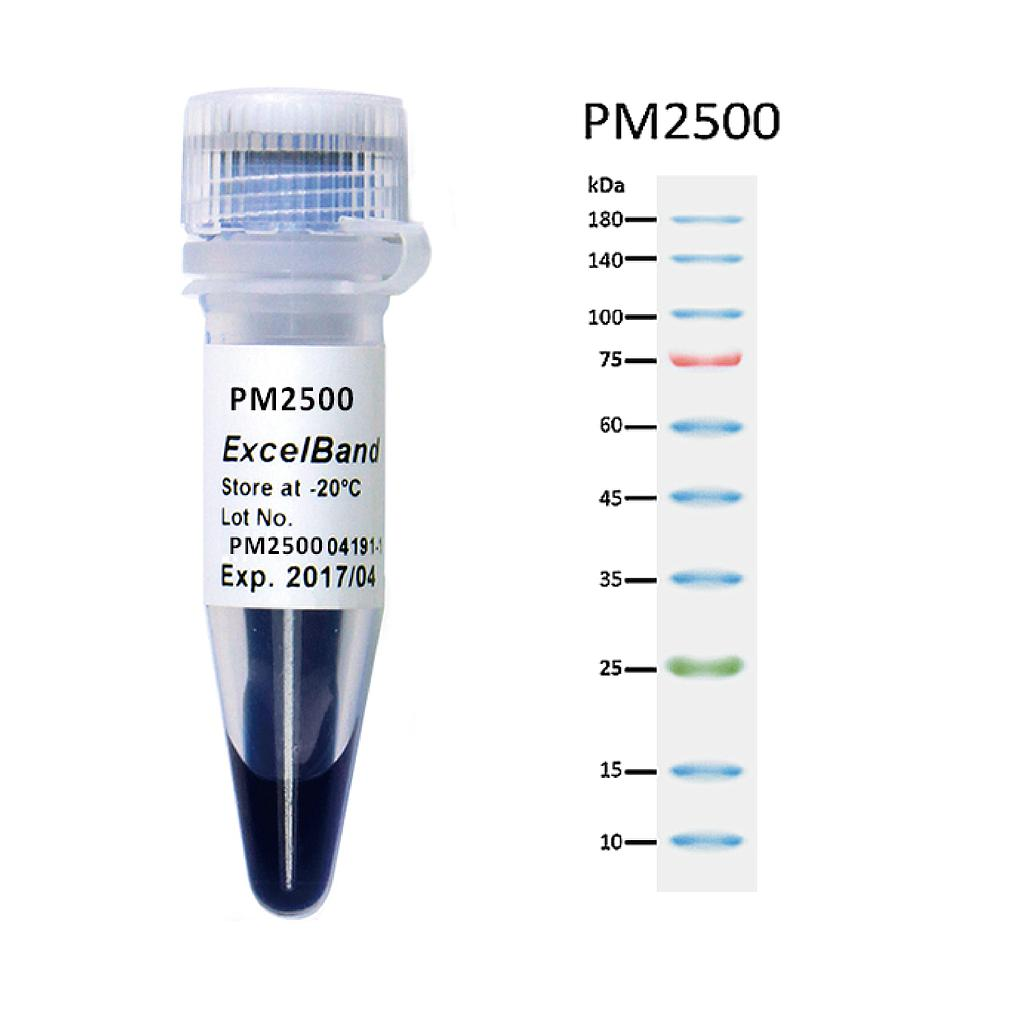
The PM2500 ExcelBand™ 3-color Regular Range Protein Marker is a ready-to-use three-color protein standard with 10 pre-stained proteins covering a wide range of molecular weights from 10 to 180 kDa in Tris-Glycine Buffer (9 to 170 kDa in Bis-Tris (MOPS) buffer and 10 to 170 kDa Bis-Tris (MES) buffer). Proteins are covalently coupled with a blue chromophore except for two reference bands (one green and one red band at 25 kDa and 75 kDa respectively) when separated on SDS-PAGE (Tris-Glycine buffer). PM2500 ExcelBand™ 3-color Regular Range Protein Marker is designed for monitoring protein separation during SDS-polyacrylamide gel electrophoresis, verification of Western transfer efficiency on membranes (PVDF, nylon, or nitrocellulose) and for approximating the size of proteins.
Detail
Description
The PM2500 ExcelBand™ 3-color Regular Range Protein Marker is a ready-to-use three-color protein standard with 10 pre-stained proteins covering a wide range of molecular weights from 10 to 180 kDa in Tris-Glycine Buffer (9 to 170 kDa in Bis-Tris (MOPS) buffer and 10 to 170 kDa Bis-Tris (MES) buffer). Proteins are covalently coupled with a blue chromophore except for two reference bands (one green and one red band at 25 kDa and 75 kDa respectively) when separated on SDS-PAGE (Tris-Glycine buffer). PM2500 ExcelBand™ 3-color Regular Range Protein Marker is designed for monitoring protein separation during SDS-polyacrylamide gel electrophoresis, verification of Western transfer efficiency on membranes (PVDF, nylon, or nitrocellulose) and for approximating the size of proteins.
Features
Ready-to-use — Premixed with a loading buffer for direct loading, no need to boil.
Two reference bands — 75 kDa (red) and 25 kDa (green)
Contents
Approximately 0.1~0.4 mg/ml of each protein in the buffer (20 mM Tris-phosphate (pH 7.5 at 25°C), 2% SDS, 0.2 mM DTT, 3.6 M urea, and 15% (v/v) glycerol).
Quality Control
Under suggested conditions, PM2500 ExcelBand™ 3-color Regular Range Protein Marker resolves 10 major bands in 15% SDS-PAGE (Tris-Glycine buffer, MOPS, and MES buffer) and after Western blotting to nitrocellulose membrane.
Storage
4°C for 3 months -20°C for long term storage
Other Products
Plasma/Serum Exosome Purification and RNA Isolation Kits
Product Info
Document
Product Info
Overview
Purification and enrichment of intact plasma/serum exosomes for functional studies
Isolate all sizes of RNA, including microRNA, irrespective of size or GC content, without bias
Versatile plasma/serum input volume
No phenol extractions, Proteinase K treatment, nor carrier RNA required
No time-consuming ultracentrifugation, filtration nor special syringes required
No precipitation reagents, nor overnight incubation required
Compatible with plasma/serum from most species
Pure exosomes are purified and are free from any other RNA-binding proteins
Purification is based on spin column chromatography that uses Norgen’s proprietary resin
The purified RNA is suitable for a variety of downstream applications, including Small RNA Sequencing. Find out more information on Norgen’s NGS services
Norgen’s Plasma/Serum Exosome and RNA Isolation Kits constitute all-in-one systems for the purification of exosomes and the sequential isolation of exosomal RNA from different plasma/serum sample volumes. The purification is based on spin column chromatography that employs Norgen’s proprietary resin. These kits are designed to isolate all sizes of RNA, including microRNA, irrespective of size or GC content, without bias. These kits provide a clear advantage over other available kits in that they do not require any special instrumentation, protein precipitation reagents, extension tubes, phenol/chloroform or protease treatments. The RNA isolated from the purified exosomes is free from any protein-bound circulating RNA and is of the highest integrity. The purified RNA can be used in a number of downstream applications including real time PCR, reverse transcription PCR, Northern blotting, RNase protection and primer extension, and expression array assays.
Norgen’s Plasma/Serum Exosome and RNA Isolation Mini Kit
For sample volumes ranging from 50 µL to 1 mL. This kit allows the user to elute into a flexible elution volume ranging from 50 µL to 100 µL.
Norgen’s Plasma/Serum Exosome and RNA Isolation Midi Kit
For sample volumes ranging from 1 mL to 4 mL. This kit allows the user to elute into a flexible elution volume ranging from 50 µL to 100 µL.
Norgen’s Plasma/Serum Exosome and RNA Isolation Maxi Kit
For sample volumes ranging from 4 mL to 10 mL. This kit allows the user to elute into a flexible elution volume ranging from 50 µL to 100 µL.
All sizes, including miRNA and small RNA (< 200 nt)
Elution Volume
50-100 μL
Time to Complete 10 Purifications
35 – 40 minutes
Average Yields*
Variable depending on specimen
*Please check page 4 of the product insert for the average yields and the common RNA quantification methods
Storage Conditions and Product Stability All solutions should be kept tightly sealed and stored at room temperature. This kit is stable for 2 years after the date of shipment. It is recommended to warm Lysis Buffer A for 20 minutes at 60°C if any salt precipitation is observed.
Important Note This kit is suitable for the purification of exosomes from fresh or frozen serum or plasma prepared from blood collected on either EDTA or Citrate. Plasma samples prepared from blood collected on heparin should not be used as heparin can significantly interfere with many downstream applications such as RT-PCR.
Test for the semi-quantitative evaluation of human Interleukin-6 (IL-6) in serum, plasma, cell culture supernatant, amnitotic fluid or cerebrospinal fluid.
This product is only available within the EU!
Method/Platform
lateral flow
Range/Assay Sensivity
50 to 10 000 pg/ml
Test Principle
IL-6 binds to a first anti IL-6 antibody conjugated to gold particles. The IL-6 loaded gold particles diffuse through the membrane and overflow the test line.
A second monoclonal antibody, specific for IL-6 is coated on the membrane. The gold particles are bound specifically and become visible as a coloured line. Colour intensity is directly proportional to the concentration of IL-6 in the sample. The conjugated specific antibodies printed as a second line on the membrane captures the rest of gold conjugate.
Document
20 tests Test for the semi-quantitative evaluation of human Interleukin-6 (IL-6) in serum, plasma, cell culture supernatant, amnitotic fluid or cerebrospinal fluid.
DBCO STP ester is a water-soluble reagent with a terminal DBCO group and a STP ester group. DBCO STP ester that can be used for the modification of peptides, antibodies, proteins, and other molecules containing the amine group. The STP esters are excellent alternatives to conventional N-hydroxysuccinimide (NHS) esters for coupling reactions in aqueous environments. The DBCO groups is commonly used for copper-free Click Chemistry reactions due to its strain promoted high energy. Reagent grade, for research use only.
Document
DBCO STP ester is a water-soluble reagent with a terminal DBCO group and a STP ester group. DBCO STP ester that can be used for the modification of peptides, antibodies, proteins, and other molecules containing the amine group. The STP esters are excellent alternatives to conventional N-hydroxysuccinimide (NHS) esters for coupling reactions in aqueous environments. The DBCO groups is commonly used for copper-free Click Chemistry reactions due to its strain promoted high energy. Reagent grade, for research use only.