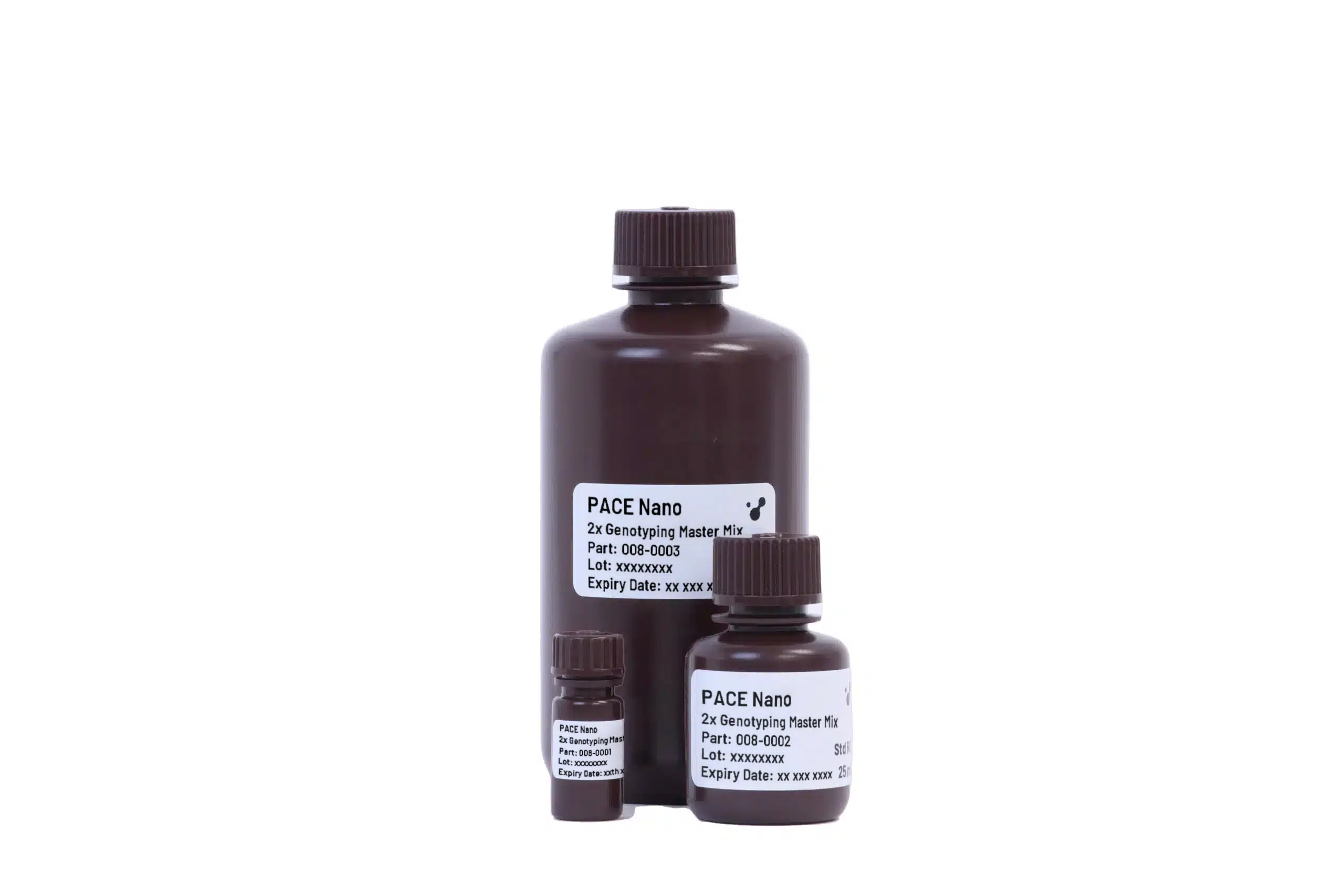
ProbeSure Multiplex Master Mix is an enhanced version of ProbeSure Master Mix, formulated to enable users to analyse up to four targets in one reaction well. For example, two bi-allelic SNPs or one reference gene and a further three genes of interest.
Users will require a plate reader capable of reading FAM, HEX, ATTO 550, ATTO 647N and ATTO 633 (the wavelengths of each of these can be found in our ProbeSure Multiplex Master Mix User Guide). ProbeSure Multiplex Master Mix is supplied at 2x concentration for convenience and is supplied with the ATTO 633 normalising dye at either high level (500 nM final concentration), low level (25 nM final concentration) or without ATTO 633.
Other Products
RNA Clean-Up and Concentration Kits
Product Info
Document
Product Info
Overview
Clean-up & concentrate total RNA (including miRNA) in minutes
Clean-up & concentrate RNA from TRIzol®, TRI Reagent®, etc
Clean-up RNA from contaminants including enzymes, primers, nucleotides
Rapid spin-column protocol, elute in 20 µL
96-well format for high throughput processing & Micro-Elute spin column formats for 8 µL are available
Purified RNA is suitable for a variety of downstream applications, including Small RNA Sequencing. Find out more information on Norgen’s NGS services
Purification is based on spin column chromatography that uses Norgen’s proprietary resin separation matrix
These kits are designed to clean-up and concentrate RNA (including miRNA) from TRIzol® and TRI Reagent®, enzymatic reactions, in vitro transcription, labelling reactions, etc. These are robust kits for all clean-up and concentration purposes for up to 35 µg of RNA in solution. The purified RNA is of the highest purity and integrity, and can be used in a number of downstream applications. These kits purify all sizes of RNA, from large mRNA and ribosomal RNA down to miRNA, siRNA and lncRNA.
RNA Clean-Up and Concentration Kit (Spin Column)
Norgen’s RNA Clean-Up and Concentration Kit provides a rapid method for the purification, cleanup and concentration of up to 35 μg of RNA isolated using different methods including phenol/guanidine-based protocols, and from various upstream enzymatic reactions such as DNase treatment and labeling. The kit elutes RNA in 20 µL. Complete 10 purifications in 20 minutes.
RNA Clean-Up and Concentration 96-Well Kit (High Throughput)
Norgen’s RNA Clean-Up and Concentration 96-Well Kit provides a rapid method for the purification, cleanup and concentration of up to 50 μg of RNA isolated using different methods including phenol/guanidine-based protocols, and from various upstream enzymatic reactions such as DNase treatment and labeling. The kit elutes RNA in 75 µL. Complete 10 purifications in 30 minutes.
RNA Clean-Up and Concentration Micro-Elute Kit (Micro-Elute)
Norgen’s RNA Clean-Up and Concentration Micro-Elution Kit provides a rapid method for the purification, cleanup and concentration of up to 10 μg of RNA isolated using different methods including phenol/guanidine-based protocols, and from various upstream enzymatic reactions such as DNase treatment, labeling and in vitro transcription. This kit is made for eluting RNA in smaller volumes of 8 µL for all types of downstream applications, for the highest concentration of RNA sample. Complete 10 purifications in 20 minutes.
Storage Conditions and Product Stability All solutions should be kept tightly sealed and stored at room temperature. This kit is stable for 2 years after the date of shipment.
1.Usages: For fungal culture and sterile inspection of drugs and biological products.
Principle: Peptone provide carbon and nitrogen sources; yeast extract powder provides B vitamins; glucose provide energy; potassium hydrogen phosphate as buffer; magnesium sulfate to provide essential trace elements.
Influenza virus infection of birds, humans and other animals is a major public health problem worldwide. Influenza viruses are classified as either type A, B or C based on differences in their nucleoproteins and matrix proteins. The type A viruses are the most virulent human pathogens among the three influenza types and cause the most severe disease and epidemics. The different types can be further classified into subtypes based on antigenic differences in two surface glycoproteins; hemagglutinin and neuroamidase. All known subtypes of influenza A can be found in birds (H1-H16, N1-N9), while a limited number of the subtypes have been found in humans (H1-H3, N1 and N2). However, over the past few years, various subtypes of Influenza A viruses, including H5N1, have been reported to infect humans (WHO, 2006). In addition, the coexistence of human influenza viruses and avian influenza viruses may provide an opportunity for genetic material to be exchanged between these viruses. This could potentially create a new virulent influenza strain that is easily transmissible and lethal to humans (Food Safety Research Information Office, 2006). Thus, there is the need for sensitive diagnostic tests to allow for the rapid and early detection of these H5 influenza virus infections, to help reduce the risk of epidemics or pandemics in both animals and humans.
H5N1 TaqMan RT-PCR Kit, 100 reactions
Ready to use format, including Master Mix for the target and PCR control to monitor for PCR inhibition and validate the quality
Specific Primer and Probe mix for the pathogen/virus/viroid of interest
Primer and Probe mix
Positive and negative control to confirm the integrity of the kit reagents
H5N1 TaqMan RT-PCR Probe/Primer Set and Controls, 100 reactions
Specific Primer/Probe mix and Positive Control for the pathogen/virus/viroid of interest
Nuclease-free water
Can be used together with Norgen’s RT-PCR Master Mix (#28113) or customer supplied master mix
For research use only and NOT intended for in vitro diagnostics.
Storage Conditions and Product Stability All kit components can be stored for 1 year after the date of production without showing any reduction in performance.
All kit components should be stored at -20°C upon arrival. Repeated thawing and freezing (> 2 x) of the Master Mix and Positive Control should be avoided, as this may affect the performance of the assay. If the reagents are to be used only intermittently, they should be frozen in aliquots.