Propargyl-PEG3-amine is a PEG linker that is reactive with carboxylic acids, activated NHS esters, carbonyls (ketone, aldehyde) etc. The propargyl group reacts with azides in copper catalyzed azide-alkyne Click Chemistry. Reagent grade, for research purpose. Please contact us for GMP-grade inquiries.
Detail
Propargyl-PEG3-amine is a PEG linker that is reactive with carboxylic acids, activated NHS esters, carbonyls (ketone, aldehyde) etc. The propargyl group reacts with azides in copper catalyzed azide-alkyne Click Chemistry. Reagent grade, for research purpose. Please contact us for GMP-grade inquiries.
Other Products
TDL5M Large Capacity Refrigerated Centrifuge
Product Info
Document
Product Info
Features:
1.Brushless frequency motor,in great torque, free maintenance, no powder pollution, quick in speed up and down.
2.Imported compressors fluorine free,double cycle cooling,cold and hot alternating easily, free environment pollution and precise in temperature control.
3. Microprocessor control, digital display which indicates the speed, time, RCF in operation, speed raising and reducing quickly, operate simply. Running parameter can be edited.
4. 10 kinds of program stored in the memory, 10 kinds of accelerating and decelerating speed for your choice.
5. Automatically electric lid lock, super speed, over temperature protection and imbalance protection. The centrifuge body is made of high quality steel, safe and reliable.
6. Rotor is connected to spindle by specialized taper sleeve, loading simple and quick, no direction.
7. There are several kinds of rotors for your choice, adapters can be designed by experimental requirements.
8. 3 tiers protection steel cover and get the ideal centrifugation result.
TIGIT is an immune receptor present on some T cells and Natural Killer cells. TIGIT binds with high affinity to the poliovirus receptor (PVR) which causes increased secretion of IL10 and decreased secretion of IL12B and suppresses T cell activation by promoting the generation of mature immunoregulatory dendritic cells. Through the CD226/TIGIT-PVR pathway, TIGIT regulates T cell mediated immunity. In cancer, TIGIT and PD-1 have been shown to be over-expressed on tumor antigen-specific CD8+ T cells and CD8+ tumor infiltrating lymphocytes (TILs) from individuals with melanoma. Blockade of TIGIT and PD-1 led to increased cell proliferation, cytokine production, and degranulation of tumour antigen-specific CD8+ T cells and TIL CD8+ T cells. It can be considered an immune checkpoint.
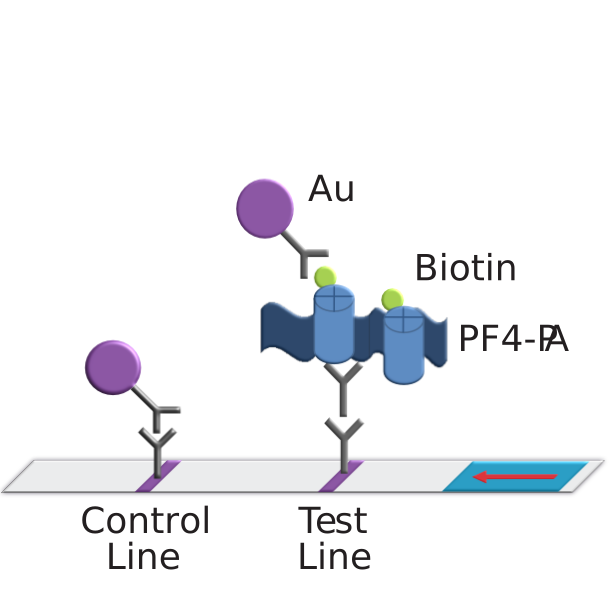
Lateral Flow Assay designed for the detection of IgG antibodies against PF4/polyanion-complexes in human citrated plasma or Serum
This product is only available in Germany!
Method/Platform
lateral flow, immunoassay
Range/Assay Sensivity
Test Principle
IgG antibodies are resposible for the heparin induced thrombocytopenia.
Immobilized anti-human IgG on the membrane of the test unit binds patients IgG-antibodies which are previously captured by the PF4/polyanion-complex which is detected by intensely colored gold nanoparticles.
The presence of PF4/polyanion-complex becomes visible at a colored test line. The surplus of gold particles continues to migrate through the membrane and is captured at the control line by specific antibodies.
Document
0 tests Lateral Flow Assay designed for the detection of IgG antibodies against PF4/polyanion-complexes in human citrated plasma or Serum


 VolumeCup