Propargyl-PEG8-t-butyl ester is a PEG reagent with an alkyne group and a t-butyl group. The alkyne group enables the formation of triazole linkage with azide-bearing compounds or biomolecules; copper is required as a catalyst. The t-butyl group can be hydrolyzed under acidic conditions. The hydrophicility of the molecule is improved by having 8 units of PEG. Reagent grade, for research purpose. Please contact us for GMP-grade inquiries.
Detail
Propargyl-PEG8-t-butyl ester is a PEG reagent with an alkyne group and a t-butyl group. The alkyne group enables the formation of triazole linkage with azide-bearing compounds or biomolecules; copper is required as a catalyst. The t-butyl group can be hydrolyzed under acidic conditions. The hydrophicility of the molecule is improved by having 8 units of PEG. Reagent grade, for research purpose. Please contact us for GMP-grade inquiries.
Preservation and isolation of both cf-DNA and cf-RNA from a single tube
Fixative-free preservative, no cross-linking of DNA
Preserve cf-DNA/ct-DNA for 30 days at ambient temperature and for up to 8 days at 37°C
Preserve cf-RNA for 30 days at ambient temperature
Preserve Circulating Tumour Cells (CTCs) for 14 days at ambient temperature
No plasma volume loss after shipping/transportation
Prevent hemolysis allowing better separation of plasma
Prevent apoptosis of blood cells and fragmentation of genomic DNA
Produce high quality/quantity of plasma cf-DNA/ct-DNA/cf-RNA
Vacuumed to draw 8.7 mL of blood in 10 mL tubes
The procedure for plasma isolation using this kit is compliant with ISO 20186-3:2019
Norgen’s cf-DNA/cf-RNA Preservative Tubes are closed, evacuated plastic tubes for the collection and the preservation of cf-DNA, circulating tumor DNA, cf-RNA and circulating tumor cells in human whole blood samples during storage and shipping. Using these tubes in combination with Norgen’s Plasma/Serum Cell-Free Circulating DNA Purification Kits or Norgen’s Plasma/Serum RNA Purification Kits enables the purification and concentration of an inhibitor-free cf-DNA/ct-DNA/cf-RNA in a very small elution volume. Plasma recovered from Norgen’s cf-DNA/cf-RNA Preservative Tubes is also compatible with any other cf-DNA and/or cf-RNA purification method. The purified cf-DNA, ct-DNA and cf-RNA are compatible with any downstream application assays, including PCR, qPCR, rt-qPCR, methylation-sensitive PCR, Southern Blot analysis, gene expression analysis, microarrays and NGS.
This product is for research use only and not for use in diagnostic procedures.
Performance
Norgen’s cf-DNA/cf-RNA Preservative Tubes abridge the collection/processing of whole blood for the subsequent purification of cf-DNA and/or cf-RNA. The cf-DNA/cf-RNA Preservative Tubes preserve and inhibit the programmed cell-death (apoptosis) of the blood, hence preventing the release of intracellular DNA/RNA into plasma. Whole blood samples can be shipped and stored at room temperature for the subsequent processing of plasma. The cf/ct DNA and cf-RNA levels are stable for up to 30 days at room temperature. The cf-DNA is also stable for up to 8 days at 37°C. When blood collected on Norgen’s cf-DNA/cf-RNA tubes is processed for plasma recovery no buffy coat will be generated and the Circulating tumor cells (CTCs) will be located at the bottom of the tube with the blood sediment. CTCs are stable for 14 days at room temperature where it can be extracted from the blood sediment or from whole preserved blood for cell sorting or for cf/DNA or cf-RNA purification.
Plasma samples produced from the whole blood sample collected into Norgen’s cf-DNA/cf-RNA Preservative Tubes and purified using Norgen’s Plasma/Serum Cell-Free Circulating DNA Purification Kits or Norgen’s Plasma/Serum RNA Purification Kits yield concentrated, high-quality and inhibitor-free cf-DNA/ct-DNA or cf-RNA for any downstream application.
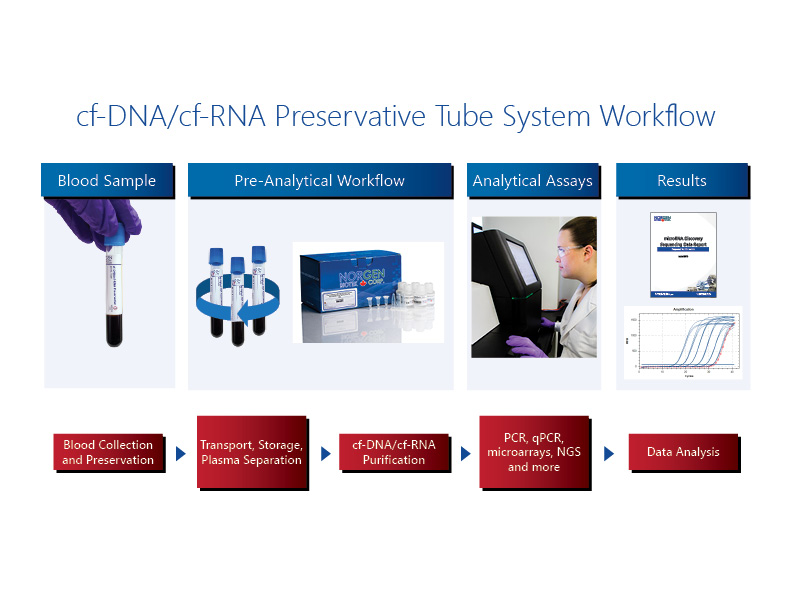
Workflow
NOTE: This product is for research use only. For the CE marked version, see Cat. Dx63950
Up to 30 days at room temperature (15-25°C) Up to 8 days at 37°C
Length of cf-RNA Preservation
Up to 30 days at room temperature (15-25°C)
Length of CTCs Preservation
Up to 14 days at room temperature (15-25°C)
Storage Conditions and Product Stability
When stored at 15-30°C, unfilled Norgen cf-DNA/cf-RNA Preservative Tubes are stable through the expiration date. See tube label for expiry date.
Short-term storage/shipping at -20°C to 37°C for up to 10 days is acceptable for unfilled Norgen cf-DNA/cf-RNA Preservative Tubes.
Do not freeze unfilled Norgen cf-DNA/cf-RNA Preservative Tubes for long term storage over 10 days. Freezing unfilled tubes may lead to loss of vacuum and precipitation may occur.
Cell-free DNA in blood samples collected in Norgen’s cf-DNA/cf-RNA Preservative Tubes is stable for up to 30 days when stored at room temperature (15-25°C)
Cell-free DNA in blood samples collected in Norgen’s cf-DNA/cf-RNA Preservative Tubes is stable for up to 8 days when stored at 37ºC.
Cell-free RNA in blood samples collected in Norgen’s cf-DNA/cf-RNA Preservative Tubes is stable for up to 30 days when stored at room temperature (15-25°C)
Circulating tumor cells (CTCs) in blood samples collected in Norgen’s cf-DNA/cf-RNA Preservative Tubes are stable for up to 14 days at room temperature (15-25ºC).
The Hepatitis B virus (HBV) is mainly transmitted via blood or blood products. In addition, sexual, oral and perinatal infections are also possible. Early symptoms of the infection include appetite loss, vomiting and abdominal symptoms, with approximately 10-20% of those patients developing fever as well as rheumatoid joint and muscle pain. Jaundice, which may be accompanied by itching, will then develop within 2-14 days. Fulminant hepatitis then occurs in about 1% of all infected patients, which in severe cases may be fatal. Of those individuals infected by HBV, 5-10% will develop chronic liver inflammation which may progress to cirrhosis of the liver or, in the worst case, primary liver cell carcinoma. The HBV virus is a hepadnavirus that has a circular genome composed of partially double-stranded DNA.
HBV TaqMan PCR Kit, 100 reactions
Ready to use format, including Master Mix for the target and PCR control to monitor for PCR inhibition and validate the quality
Specific Primer and Probe mix for the pathogen/virus/viroid of interest
Primer and Probe mix
Positive and negative control to confirm the integrity of the kit reagents
HBV TaqMan PCR Probe/Primer Set and Controls, 100 reactions
Specific Primer/Probe mix and Positive Control for the pathogen/virus/viroid of interest
Nuclease-free water
Can be used together with Norgen’s PCR Master Mix (#28007) or customer supplied master mix
For research use only and NOT intended for in vitro diagnostics.
Storage Conditions and Product Stability All kit components can be stored for 2 years after the date of production without showing any reduction in performance.
All kit components should be stored at -20°C upon arrival.