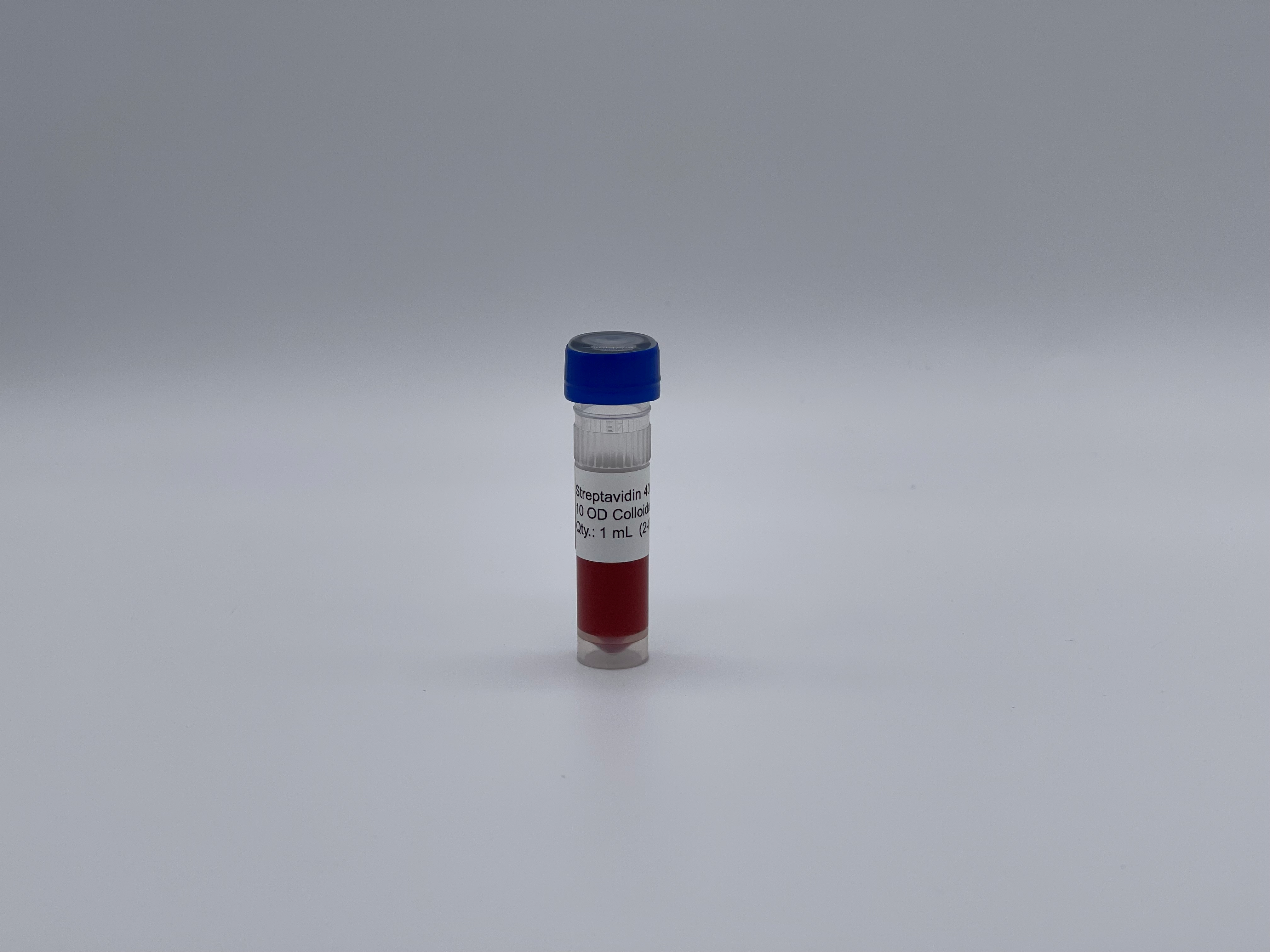
Functionally tested Protein A conjugated gold Perfect for Lateral Flow Development and use in final product 40nm gold particles conjugated to Protein A are offered in 10 OD 1mL size. If a different OD or amount is required please
Product image shows functional testing of Protein A 40nm colloidal gold on a lateral flow test. Protein A 40nm colloidal gold was incubated in lateral flow running buffer alone or in the presence of a limiting amount of monoclonal antibody that targets the chemical-BSA conjugate. The gold was then applied to the sample port of a cassette containing a lateral flow strip sprayed with a chemical conjugate (Chemical-BSA) on the test line and a goat anti mouse antibody as the control line. The data demonstrates the specificity and robustness of the Protein A 40nm colloidal gold.
Our products are produced in a state-of-the-art manufacturing facility that enable rapid turnaround times while ensuring batch to batch consistency and reliability.
Other Products
96-Well Low Elution Ring Magnetic Plate with Integrated Cushion Base
Product Info
Document
Product Info
Designed for those labs wishing to separate magnetic beads into rings.
The Permagen ring magnet low elution plate with integrated cushion base plate was designed for use in automation applications where volumes as low as 5 µL are required. Most PCR plates are bent, leading to inconsistent lab results. Unlike most products, we have added an angled frame around the top of our plate, this helps with two things, straightening out the PCR plate, and leading it to the proper location on the magnets during automation while the cushion assist compensates for labware inconsistencies.
SBS SLAS Footprint (127.75mm x 85.50mm) to fit into any automated liquid handling robot
Features include solid aluminum alloy construction and hard coat anodized finish for years of trouble-free use, and compatible with any magnetic beads
Designed for those labs wishing to separate magnetic beads into rings.
The Permagen ring magnet low elution plate with integrated cushion base plate was designed for use in automation applications where volumes as low as 5 µL are required. Most PCR plates are bent, leading to inconsistent lab results. Unlike most products, we have added an angled frame around the top of our plate, this helps with two things, straightening out the PCR plate, and leading it to the proper location on the magnets during automation while the cushion assist compensates for labware inconsistencies.
Short term stability: 2-8oC, Long term stability: See individual component labels
Stability:
> 2 years under recommended storage conditions
Analyte:
Phosphate
Assay Format:
Spectrophotometer, Auto-analyser
Detection Method:
Absorbance
Wavelength (nm):
360
Signal Response:
Increase
Linear Range:
0.1 to 10 μg of phosphate per assay
Limit of Detection:
0.16 mg/L
Reaction Time (min):
~ 20 min
Application examples:
Processed foods and drinks, bakery products, dairy products, waste water samples, cosmetics, pharmaceuticals and other materials (e.g. biological cultures, etc.).
The Phosphate Assay Kit is a rapid, simple, reliable and accurate method for the specific measurement and analysis of phosphate in water, foodstuffs, beverages and other materials. The phosphate detection reaction employs the defined chemical substrate 2-amino-6-mercapto-7-methylpurine ribonucleoside (MESG). In the presence of phosphate, the substrate is converted enzymatically by purine nucleoside phosphorylase (PNPase) to the products ribose 1-phosphate and 2-amino-6-mercapto-7-methylpurine. An application note describes the dephosphorylation reaction of phytic acid using phytase and alkaline phosphatase (sold separately), and subsequent phosphate detection using the reagents provided in K-PHOS.
This method is suitable for analysis using spectrophotometer and auto-analyser.
Note for Content: The number of manual tests per kit can be doubled if all volumes are halved.
Need other products? See our complete list of assay kits.
Advantages
Chemically defined detection method
All reagents stable for > 2 years after preparation
Rapid reaction (~ 20 min)
Mega-Calc™ software tool is available from our website for hassle-free raw data processing
Standard included
Suitable for manual and auto-analyser formats
Document
The Phosphate Assay Kit is a rapid, simple, reliable and accurate method for the specific measurement and analysis of phosphate in water, foodstuffs, beverages and other materials. The phosphate detection reaction employs the defined chemical substrate 2-amino-6-mercapto-7-methylpurine ribonucleoside (MESG). In the presence of phosphate, the substrate is converted enzymatically by purine nucleoside phosphorylase (PNPase) to the products ribose 1-phosphate and 2-amino-6-mercapto-7-methylpurine. An application note describes the dephosphorylation reaction of phytic acid using phytase and alkaline phosphatase (sold separately), and subsequent phosphate detection using the reagents provided in K-PHOS.
PEG13-bis(Amino-Tri-(Propargyl-PEG2-ethoxymethyl)-methane) is large molecule with two sets of three terminal alkynes joined together by a large PEG linker. The alkynes are most frequently used in copper click chemistry with azides. The PEG linkers as well as numerous amide bonds provide high aqueous solubility to this compound, which may alter ADME of this compound.
Document
PEG13-bis(Amino-Tri-(Propargyl-PEG2-ethoxymethyl)-methane) is large molecule with two sets of three terminal alkynes joined together by a large PEG linker. The alkynes are most frequently used in copper click chemistry with azides. The PEG linkers as well as numerous amide bonds provide high aqueous solubility to this compound, which may alter ADME of this compound.