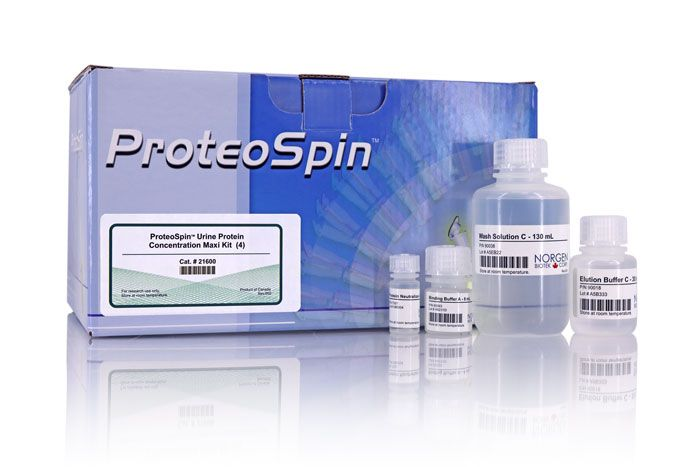
Rapid and simple procedure to generate digested peptides
Simultaneous digestion, purification and concentration at once
Peptide generation is complete, with no generation of additional artifacts being detected in mass spectrometry
Peptides are ready for applications such as mass spectrometry and SDS-PAGE
Purification is based on spin column chromatography that uses Norgen’s resin separation matrix
This kit is highly efficient in the enzymatic digestion of simple and complex protein samples using trypsin and the subsequent purification of the resulting peptides using a convenient spin column format. Trypsin is added to the protein sample and bound to the column. Salts are washed away and the trypsin is then activated to digest proteins. Peptides are then eluted in a small volume and ready for downstream analysis. The peptides generated are complete, with no additional artifacts being detected in mass spectrometry. Fifteen micrograms of protein can be processed, digested and purified with each spin column with about 20 minutes of hands-on time (plus trypsin incubation). The simultaneous protein digestion and volumetric concentration of the purified peptides makes the kit a convenient method for preparing peptides to be analyzed by many downstream applications such as mass spectrometry and more.
Storage Conditions All solutions should be kept tightly sealed and stored at room temperature. Once opened, the solution should be stored at 4°C. This kit is stable for 2 years after the date of shipment.
Component
Cat. 17500 (25 preps)
Wash Solution C
30 mL
Binding Buffer A
4 mL
Column Activation Buffer
3 mL
Micro Spin Columns
25
Collection Tubes
25
Elution tubes (1.7 mL)
25
Product Insert
1
Other Products
N-(Propargyl-PEG2)-PEG3-t-butyl ester
Product Info
Document
Product Info
N-(Propargyl-PEG2)-PEG3-t-butyl ester is a branched PEG linker with an alkyne group and a t-butyl ester. The alkyne group reacts with azide-bearing compound in coppper catalyzed azide-alkyne Click Chemistry reaction. The amino group is reactive with carboxylic acids, activated NHS esters, and carbonyls. Reagent grade, for research purpose. Please contact us for GMP-grade inquiries.
Document
N-(Propargyl-PEG2)-PEG3-t-butyl ester is a branched PEG linker with an alkyne group and a t-butyl ester. The alkyne group reacts with azide-bearing compound in coppper catalyzed azide-alkyne Click Chemistry reaction. The amino group is reactive with carboxylic acids, activated NHS esters, and carbonyls. Reagent grade, for research purpose. Please contact us for GMP-grade inquiries.
1.System optimization and adaptation:MIRA reagents have undergone a series of screenings of the entire system, types and concentrations of cofactors, and multiple optimizations of the production freeze-drying process. Based on the mastery of the components and processes, we can make adjustments according to customer needs to suit them methodology or project. 2.Diversified product forms:For example, we can provide reagents in different systems and forms (dry powder/microsphere/liquid), etc., to achieve personalized customized services according to customer needs. 3.Industrial application support: It has a 4,000-square-meter factory building to support customer projects in entrusting freeze-drying production and industrial application of the project.
Document
MIRA VS RPA,MIRA Advantages:
1.System optimization and adaptation:MIRA reagents have undergone a series of screenings of the entire system, types and concentrations of cofactors, and multiple optimizations of the production freeze-drying process. Based on the mastery of the components and processes, we can make adjustments according to customer needs to suit them methodology or project. 2.Diversified product forms:For example, we can provide reagents in different systems and forms (dry powder/microsphere/liquid), etc., to achieve personalized customized services according to customer needs. 3.Industrial application support: It has a 4,000-square-meter factory building to support customer projects in entrusting freeze-drying production and industrial application of the project.
Magnetic bead nucleic acid purification technology uses nano or micron superparamagnetic material as the matrix, generally black ferric oxide or yellowish brown ferricoxide as the magnetic material. The surface of bead is coated with appropriate functional groups, which can adsorb nucleic acid. Magnetic beads commonly used for nucleic acids, containing carboxyl groups, hydroxyl groups, or silicon groups. Silicon-based magnetic beads are the most common, and its principle of adsorbing nucleic acid is consistent with the classical glass milk purification technology or glass fiber filter membrane purification method. Magpure particle is a kind of polydisperse fast speed silica magnetic beads. The core is ferricoxide, accounting for 50%, and the surface coating is silica, accounting for 50%. The product can be used for plasmid extraction, gel DNA recovery, product purification, genomic DNA and RNA extraction, and viral nucleic acid extraction.
Details
Specifications
Features
Specifications
Concentration
70 mg/ml
Appearance
Suspension of yellowish brown particles
Surface functional group
Si-OH, Silanol
Dispersibility
Polydisperse Amorphous
Particle size
0.2-2 μm
Preservation conditions
Room Temperature, valid for up to 2 years.It is recommended to store in 2-8°C to prevent microbial growth.
Magnetic response speed
~60 seconds
Settling velocity
>10 minutes
High salt mediated binding
>2M guanidine isothiocyanate, DNA recovery up to 80%
Alcohol mediated binding
2M guanidine hydrochloride / isopropanol (30%), and the recovery of DNA / RNA was as high as 85%
PEG8000 mediated binding
The recovery of DNA/RNA was up to 85%
DNase/RNase
Not detected
DNA residue
<1 ppm
Recommended application
Plasmid extraction, gel DNA recovery, viral nucleic acid isolation
Principle
Highsalt mediated binding: in the solution containing 2-4M guanidine isothiocyanate, Magpure particles can selectively recover DNA molecules, and impurities such as protein polysaccharides are not adsorbed.
Alcohol mediated binding: in the solution containing guanidine salt and alcohol (>25%), Magpure particles can selectively recover DNA/RNA molecules, and proteins and other impurities are not adsorbed.
After biological samples are treated with digestive solution or lysis Buffer, DNA/RNA is released from cells, organelles and protein complexes (ribosomes and nucleosomes) into reagents. After Magpure particles and binding solution are added, DNA/RNA is adsorbed to the surface of Magpure particles to form DNA/RNA bead complex. Under the action of the magnetic field, the magnetic beads are separated and collected, and the impurities such as protein are removed with the waste liquid. After two or three steps of further cleaning, the DNA/RNA magnetic bead complex is resuspended in sterilized water or TE buffer, and the DNA/RNA falls off from the surface of the magnetic beads, so as to achieve the purpose of purification.
gDNA/RNA Isolation from Blood, Tissue, Plant, Swab, Spots, Stool, Soil and etc.Viral DNA/RNA IsolationAgarose Gel DNA Purification
DNA/RNA Isolation from low nucleic acid content samplesPlasmid IsolationDNA/RNA Clean Up
Circulating DNA IsolationViral Nucleic acid IsolationgDNA Isolation FFPE DNA/RNA Isolation
Plasmid extractiongel DNA recoverygenomicDNA/RNA extraction viral nucleic acid extractionCirculating DNA extraction
DNA/RNA Clean Up and concentrationDNA/RNA Isolation from low nucleic acid content samplesResearch immuno assays
The MagPure magnetic-particle technology combines the speed and efficiency of silica-based DNA purification with the convenient handling of magnetic particles. DNA binds to the silica surface of the magnetic particles in the presence of a chaotropic salt. DNA bound to the particles is then efficiently washed, considerably improving the purity of DNA. High-quality DNA is eluted. The automated purification procedure completely removes enzymes, nucleotides, and other contaminants and inhibitors. Purified DNA is suitable for direct use in downstream applications, such as sequencing and microarray analysis.
Document
Magnetic bead nucleic acid purification technology uses nano or micron superparamagnetic material as the matrix, generally black ferric oxide or yellowish brown ferricoxide as the magnetic material. The surface of bead is coated with appropriate functional groups, which can adsorb nucleic acid. Magnetic beads commonly used for nucleic acids, containing carboxyl groups, hydroxyl groups, or silicon groups. Silicon-based magnetic beads are the most common, and its principle of adsorbing nucleic acid is consistent with the classical glass milk purification technology or glass fiber filter membrane purification method. Magpure particle is a kind of polydisperse fast speed silica magnetic beads. The core is ferricoxide, accounting for 50%, and the surface coating is silica, accounting for 50%. The product can be used for plasmid extraction, gel DNA recovery, product purification, genomic DNA and RNA extraction, and viral nucleic acid extraction.