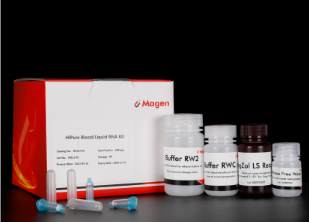
The HiPure Liquid RNA & miRNA Kit integrates phenol/guanidine-based sample lysis and silica membrane purification of total RNA. MagZol LS Reagent, included in the kits, is a monophasic solution of phenol and guanidine thiocyanate designed to facilitate lysis of liquid sample and inhibit RNase. The high lysis efficiency of the reagent and the subsequent removal of contaminants by organic phase extraction enable the use of up to 0.25ml liquid sample per mini spin column.
Detail
Introduction
The HiPure Liquid RNA & miRNA Kit integrates phenol/guanidine-based sample lysis and silica membrane purification of total RNA. MagZol LS Reagent, included in the kits, is a monophasic solution of phenol and guanidine thiocyanate designed to facilitate lysis of liquid sample and inhibit RNase. The high lysis efficiency of the reagent and the subsequent removal of contaminants by organic phase extraction enable the use of up to 0.25ml liquid sample per mini spin column.
Details
Specifications
Features
Specifications
Main Functions
Isolation total RNA from 0.25ml body fluids using column and MagZol LS reagent
Applications
qPCR / RT-PCR, liquid or solid-phasechip analysis, hybridization and SNP detection
0.25ml liquid samples are homogenized in 0.75ml MagZol LS Reagent. After addition of chloroform, the homogenate is separated into aqueous and organic phases by centrifugation. The upper, aqueous phase is extracted, and ethanol is added to provide appropriate binding conditions. The sample is then applied to the spin column, where the total RNA (up to 100 µg) binds to the membrane and phenol and other contaminants are efficiently washed away. High-quality RNA is then eluted in 30–100µl of RNase-free water.
Advantages
High quality – high purity total RNA can be directly used in various sensitive downstream applications
Fast – isolation of several samples can be completed in 40 minutes by using column purification method
Safety – no phenol chloroform extraction required
Sensitive – direct lysis of blood, plasma and other samples without separation of leukocytes
Kit Contents
Contents
R416302
R416303
Purification Times
50 Preps
250 Preps
HiPure RNA Mini Columns
50
250
2ml Collection Tubes
50
2 x 125
MagZol LS Reagent
60 ml
270 ml
Buffer RWC
20 ml
60 ml
Buffer RW2*
20 ml
2 x 50 ml
RNase Free Water
10 ml
30 ml
Storage and Stability
MagZol LS Reagent should be stored at 2-8°C upon arrival. However, short-term storage (up to 24 weeks) at room temperature (15-25°C) does not affect their performance. The remaining kit components can be stored dry at room temperature (15-25°C) and are stable for at least 18 months under these conditions.
Other Products
D3142 HiPure Soil DNA Kit
Product Info
Document
Product Info
Introduction
Soil samples contain a large number of microorganisms, the vast majority of which can not be directly cultivated for reproduction and research. Extracting DNA from soil samples is the most effective method for studying soil microorganisms. At present, there are mainly direct and indirect methods for extracting microbial DNA from soil samples. The direct method refers to placing soil samples in the lysis solution, and using effective wall breaking methods to release all microbial DNA into the lysis solution, followed by separation and extraction, such as Zhou’s method. Indirect method refers to placing soil in a buffer, such as Buffer PBS, to separate microorganisms from the soil and then extract DNA. The indirect method can greatly reduce the impact of humic acids and heavy metal salts on DNA extraction in soil, but this method will lose many microorganisms and the resulting DNA is not the entire genome (metagenome) of the soil sample. Currently, few researchers have adopted this method. Extracting DNA directly from soil samples can maximize the likelihood of obtaining the entire genome, but this method faces the following issues:
1. Humic acid pollution. The soil, especially in forests and grasslands, is rich in humic acids. Humic acid is a series of organic molecules, some of which are very similar to nucleic acid molecules and difficult to remove during purification. Trace amounts of humic acid pollution can lead to downstream applications such as PCR and enzyme digestion failure.
2. Lysis method. Soil samples contain various microorganisms, such as bacteria and fungi. Gram positive bacteria and fungi both contain very thick bacterial walls, and effectively breaking down the cell walls of these microorganisms is crucial for extracting high-yield metagenomic DNA. Due to the complexity of soil samples, it is not feasible to use enzymatic methods (such as lysozyme, wall breaking enzyme, snail enzyme) or liquid nitrogen grinding, as the soil contains various metalions or inhibitory factors that inactive the digestive enzymes, or the presence of sand particles in the soil makes liquid nitrogen grinding difficult.
3. The DNA yield is difficult to control. Soil samples would have significant changes in the number and variety of microorganisms due to fertility, inferiority, high moisture content, dryness, or depth of sampling. In a small range of soil samples, the DNA content often varies by thousands of times. In addition, certain chemical components in soil, such as heavy metal salts and clay substances, can cause a decrease in DNA yield.
Magen’s HiPure Soil DNA Kits are currently the most optimized kit for soil DNA extraction. The kit adopts glass bead grinding method and thermal shock chemical wall breaking method, which can be carried out in the point vortex instrument without special bead grinding instrument, and is suitable for a wide range of laboratories. The Absorber Solution in the reagent kit is a humic acid adsorbent exclusively developed by Magen Company, which can efficiently remove various humic acid pollutants. In addition, an alcohol-free silica gel column purification method is also used to efficiently remove various soluble metal salts and other soluble inhibitory factors from the soil. The kit has successfully extracted from the following soil (partially based on customer feedback): soil from forests in nature reserves (30 to 40 years old forest soil with a surface layer of 30-50cm deciduous layer), mangrove soil, grasslands, farmland, seabed mud, sludge, mineral area soil, organic matter contaminated soil, pond mud, garbage mud, air conditioning pipeline deposits, etc.
This product allows rapid and reliable isolation of high-quality genomic DNA from various soil samples. Up to 500 mg soil samples can be processed in 60 minute. The system combines the reversible nucleic acid binding properties of HiPure matrix with the speed and versatilityof spin column technology to eliminate PCR inhibiting compounds such as humic acid from soil samples. Purified DNA is suitable for PCR, restriction digestion, and next-generation sequencing. There are no organic extractions thus reducing plastic waste and hands-on time to allow multiple samples to be processed in parallel.
Details
Specifications
Features
Specifications
Main Functions
Isolation DNA from 200-500mg soil sample
Applications
PCR, southern blot and enzyme digestion, etc.
Purification method
Mini spin column
Purification technology
Silica technology
Process method
Manual (centrifugation or vacuum)
Sample type
Soil
Sample amount
200-500mg
Elution volume
≥30μl
Time per run
≤60 minutes
Liquid carrying volume per column
800μl
Binding yield of column
100μg
Principle
Soil sample is homogenized and then treated in a specially formulated buffer containing detergent to lyse bacteria, yeast, and fungal samples. humic acid,proteins, polysaccharides, and other contaminants are removed using our proprietary Absorber Solution. Binding conditions are then adjusted and the sample is applied to a DNA Mini Column. Two rapid wash steps remove trace contaminants and pure DNA is eluted in low ionic strength buffer. Purified DNA can be directly used in downstream applications without the need for further purification.
Advantages
Fast – several samples can be extracted in 40 minutes (after digestion)
High purity – purified DNA can be directly used in various downstream applications
Good repeatability – silica technology can obtain ideal results every time
High recovery – DNA can be recovered at the level of PG
Kit Contents
Contents
D314202
D314203
Purification Times
50 Preps
250 Preps
Hipure DNA Mini Columns II
50
250
2ml Collection Tubes
50
250
2ml Bead Tubes
50
250
Buffer SOL
60 ml
250 ml
Buffer SDS
5 ml
20 ml
Buffer PS
10 ml
50 ml
Absorber Solution
10 ml
50 ml
Buffer GWP
40 ml
220 ml
Buffer DW1
30 ml
150 ml
Buffer GW2*
20 ml
2 x 50 ml
Buffer AE
15 ml
30 ml
Storage and Stability
Absorber Solution should be stored at 2-8°C upon arrival. However, short-term storage (up to 24 weeks) at room temperature (15-25°C) does not affect their performance. The remaining kit components can be stored dry at room temperature (15-25°C) and are stable for at least 18 months under these conditions.
Experiment Data
Document
Soil samples contain a large number of microorganisms, the vast majority of which can not be directly cultivated for reproduction and research. Extracting DNA from soil samples is the most effective method for studying soil microorganisms. At present, there are mainly direct and indirect methods for extracting microbial DNA from soil samples. The direct method refers to placing soil samples in the lysis solution, and using effective wall breaking methods to release all microbial DNA into the lysis solution, followed by separation and extraction, such as Zhou’s method. Indirect method refers to placing soil in a buffer, such as Buffer PBS, to separate microorganisms from the soil and then extract DNA. The indirect method can greatly reduce the impact of humic acids and heavy metal salts on DNA extraction in soil, but this method will lose many microorganisms and the resulting DNA is not the entire genome (metagenome) of the soil sample. Currently, few researchers have adopted this method. Extracting DNA directly from soil samples can maximize the likelihood of obtaining the entire genome, but this method faces the following issues:
The 16S V3-V5 Library Preparation Kit for Illumina consists of the reagents and components required for library preparation of the 16S V3-V4 amplicon libraries to be used for next-generation sequencing on Illumina platforms. All molecular reagents including primers, enzyme mixes, indexes, and buffers are provided. Instructions for PCR clean up with the AMPure XP Magnetic Beads (supplied by customer) are also included for rapid purification of nucleic acid products generated at two steps of the workflow. The library prep workflow could be used for purified DNA inputs from different sources including stool, soil, water, saliva, plant, urine, skin swab, vaginal swab, cheek swab, nasal swab, plasma/serum, tongue swab, gum swab, and others.
The 16S V3-V5 Library Preparation Kit for Illumina has a streamlined procedure that reduces the handling time such that the library prep procedure can be completed in approximately 4 hours (see diagram below). Input DNA is first subjected to targeted PCR to amplify the V3-V4 region of the DNA encoding 16S rRNA. The post-PCR reaction is then cleaned up using AMPure XP beads. Dual index primers are then added using a limited-cycle PCR. The indexed amplicons flanked by 5′ and 3′ barcoded adaptors are then cleaned using AMPure XP beads. The libraries are then ready for quantification, pooling and sequencing.
Storage Conditions and Product Stability Norgen’s 16S V3-V5Library Prep Kit for Illumina is shipped as one kit box (for the 24 prep kit) or two sub-component kits (for the 96 prep kit). All kits should be stored at -20°C upon arrival.
All kit components should remain stable for at least 1 year when stored at the specified storage conditions.