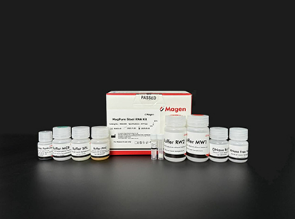
This product is specially designed for stool RNA extraction. The kit is suitable for extracting high-purity microbial or host cell RNA from ≤ 0.15g stool samples. The purified RNA can be directly used in RT-PCR and Northern hybridization.
Detail
Introduction
This product is specially designed for stool RNA extraction. The kit is suitable for extracting high-purity microbial or host cell RNA from ≤ 0.15g stool samples. The purified RNA can be directly used in RT-PCR and Northern hybridization.
Details
Principle
The Kit combines the speed and efficiency of silica-based technology with the convenient handling of magnetic particles for purification of total RNA. Samples are lysed and RNA is purified from lysates in one step through its binding to the silica surface of the particles in the presence of a chaotropic salt. The particles are separated from the lysates using a magnet and DNA is removed by treatment with RNase-free DNase. The magnetic particles are efficiently washed, and RNA is eluted in RNase-free water.
Kit Contents
Contents
R662601
R662602
R662603
Purification Times
48 Preps
96 Preps
5 x 96 Preps
MagPure RNA Particles
1.7 ml
4.0 ml
18 ml
DNase I
600 μl
2 x 600 μl
10 x 600 μl
DNase Buffer
30 ml
40 ml
200 ml
Buffer SPL
30 ml
60 ml
270 ml
Buffer PHC
30 ml
60 ml
270 ml
Buffer MCB*
9 ml
15 ml
75 ml
Buffer ALB3*
10 ml
20 ml
100 ml
Buffer GW1*
44 ml
66 ml
2 x 220 ml
Buffer RW2*
20 ml
50 ml
2 x 100 ml
RNase Free Water
10 ml
30 ml
120 ml
2ml Bead Tubes
48
96
5 x 96
Storage and Stability
MagPure RNA Particles should be stored at 2–8°C upon arrival. DNase I should be stored at -20°C. However, short-term storage (DNase I up to 1 weeks, MagPure RNA Particles up to 8 weeks) at room temperature (15–25°C) does not affect their performance. The remaining kit components can be stored at room temperature (15–25°C) and are stable for at least 18 months under these conditions.
Other Products
Leukocyte RNA Purification Kits
Product Info
Document
Product Info
Overview
Fractionate leukocytes from whole blood in minutes with provided RBC Lysis Buffer
Isolate total RNA, including microRNA, without phenol
Rapid and convenient spin-column format and 96-well plate for high throughput applications
Purified RNA is ready for any downstream application including RT-PCR, qRT-PCR, NGS, arrays and more. Find out more information on Norgen’s NGS services
Purification is based on spin column chromatography that uses Norgen’s proprietary resin separation matrix
These kits provide a rapid method for the isolation and purification of total leukocyte (white blood cell) RNA from mammalian blood samples. These kits are supplied with an RBC (red blood cell) Lysis Buffer for selective removal of red blood cells and fractionation of leukocytes by centrifugation. Isolation of leukocyte RNA results in improved expression profiling and other downstream applications by removing the masking effects of some RNAs which are very abundant in whole blood, such as globin mRNAs. These kits are able to isolate total leukocyte RNA, including both large mRNA and all small RNA species containing microRNA (miRNA) and small silencing RNA (siRNA). The purified RNA is of the highest quality and can be used in a number of downstream applications.
Leukocyte RNA Purification Kit (Spin Column)
This kit provides a rapid method for the isolation and purification of total leukocyte RNA from mammalian blood samples in 40 minutes. Allowable blood input ranges from 10 μL to 2 mL or 3 x 10⁶ Leukocytes
Leukocyte RNA Purification Plus Kit (Plus)
Norgen’s Leukocyte RNA Purification Plus Kit provides a rapid method for the isolation and purification of total leukocyte (white blood cell) RNA from up to 3 mL of mammalian blood samples. Complete 10 purifications in as little as 40 minutes.
Purification is based on 96-well column chromatography using Norgen’s proprietary resin as the separation matrix. Purification can be performed using either a vacuum manifold or centrifugation. Norgen’s kit allows for the isolation of total leukocyte RNA, including all small RNA species. The purified RNA is of the highest quality and can be used in a number of downstream applications including real time PCR, reverse transcription PCR, northern blotting, RNase protection and primer extension, and expression array assays. Allowable blood input ranges from 10 μL to 1 mL or 1.5 x 10⁶ Leukocytes.
All solutions should be kept tightly sealed and stored at room temperature. The RBC Lysis Buffer should be stored at 4°C upon arrival. These reagents should remain stable for at least 1 year in their unopened containers.
Short term stability: 2-8oC, Long term stability: See individual component labels
Stability:
> 2 years under recommended storage conditions
Analyte:
Phosphate
Assay Format:
Spectrophotometer, Auto-analyser
Detection Method:
Absorbance
Wavelength (nm):
360
Signal Response:
Increase
Linear Range:
0.1 to 10 μg of phosphate per assay
Limit of Detection:
0.16 mg/L
Reaction Time (min):
~ 20 min
Application examples:
Processed foods and drinks, bakery products, dairy products, waste water samples, cosmetics, pharmaceuticals and other materials (e.g. biological cultures, etc.).
The Phosphate Assay Kit is a rapid, simple, reliable and accurate method for the specific measurement and analysis of phosphate in water, foodstuffs, beverages and other materials. The phosphate detection reaction employs the defined chemical substrate 2-amino-6-mercapto-7-methylpurine ribonucleoside (MESG). In the presence of phosphate, the substrate is converted enzymatically by purine nucleoside phosphorylase (PNPase) to the products ribose 1-phosphate and 2-amino-6-mercapto-7-methylpurine. An application note describes the dephosphorylation reaction of phytic acid using phytase and alkaline phosphatase (sold separately), and subsequent phosphate detection using the reagents provided in K-PHOS.
This method is suitable for analysis using spectrophotometer and auto-analyser.
Note for Content: The number of manual tests per kit can be doubled if all volumes are halved.
Need other products? See our complete list of assay kits.
Advantages
Chemically defined detection method
All reagents stable for > 2 years after preparation
Rapid reaction (~ 20 min)
Mega-Calc™ software tool is available from our website for hassle-free raw data processing
Standard included
Suitable for manual and auto-analyser formats
Document
The Phosphate Assay Kit is a rapid, simple, reliable and accurate method for the specific measurement and analysis of phosphate in water, foodstuffs, beverages and other materials. The phosphate detection reaction employs the defined chemical substrate 2-amino-6-mercapto-7-methylpurine ribonucleoside (MESG). In the presence of phosphate, the substrate is converted enzymatically by purine nucleoside phosphorylase (PNPase) to the products ribose 1-phosphate and 2-amino-6-mercapto-7-methylpurine. An application note describes the dephosphorylation reaction of phytic acid using phytase and alkaline phosphatase (sold separately), and subsequent phosphate detection using the reagents provided in K-PHOS.
Methylation Specific Bisulfite Seq Library Prep Kit
Product Info
Document
Product Info
Bisulfite seq is a well know technology to detect DNA methylation and several technologies such as WGBS, RRBS, MeDIP-Seq, and MSBS are used for whole genome DNA methylation analysis. DNA methylation is important for regulation of cell development, differentiation and gene expression in molecular biology, genetics and epigenetics. Most methylated cytosines are found at CpG sites, and 70-80% of cytosines are methylated. The number of CpG sites in human genome is around 28 million, which is less than 1% of the genome compared with 4.4% expected.
Whole genome bisulfite sequencing (WGBS) is the most effective method of DNA methylation analysis. The only limitation is the sequencing cost is very high because the whole genome is sequenced including all the non-methylated regions.
Reduced Representation Bisulfite Sequencing (RRBS) is the reduced representation of a smaller fraction of the methylated CpG sites. RRBS combines restriction enzyme digestion and bisulfite sequencing, and enriches the sequencing for methylated CpG sites. It is an efficient technology for estimate the whole genome methylation patterns at the single base level. Although this allows a higher coverage depth and reduces the sequencing cost, the limitation is only 10% of the methylated CpG sites are covered.
Methylated DNA Immunoprecipitation Sequencing (MeDIP-Seq) is another whole genome enrichment technique used for selection of methylated DNA. Using antibodies against 5-methylcytosine, methylated DNA is enriched from whole genomic DNA via immunoprecipitation. 5-methylcytosine antibodies are incubated with fragmented genomic DNA and precipitated, followed by DNA purification and sequencing. There are several drawbacks of MeDIP-Seq: 1. Low resolution (150~200 bp) as opposed to the single base resolution; 2. Non-specific interaction due to antibody specificity and selectivity. 3. Bias towards hypermethylated regions.
The Methylation Specific Bisulfite Seq (MSBS) Library Prep Kit (illumina platform) was developed for construction of NGS libraries for methylated CpG sites using bisulfite treated DNA (20 ng – 500 ng) as input. The kit enriches methylated CpG regions, thus significantly reduce the sequencing cost. The kit estimates the whole genome methylation patterns at the single base level since it is based on a bisulfite-seq technology.
It is known that bisulfite treatment of completed NGS libraries causes tremendous damage to the libraries. By using bisulfite treated DNA as input, the kit overcomes the significant library loss due to the bisulfite conversion. The kit contains a mixture of PCR polymerases that have high-fidelity amplification and uracil tolerance which is ideal for bisulfite treated DNA.
Methylation Specific Bisulfite Seq Library Prep Kit Workflow
Three index types are available for the kit:
Non-index (Cat.# 30101): Libraries do not have index.
Index (Cat.# 30102): Each primer contains a unique barcode sequence of 6 bases to identify the individual library. Library multiplexing capacity is up to 48 samples. Index information can be downloaded here.
Unique dual index (Cat.# 30103): The multiplexing of bisulfite sequencing library is up to 96 samples with unique dual indexes. We used a Four-Base Difference Index System to generate indexes that have at least 4 bases different from each other in the 8-base index. The index primers remove NGS errors including index cross-contamination, index hopping, reads mis-assignment etc. Index information can be downloaded here.
Methylation Specific Bisulfite Seq advantages
Enrichment of methylated CpG sites
Single-base resolution
Low cost for sequencing
Fast
Total time: 1.5 hours
Hands-on time: 10 minutes
Simple workflow
Bisulfite treated DNA as input: From 20 ng to 500 ng
MSBS Library Prep Kit enriches CpG sites
High methylation regions and low methylation regions in human genome.
High methylation region in human genome.
Low methylation region in human genome.
Sequencing setting: Single-end 35 cycles (Read 1, 35 bases) recommended To maximize the methylated CpG enrichment, we recommend to sequence the MSBS libraries with single end 35 cycles (read1, 35 bases). This is because the enriched methylated CpG sites are mainly located around the beginning of read 1 sequences. Shorter single end reads tend to have better methylated CpG enrichment.
Document
Bisulfite seq is a well know technology to detect DNA methylation and several technologies such as WGBS, RRBS, MeDIP-Seq, and MSBS are used for whole genome DNA methylation analysis. DNA methylation is important for regulation of cell development, differentiation and gene expression in molecular biology, genetics and epigenetics. Most methylated cytosines are found at CpG sites, and 70-80% of cytosines are methylated. The number of CpG sites in human genome is around 28 million, which is less than 1% of the genome compared with 4.4% expected.