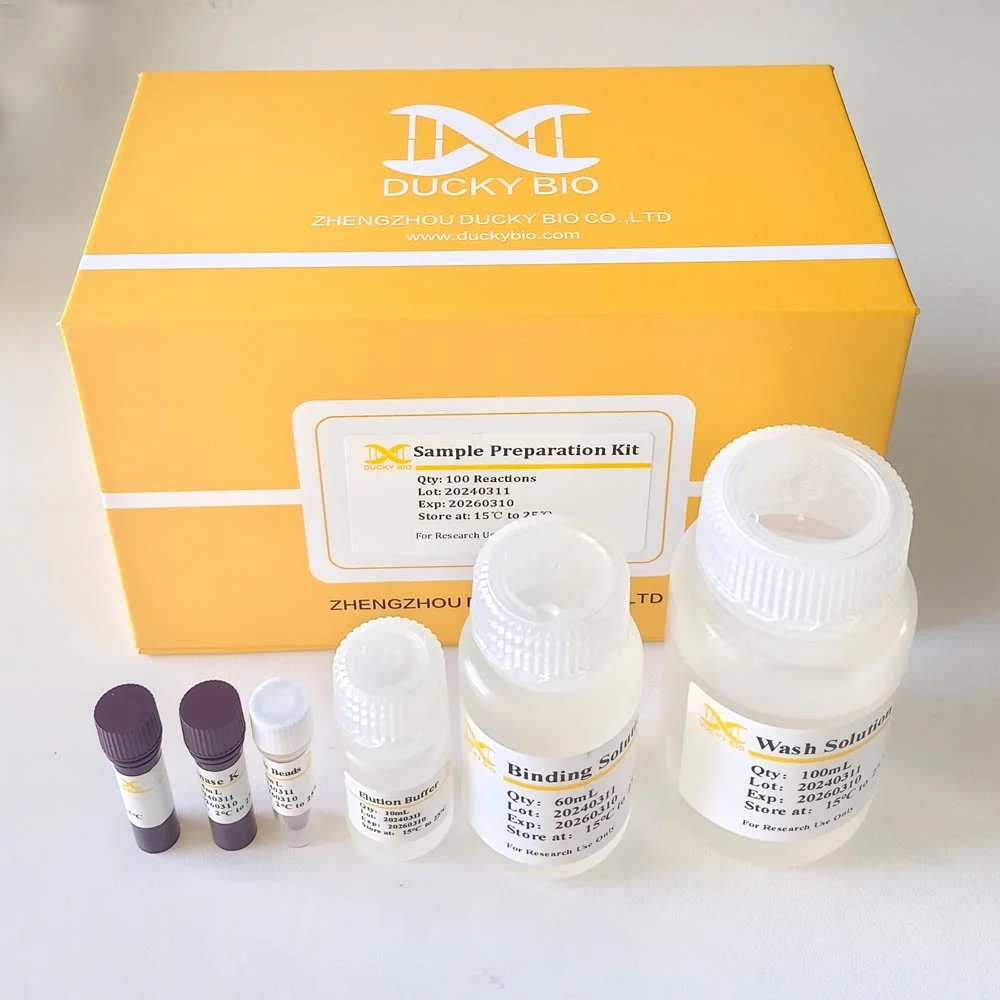
Note: Price not include shipment & duty, contact us to get full quote. The Residual DNA Sample Preparation Kit uses chemical lysis and magnetic beads to extract DNA from diverse sample types, including samples that contain high protein and low DNA concentration. The kit extracts residual genomic DNA from products that are produced in cell lines. The operation is easier and the higher nucleic acid yield is guaranteed at the same time.
Detail
Description
The Residual DNA Sample Preparation Kit uses chemical lysis and magnetic beads to extract DNA from diverse sample types, including samples that contain high protein and low DNA concentration. The kit extracts residual genomic DNA from products that are produced in cell lines such as CHO, E. coli, E1A, HEK293, Vero, NS0 and Baculovirus. For quantification of residual DNA, we recommend using the resDNASEQ Residual DNA Quantitation kit as described in the resDNASEQ Residual DNA Quantitation kit User Guide. To ensure accurate quantitative results, each sample in triplicate and perform a single PCR reaction for each extraction.
Video Player
Features of theresDNASEQ E.coli Residual DNA Quantitation kit include:
Simpler and Rapid
Only three steps will be need for Sample Preparation,and the total time of Sample preparation is about 30 minites.
Good Recovery
The good Recovery rate of Sample Preparation.
Easy to store
All components of the Sample Preparation Kit can be stored at room temperature.
Other Products
cf-DNA/cf-RNA Preservative Tubes
Product Info
Document
Product Info
Overview
Preservation and isolation of both cf-DNA and cf-RNA from a single tube
Fixative-free preservative, no cross-linking of DNA
Preserve cf-DNA/ct-DNA for 30 days at ambient temperature and for up to 8 days at 37°C
Preserve cf-RNA for 30 days at ambient temperature
Preserve Circulating Tumour Cells (CTCs) for 14 days at ambient temperature
No plasma volume loss after shipping/transportation
Prevent hemolysis allowing better separation of plasma
Prevent apoptosis of blood cells and fragmentation of genomic DNA
Produce high quality/quantity of plasma cf-DNA/ct-DNA/cf-RNA
Vacuumed to draw 8.7 mL of blood in 10 mL tubes
The procedure for plasma isolation using this kit is compliant with ISO 20186-3:2019
Norgen’s cf-DNA/cf-RNA Preservative Tubes are closed, evacuated plastic tubes for the collection and the preservation of cf-DNA, circulating tumor DNA, cf-RNA and circulating tumor cells in human whole blood samples during storage and shipping. Using these tubes in combination with Norgen’s Plasma/Serum Cell-Free Circulating DNA Purification Kits or Norgen’s Plasma/Serum RNA Purification Kits enables the purification and concentration of an inhibitor-free cf-DNA/ct-DNA/cf-RNA in a very small elution volume. Plasma recovered from Norgen’s cf-DNA/cf-RNA Preservative Tubes is also compatible with any other cf-DNA and/or cf-RNA purification method. The purified cf-DNA, ct-DNA and cf-RNA are compatible with any downstream application assays, including PCR, qPCR, rt-qPCR, methylation-sensitive PCR, Southern Blot analysis, gene expression analysis, microarrays and NGS.
This product is for research use only and not for use in diagnostic procedures.
Performance
Norgen’s cf-DNA/cf-RNA Preservative Tubes abridge the collection/processing of whole blood for the subsequent purification of cf-DNA and/or cf-RNA. The cf-DNA/cf-RNA Preservative Tubes preserve and inhibit the programmed cell-death (apoptosis) of the blood, hence preventing the release of intracellular DNA/RNA into plasma. Whole blood samples can be shipped and stored at room temperature for the subsequent processing of plasma. The cf/ct DNA and cf-RNA levels are stable for up to 30 days at room temperature. The cf-DNA is also stable for up to 8 days at 37°C. When blood collected on Norgen’s cf-DNA/cf-RNA tubes is processed for plasma recovery no buffy coat will be generated and the Circulating tumor cells (CTCs) will be located at the bottom of the tube with the blood sediment. CTCs are stable for 14 days at room temperature where it can be extracted from the blood sediment or from whole preserved blood for cell sorting or for cf/DNA or cf-RNA purification.
Plasma samples produced from the whole blood sample collected into Norgen’s cf-DNA/cf-RNA Preservative Tubes and purified using Norgen’s Plasma/Serum Cell-Free Circulating DNA Purification Kits or Norgen’s Plasma/Serum RNA Purification Kits yield concentrated, high-quality and inhibitor-free cf-DNA/ct-DNA or cf-RNA for any downstream application.
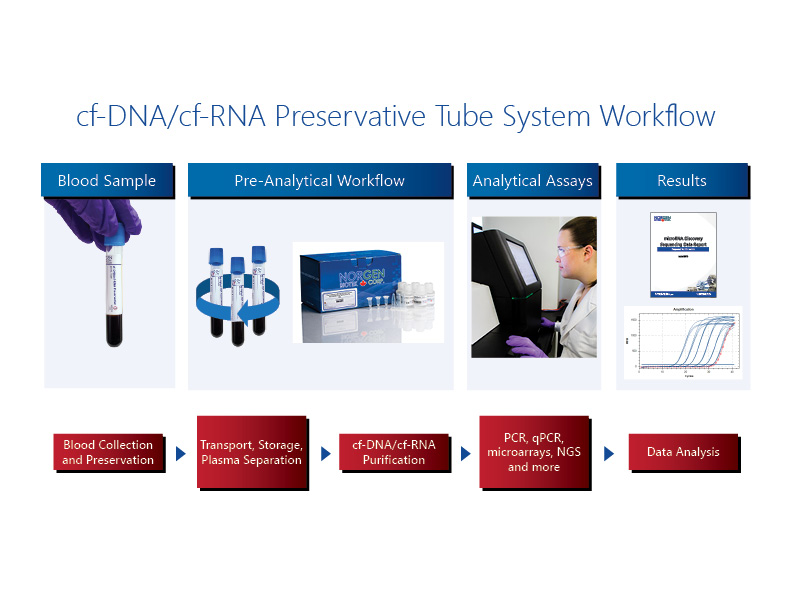
Workflow
NOTE: This product is for research use only. For the CE marked version, see Cat. Dx63950
Up to 30 days at room temperature (15-25°C) Up to 8 days at 37°C
Length of cf-RNA Preservation
Up to 30 days at room temperature (15-25°C)
Length of CTCs Preservation
Up to 14 days at room temperature (15-25°C)
Storage Conditions and Product Stability
When stored at 15-30°C, unfilled Norgen cf-DNA/cf-RNA Preservative Tubes are stable through the expiration date. See tube label for expiry date.
Short-term storage/shipping at -20°C to 37°C for up to 10 days is acceptable for unfilled Norgen cf-DNA/cf-RNA Preservative Tubes.
Do not freeze unfilled Norgen cf-DNA/cf-RNA Preservative Tubes for long term storage over 10 days. Freezing unfilled tubes may lead to loss of vacuum and precipitation may occur.
Cell-free DNA in blood samples collected in Norgen’s cf-DNA/cf-RNA Preservative Tubes is stable for up to 30 days when stored at room temperature (15-25°C)
Cell-free DNA in blood samples collected in Norgen’s cf-DNA/cf-RNA Preservative Tubes is stable for up to 8 days when stored at 37ºC.
Cell-free RNA in blood samples collected in Norgen’s cf-DNA/cf-RNA Preservative Tubes is stable for up to 30 days when stored at room temperature (15-25°C)
Circulating tumor cells (CTCs) in blood samples collected in Norgen’s cf-DNA/cf-RNA Preservative Tubes are stable for up to 14 days at room temperature (15-25ºC).
Transcription Factor E3 (TFE3) is a transcription factor that binds to the MUE3-type E-box sequences involved in TGF-β signalling. Anti-TFE3 staining is the most sensitive and specific indicator of Xp11 translocation renal cell carcinomas. Since alveolar soft part sarcoma (ASPS) is characterized by a specific chromosomal rearrangement resulting in a chimeric transcription factor (ASPSCR1-TFE3), this TFE3 IVD antibody is also a useful diagnostic tool for recognizing ASPS.
The series of DNA Size Selection Kits (Magnetic Beads) were developed for DNA size selection using magnetic beads. A total of 11 kits are available, with different selection ranges spanning from 50 bp to over 10 kb. The kits provide a simple and quick approach for the enrichment of a specific range of DNA fragments. The kit workflow allows double-sided or single-sided size selection for specific size cutoffs.
Gel images of different ranges of size selection. Sheared human genomic DNA was used as input.
.
DNA size selection is a selective capture of DNA fragments of a specific range of size for next-generation sequencing (NGS) library preparations, PCR, ChIP assay, DNA ligations, endonuclease digestions, adapter removal, and other genomics and molecular biology applications. DNA size selection is preferred after NGS library prep in most of the cases. The NGS library preparation is related to the quality of the sequencing data. Precise NGS library size selection can increase sequencing efficiency, improve data quality, and reduce costs.
There are two types of sequencing technologies: short-read sequencing and long-read sequencing. Short-read sequencing uses DNA libraries that contain small insert DNA fragments of similar sizes, usually several hundred base pairs. The sequencing efficiency can be improved if the DNA size selection is in the right range. Cat.# 20104S and 20104L are the best kits for NGS library size selection of illumina paired-end 100 (PE100) sequencing with 100-200 bp library inserts; Cat.# 20105S and 20105L are the best kits for NGS library size selection of illumina paired-end 150 (PE150) sequencing with 150-300 bp library inserts; and Cat.# 20106S and 20106L are the best kits for NGS library size selection of illumina paired-end 300 (PE300) sequencing with 300-600 bp library inserts.
Long-read sequencing uses a large DNA fragment as input and makes very long reads. Usually, library size selection is preferred to remove smaller fragments. Cat.# 20110S and 20110L are the best kits for long-read sequencing size selection with DNA sizes >5 kb, and Cat.# 20111S and 20111L are the best kits for long-read sequencing size selection with DNA sizes >10 kb.
The magnetic beads technology uses paramagnetic particles, also known as SPRI (Solid Phase Reversible Immobilization) beads, to bind DNA reversibly and selectively. DNA fragments can be size-selected and purified by changing the properties of the magnetic beads or SPRI beads. The magnetic beads can easily separate the beads-binding DNA from the contaminants and unwanted components in the samples. The samples after DNA size selection are free of contaminants such as buffer components, enzymes, proteins, salts, dNTPs, primers, and adapters. Our proprietary magnetic beads reagents improve yield, selectivity, and reproducibility.
Specific DNA fragments at a certain length range can be purified simply using magnetic separation with different beads components, avoiding tedious and time-consuming gel extraction and column-based purification. The magnetic beads method is popular for common DNA size selection, including library size selection. The first beads-binding step, referred to as the right-side clean-up, removes large DNA fragments. The large DNA fragments are bound to the beads and are discarded. The desired DNA fragments in the supernatant are transferred to a new well, and new beads are added to the supernatant for the second beads-binding, referred to as the left-side clean-up. The double-size selected DNA fragments are eluted after ethanol rinsing.
DNA size selection with dual clean-ups.
.
A single clean-up is needed for DNA size selection with large fragments. In this case, only the large DNA fragments are bound to the beads. The selected larger DNA fragments are eluted after ethanol rinsing.
DNA size selection with single clean-up for >5 kb and >10 kb DNA.
.
Features of DNA size selection and library size selection
High specificity and high recovery of size selection
11 selection ranges are available, including 5 ranges for NGS library size selection
50-100 bp
100-200 bp
200-500 bp
250-350 bp: ideal for illumina PE100 sequencing
300-450 bp: ideal for illumina PE150 sequencing
450-750 bp: ideal for illumina PE300 sequencing
500-1000 bp
1-3 kb
1-5 kb
>5 kb: ideal for long-read sequencing
>10 kb: ideal for long-read sequencing
Fast and simple
20-min protocol
No gel purification required
No columns required
No centrifugation required
Efficient removal of contaminants and unwanted components