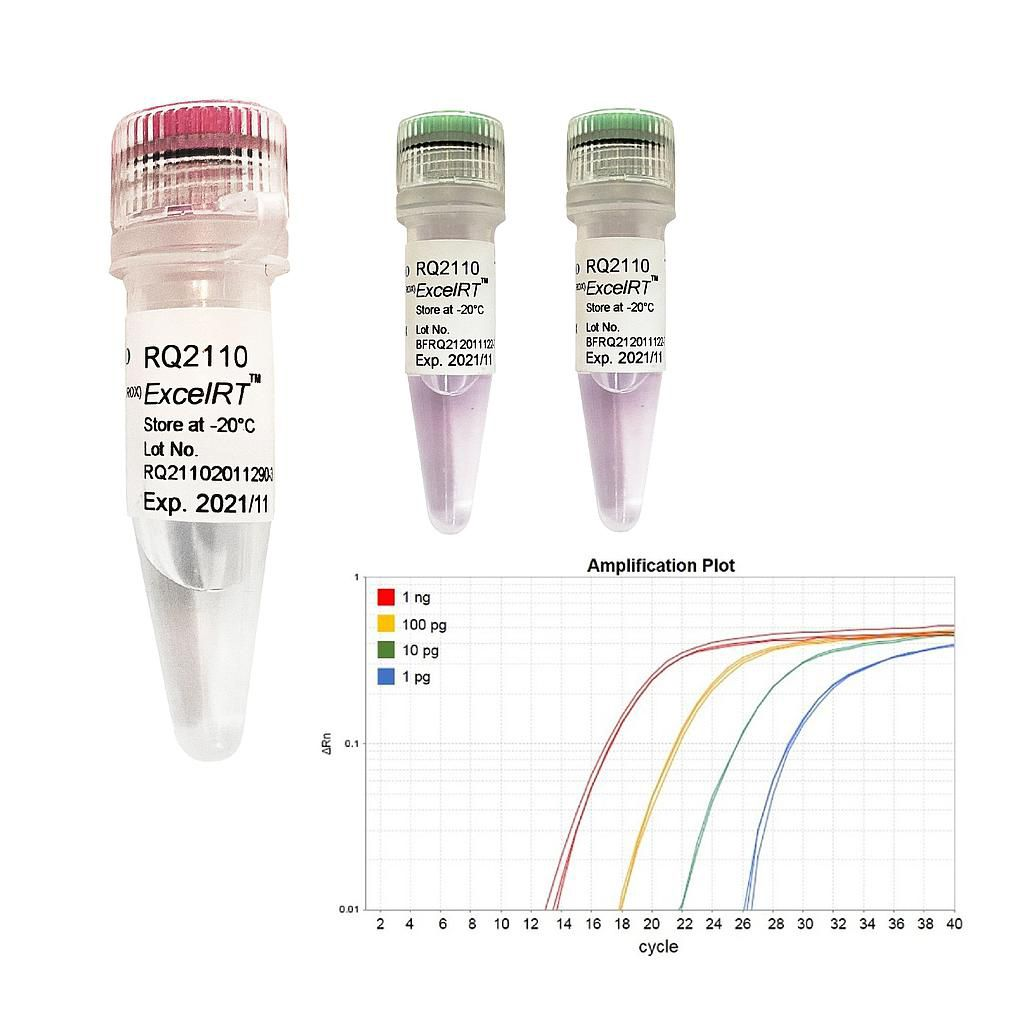
The ExcelRT™ One-Step RT-qPCR kit (TaqMan, ROX) is designed for reverse transcription and quantitative real-time analysis of a specific target RNA by one-step reaction. The ExcelRT™ One-Step RT-qPCR kit (TaqMan, ROX), consisting of One-Step RT Enzyme Mix and 2X One-Step Master Mix, is a convenient kit designed for highly efficient cDNA synthesis and highly specific real-time PCR in a single tube. The One-Step RT Enzyme Mix contains a thermostable ExcelRT™ Reverse Transcriptase and a RNAok™ RNase inhibitor. Consequently, One-Step RT Enzyme Mix can reverse transcribe RNA to cDNA at a wide temperature range from 42 to 60°C and active against RNase A, RNase B and RNase C. By containing specialized hot-start Taq DNA polymerase, which greatly reduce primer-dimer formation and can be activated within 2 minutes, the 2X One-Step Master Mix features high specificity and is suitable for fast cycle program. This master mix includes ROX reference dye for normalization of each RT-qPCR assay.
Detail
Description
The ExcelRT™ One-Step RT-qPCR kit (TaqMan, ROX) is designed for reverse transcription and quantitative real-time analysis of a specific target RNA by one-step reaction. The ExcelRT™ One-Step RT-qPCR kit (TaqMan, ROX), consisting of One-Step RT Enzyme Mix and 2X One-Step Master Mix, is a convenient kit designed for highly efficient cDNA synthesis and highly specific real-time PCR in a single tube. The One-Step RT Enzyme Mix contains a thermostable ExcelRT™ Reverse Transcriptase and a RNAok™ RNase inhibitor. Consequently, One-Step RT Enzyme Mix can reverse transcribe RNA to cDNA at a wide temperature range from 42 to 60°C and active against RNase A, RNase B and RNase C. By containing specialized hot-start Taq DNA polymerase, which greatly reduce primer-dimer formation and can be activated within 2 minutes, the 2X One-Step Master Mix features high specificity and is suitable for fast cycle program. This master mix includes ROX reference dye for normalization of each RT-qPCR assay.
Features
Reverse transcription at wide temperature range (42-60°C)
High specificity
Suitable for fast cycle program
With ROX reference dye
Storage
Aliquot to avoid multiple freeze-thaw cycles (stable within 30 freeze-thaw cycles)
Protect from light
-20°C for 12 months
Other Products
IVD3018 HiPure Universal DNA Kit
Product Info
Document
Product Info
Introduction
This product is suitable for rapid extraction of total DNA from tissue, cells, blood, saliva, swabs, blood spots, semen and other clinical samples. DNA can be used directly for PCR, quantitative PCR, Southern Blot, test of virus DNA and so on.
Details
Specifications
Features
Specifications
Main Functions
Isolation total DNA from tissue / blood / body fluid / swab /dry blood spots
Applications
PCR, qPCR, southern bolt and virus detection, etc.
Purification method
Mini spin column
Purification technology
Silica technology
Process method
Manual (centrifugation or vacuum)
Sample type
Tissue, cell, blood, saliva, swab, blood spot, semen and other clinical samples
This product is based on silica Column purification. The sample is lysed and digested with lysate and protease, DNA is released into the lysate. Transfer to an adsorption column. Nucleic acid is adsorbed on the membrane, while protein is not adsorbed and is removed with filtration. After washing proteins and other impurities, nucleic acid was finally eluted with low-salt buffer (10mm Tris, pH9.0, 0.5mm EDTA).
Advantages
High quality DNA – meet a variety of downstream applications, including PCR, qPCR, enzyme digestion, hybridization, etc.
Fast – without separation of leukocytes, organic extraction or ethanol precipitation
Simple – all nucleic acids can be obtained by direct digestion
Wide applicability – It can handle various liquid samples, animal tissues and cultured cells
Kit Contents
Contents
IVD3018
Purification Times
100
HiPure DNA Mini Columns I
100
2ml Collection Tubes
2 x 100
Buffer ATL
60 ml
Buffer AL
60 ml
Buffer GW1
44 ml
Buffer GW2
50 ml
Proteinase K
60 mg
Protease Dissolve Buffer
5 ml
Buffer AE
15 ml
Storage and Stability
Proteinase K should be stored at 2–8°C upon arrival. However, short-term storage (up to 12 weeks) at room temperature (15–25°C) does not affect their performance. The remaining kit components can be stored at room temperature (15–25°C) and are stable for at least 18 months under these conditions. The entire kit can be stored at 2–8°C, but in this case buffers should be redissolved before use. Make sure that all buffers are at room temperature when used.
Experiment Data
Document
This product is suitable for rapid extraction of total DNA from tissue, cells, blood, saliva, swabs, blood spots, semen and other clinical samples. DNA can be used directly for PCR, quantitative PCR, Southern Blot, test of virus DNA and so on.
The SMO-HiFi™ DNA Polymerase is a new genetically modified, recombinant DNA polymerase with fidelity 70 times higher than Taq DNA polymerase during amplification, as well as very high elongation rate. Being highly thermostable, SMO-HiFi™ DNA Polymerase can remain viable even after being subjected to boiling for 2 minutes. The SMO-HiFi™ DNA Polymerase is also designed to operate in much lower Mg2+ concentration as compared to other DNA polymerase products.
Features
5’→3′ DNA polymerase activity
3’→5′ exonuclease (proofreading) activity
High reaction rate (up to 1 kb/10 seconds)
High fidelity, 70 times higher than Taq DNA polymerase
Blunt end amplicons
Thermo-stable: half-life is more than 10 hrs at 95°C
Storage
[TF1000] SMO-HiFi™ DNA Polymerase
-20°C for 24 months
Document
The SMO-HiFi™ DNA Polymerase is a new genetically modified, recombinant DNA polymerase with fidelity 70 times higher than Taq DNA polymerase during amplification, as well as very high elongation rate. Being highly thermostable, SMO-HiFi™ DNA Polymerase can remain viable even after being subjected to boiling for 2 minutes. The SMO-HiFi™ DNA Polymerase is also designed to operate in much lower Mg2+ concentration as compared to other DNA polymerase products.
Gel images of different ranges of library size selection. Sheared human genomic DNA was used as input.
.
Library size selection is an enrichment of a specific range of library sizes for NGS library preparations. The NGS library preparation is related to the quality of the sequencing data. Precise NGS library size selection can increase sequencing efficiency, improve data quality, and reduce costs.
There are two types of sequencing technologies: short-read sequencing and long-read sequencing. Short-read sequencing uses DNA libraries that contain small insert DNA fragments of similar sizes, usually several hundred base pairs. The sequencing efficiency can be improved if the DNA size selection is in the right range. Cat.# 20104S and 20104L are the best kits for NGS library size selection of illumina paired-end 100 (PE100) sequencing with 100-200 bp library inserts; Cat.# 20105S and 20105L are the best kits for NGS library size selection of illumina paired-end 150 (PE150) sequencing with 150-300 bp library inserts; and Cat.# 20106S and 20106L are the best kits for NGS library size selection of illumina paired-end 300 (PE300) sequencing with 300-600 bp library inserts.
Long-read sequencing uses a large DNA fragment as input and makes very long reads. Usually, library size selection is preferred to remove smaller fragments. Cat.# 20110S and 20110L are the best kits for long-read sequencing size selection with DNA sizes >5 kb, and Cat.# 20111S and 20111L are the best kits for long-read sequencing size selection with DNA sizes >10 kb.
The magnetic beads, or SPRI (Solid Phase Reversible Immobilization) beads, is well used for the purification of DNA due to their reversible DNA binding. The NGS library can be size-selected by the magnetic beads or SPRI beads. The properties of the magnetic beads can be changed for a specific range of DNA binding. The contaminants and other unwanted components in the libraries can also be removed during size selection.
Specific ranges of NGS libraries can be selected using magnetic beads with different buffer compositions. The first DNA-beads binding step, also called the right-side clean-up, removes large NGS library fragments. The large NGS library fragments that bind to the beads are discarded with the beads pellet. The desired NGS library fragments in the supernatant are transferred to a new well, and new beads are added to the supernatant for the second beads-DNA binding, also called the left-side clean-up. After the rinsing step, the NGS library fragments with the dual selection are eluted in water or an appropriate buffer. The magnetic beads method has great advantages over time-consuming column purification and tedious gel-based purification.
NGS library size selection with dual clean-ups.
.
Library size selection for long-read sequencing only requires a single clean-up. In this case, only the large library fragments are bound to the beads, while other small library fragments are discarded with the supernatant. The selected larger library fragments are eluted in water or an appropriate buffer after the rinsing step.
NGS library size selection with single clean-up for >5 kb and >10 kb libraries.