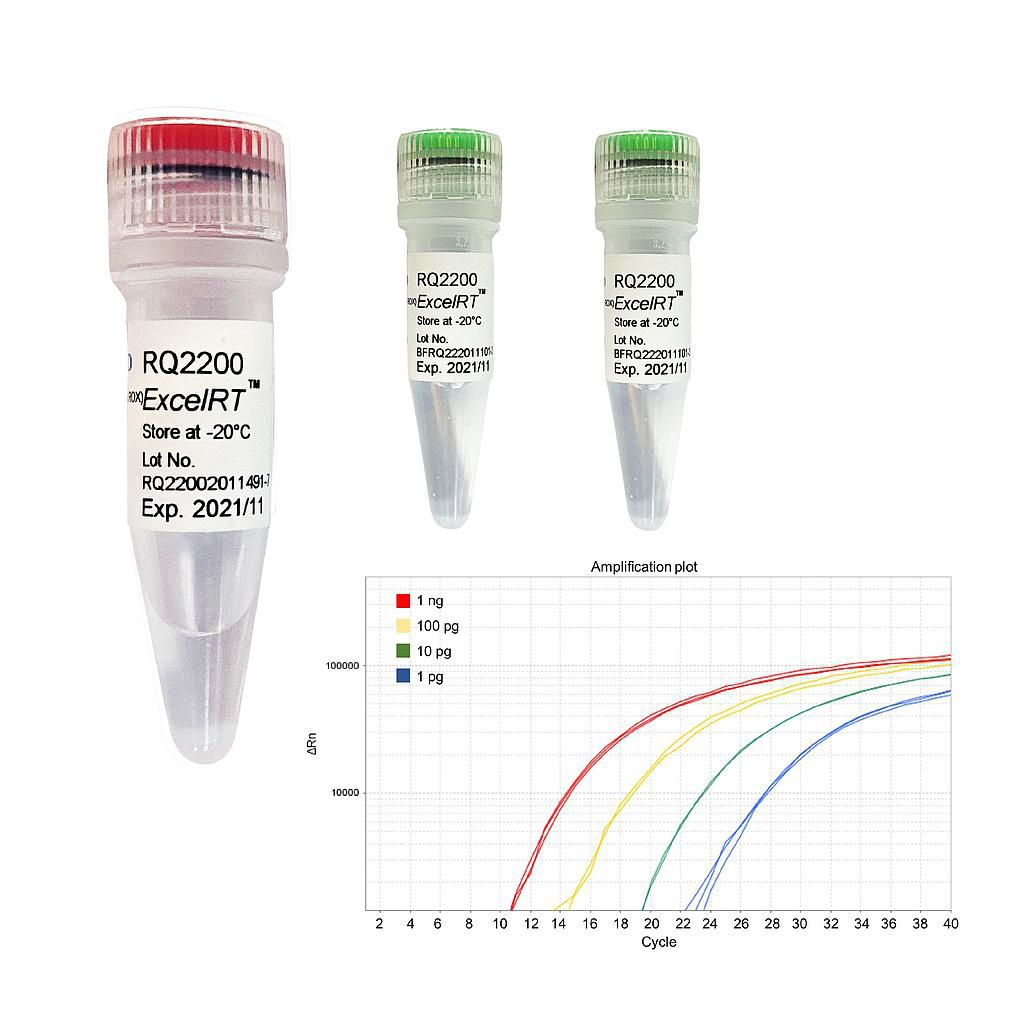
[RQ2200] ExcelRT™ One-Step RT-qPCR Kit (TaqMan, no ROX), 200 RXN
Facebook
X
Pinterest
Email
The ExcelRT™ One-Step RT-qPCR kit (TaqMan, no ROX) is designed for reverse transcription and quantitative real-time analysis of a specific target RNA by one-step reaction. The ExcelRT™ One-Step RT-qPCR kit (TaqMan, no ROX), consisting of One-Step RT Enzyme Mix and 2X One-Step Master Mix, is a convenient kit designed for highly efficient cDNA synthesis and highly specific real-time PCR in a single tube. The One-Step RT Enzyme Mix contains a thermostable ExcelRT™ Reverse Transcriptase and a RNAok™ RNase inhibitor. Consequently, One-Step RT Enzyme Mix can reverse transcribe RNA to cDNA at a wide temperature range from 42 to 60°C and active against RNase A, RNase B and RNase C. By containing specialized hot-start Taq DNA polymerase, which greatly reduce primer-dimer formation and can be activated within 2 minutes, the 2X One-Step Master Mix features high specificity and is suitable for fast cycle program.
Detail
Description
The ExcelRT™ One-Step RT-qPCR kit (TaqMan, no ROX) is designed for reverse transcription and quantitative real-time analysis of a specific target RNA by one-step reaction. The ExcelRT™ One-Step RT-qPCR kit (TaqMan, no ROX), consisting of One-Step RT Enzyme Mix and 2X One-Step Master Mix, is a convenient kit designed for highly efficient cDNA synthesis and highly specific real-time PCR in a single tube. The One-Step RT Enzyme Mix contains a thermostable ExcelRT™ Reverse Transcriptase and a RNAok™ RNase inhibitor. Consequently, One-Step RT Enzyme Mix can reverse transcribe RNA to cDNA at a wide temperature range from 42 to 60°C and active against RNase A, RNase B and RNase C. By containing specialized hot-start Taq DNA polymerase, which greatly reduce primer-dimer formation and can be activated within 2 minutes, the 2X One-Step Master Mix features high specificity and is suitable for fast cycle program.
Features
Reverse transcription at wide temperature range (42-60°C)
High specificity
Suitable for fast cycle program
With no ROX reference dye
Storage
Aliquot to avoid multiple freeze-thaw cycles (stable within 30 freeze-thaw cycles)
Protect from light
-20°C for 12 months
Other Products
ChIP-Seq Library Prep Kit (illumina and MGI Platforms)
Product Info
Document
Product Info
The ChIP-Seq Library Prep Kit (illumina and MGI Platform) was developed for the construction of high quality ChIP-Seq libraries using 5 ng to 400 ng of ChIP DNA as input. The kit is compatible with ChIP DNA fragments generated from both enzymatic methods and physical methods (sonication, nebulization etc.).
ChIP-Seq Library Prep Kit Workflow
ChIP-Seq is the combination of chromatin immunoprecipitation (ChIP) with next generation sequencing. It is a powerful tool for the analysis of global transcription factors and other proteins in diseases and biological pathways, and characterization of histone modifications in a genome-wide level at single-base resolution. ChIP-Seq delivers whole genome level of functional profiling of global transcription factors, and provides better understanding of epigenetic modifications.
Three index types are available for the ChIP-Seq Library Prep Kit of the illumina platform:
Non-index (Cat.# 30032): Libraries do not have index.
Index (Cat.# 30034): Each index primer contains a unique 6-base index sequence can be used for identification. 48 samples can be pooled together. Index information can be downloaded here.
Unique dual index (Cat.# 30036): The ChIP-Seq library multiplexing for 96 samples is possible. Our unique 4-Base Difference Index System have 8 bases index length and at least 4 bases are different from each other for better library identification. Our unique dual indexing primers remove sequencing errors such as index hopping, index contamination, mis-assignment, and other errors. Index information can be downloaded here.
Indexes are available for the MGI platform kits (Cat.# 34034).
Kit advantages:
Super fast protocol
Library prep can be done in 1.5 hours
The hands-on time is only around 10 minutes
Easy procedure
Ready-to-use master mix simplified the procedure
Less reaction components make it easy to setup reactions
Reduced more than half of the beads cost
Input ChIP DNA: From 5 ng to 400 ng
Comparison of library conversion efficiency under the same condition. Input DNA amounts are 5 ng and 30 ng. BioDynami ChIP-Seq Library Prep Kit (Cat.# 30034) was used.
Comparison of aligned reads, aligned rate and duplication rate. Input DNA amounts are 5 ng and 30 ng. BioDynami ChIP-Seq Library Prep Kit (Cat.# 30034) was used.
Data comparison: Input DNA amounts are 5 ng and 30 ng. BioDynami ChIP-Seq Library Prep Kit (Cat.# 30034) was used. Sequencing peak regions are shown.
Document
The ChIP-Seq Library Prep Kit (illumina and MGI Platform) was developed for the construction of high quality ChIP-Seq libraries using 5 ng to 400 ng of ChIP DNA as input. The kit is compatible with ChIP DNA fragments generated from both enzymatic methods and physical methods (sonication, nebulization etc.).
These kits provide a fast, reliable and convenient method to purify and concentrate high quality, high purity and inhibitor-free cell-free circulating and exosomal RNA using a convenient spin column method. These kits can purify RNA from fresh or frozen serum or plasma samples prepared from blood collected on either EDTA or Citrate. Plasma samples prepared from blood collected on heparin should not be used, as heparin can significantly interfere with many downstream applications such as RT-PCR. The purified plasma/serum RNA is fully compatible with all downstream applications including PCR, qPCR, methylation-sensitive reverse transcription qPCR, reverse transcription PCR, Northern blotting, RNase protection and primer extension, expression array assays, and NGS. The EXTRAClean columns undergo stringent processing and rigorous quality control measures to minimize contamination traces, ensuring optimal results for sensitive applications such as NGS.
Background
Cell-free circulating RNA, including exosomal RNA in plasma or serum, has the potential to provide biomarkers for certain cancers and disease states, and includes tumor-specific extracellular RNA in the blood. Exosomes are 40 – 100 nm membrane vesicles, which are secreted by most cell types. Exosomes can be found in saliva, blood, urine, amniotic fluid and malignant ascitic fluids, among other biological fluids. Evidence has been accumulating recently that these vesicles act as cellular messengers, conveying information to distant cells and tissues within the body. The exosomes contain cell-specific proteins, lipids and RNAs, which are transported to other cells, where they can alter function and/or physiology. These exosomes may play a functional role in mediating adaptive immune responses to infectious agents and tumours, tissue repair, neural communication and transfer of pathogenic proteins. Recent work has demonstrated the presence of distinct subsets of microRNAs within exosomes which depend upon the tumour cell type from which they are secreted. For this reason, exosomal RNAs may serve as biomarkers for various diseases including cancer. As the RNA molecules encapsulated within exosomes are protected from degradation by RNAses, they can be efficiently recovered from biological fluids, such as plasma or serum.
EXTRAClean Plasma/Serum RNA Purification Mini Kit
This kit can purify RNA from fresh or frozen serum or plasma samples prepared from blood collected on either EDTA or Citrate, from volumes ranging from 50 μL to 200 μL. The purified plasma/serum RNA is eluted in a flexible final volume of 10 μL to 25 μL.
EXTRAClean Plasma/Serum RNA Purification Midi Kit
This utilizes a two-column method, and can purify RNA from fresh or frozen serum or plasma samples prepared from blood collected on either EDTA or Citrate, from volumes ranging from 250 μL to 1.5 mL. The first column will handle the large volume input of bodily fluids that is followed by a concentration on a mini column for a final elution of 50 μL to 100 μL.
EXTRAClean Plasma/Serum RNA Purification Maxi Kit
This kit can purify RNA from fresh or frozen serum or plasma samples prepared from blood collected on either EDTA or Citrate, from volumes ranging from 2 mL to 5 mL. The first column will handle the large volume input of bodily fluids that is followed by a concentration on a mini column for a final elution of 50 μL to 100 μL.
All sizes, including miRNA and small RNA (<200 nt)
Average Yields¥
Variable depending on specimen
† This kit is suitable for the isolation of RNA from fresh or frozen serum or plasma prepared from blood collected on either EDTA or Citrate. Plasma samples prepared from blood collected on heparin should not be used as heparin can significantly interfere with many downstream applications such as RT-PCR
¥ Please check page 6 for Average Plasma/Serum Yields and Common RNA Quantification Methods
Storage Conditions and Product Stability All solutions should be kept tightly sealed and stored at room temperature. This kit is stable for 2 years after the date of shipment. It is recommended to warm Lysis Buffer A for 20 minutes at 60°C if any salt precipitation is observed.