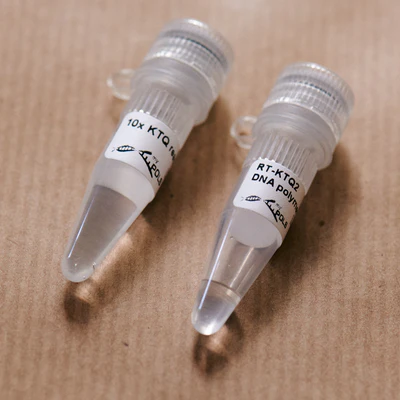
RNA into DNA and PCR in one step? Then, this enzyme will simplify PCR analysis from RNA templates reducing labor and time. RT-KTQ2 was evolved from the thermostable KlenTaq DNA polymerase with no significant reverse transcriptase activity. Four mutations ensure that the variant is reverse transcriptase active and even PCR active, while maintaining the thermostability. This allows to perform reactions at high temperatures minimizing problems encountered with strong secondary structures in RNA that melt at elevated temperatures. For further information refer to the original publication.
Detail
RNA into DNA and PCR in one step? Then, this enzyme will simplify PCR analysis from RNA templates reducing labor and time. RT-KTQ2 was evolved from the thermostable KlenTaq DNA polymerase with no significant reverse transcriptase activity. Four mutations ensure that the variant is reverse transcriptase active and even PCR active, while maintaining the thermostability. This allows to perform reactions at high temperatures minimizing problems encountered with strong secondary structures in RNA that melt at elevated temperatures. For further information refer to the original publication.
Available upon request and for R&D use only – Contact Us
RT-KTQ2 DNA polymerase is supplied as a 5 µM solution containing glycerol and is supplied together with 10x reaction buffer.
The enzyme can also be used for real-time cycling, when adding a suitable dye.
Other Products
12927 MagPure Circulating DNA Rich Maxi Kit
Product Info
Document
Product Info
Introduction
This kit is designed to rich and extract 100bp-500bp circulating DNA from 5 ml cell-free body fluids (such asplasma, serum), and remove fragments above 500bp. Machine reaction only takes 90 minutes. Magnetic-particle technology provides high-quality DNA that is suitable for direct use in downstream applications such as PCR and next generation sequencing.
Details
Specifications
Features
Specifications
Main Functions
Isolation circulating DNA from 5ml plasma, serum, body fluids
Applications
qPCR, NGS, etc.
Purification technology
Magnetic beads technology
Process method
Manual (centrifugation or vacuum)
Sample type
Serum, plasma
Sample amount
5ml
Elution volume
≥40μl
Time per run
≤50 minutes
Principle
This product is based on the purification method of high binding magnetic particles. The sample is lysed and digested under the action of lysate and Protease. DNA is released into the lysate. After adding magnetic particles and binding solution, DNA will be adsorbed on the surface of magnetic particles, and impurities such as proteins will be removed without adsorption. The adsorbed particles were washed with washing solution to remove proteins and impurities, washed with ethanol to remove salts, and finally DNA was eluted by elution buffer.
Advantages
Economy – less than 50% of the price of Qiagen and other imported products
Automatic – without labour
Kit Contents
Contents
1292750
12927200
Purification Times
50
200
MagPure Particles G
20 ml
80 ml
MagBind Particles (selection particles)
14 ml
58 ml
Selection Solution
100 ml
400 ml
Proteinase K
300 mg
1.2 g
Protease Dissolve Buffer
25 ml
100 ml
Buffer SDS(20%)
15 ml
60 ml
Buffer MLK
300 ml
3 x 450 ml
Buffer BST1
225 ml
2x 450 ml
Buffer MKW1
225 ml
2x 450 ml
Buffer MW2*
50 ml
2x 100 ml
Buffer AE
10 ml
30 ml
Storage and Stability
MagPure Particles G, MagBind Particles and Proteinase K should bestored at 2–8°C upon arrival. However, short-term storage (up to 12 weeks) at room temperature (15–25°C) does not affect their performance. The remaining kit components can be stored dry at roomtemperature (15–25°C) and are stable for at least 18 months underthese conditions.The entire kit can be stored at 2–8°C, but in this case buffers should be redissolved before use. Make sure that all buffers are at room temperature when used.
Document
This kit is designed to rich and extract 100bp-500bp circulating DNA from 5 ml cell-free body fluids (such asplasma, serum), and remove fragments above 500bp. Machine reaction only takes 90 minutes. Magnetic-particle technology provides high-quality DNA that is suitable for direct use in downstream applications such as PCR and next generation sequencing.
[PM5200] ExcelBand™ 3-color Pre-Stained Protein Ladder, Broad Range (3.5-245 kDa), 250 μl x 2
Product Info
Document
Product Info
Description
The PM5200 3-color Pre-Stained Protein Ladder Broad Range is a ready-to-use three-color protein standard with 15 pre-stained proteins covering a wide range of molecular weights from 5 to 245 kDa in Tris-Glycine Buffer (3.5 to 235 kDa in Bis-Tris (MOPS) buffer and Bis-Tris (MES) buffer). Proteins are covalently coupled with different chromophores for easy identification of bands, with three reference proteins carrying enhanced intensity corresponding to a blue band at 20 kDa, green at 40 kDa, and red at 75 kDa, respectively, as separated on SDS-PAGE (Tris-Glycine buffer). The PM5200 3-color Pre-Stained Protein Ladder Broad Range is designed for monitoring protein separation during SDS-polyacrylamide gel electrophoresis, verification of Western transfer efficiency on membranes (PVDF, nylon, or nitrocellulose) and for approximating the size of proteins.
Features
Ready-to-use — Premixed with a loading buffer for direct loading, no need to boil.
Three reference bands — 75 kDa (red), 40 kDa (green), and 20 kDa (blue)
Contents
Approximately 0.1~0.4 mg/ml of each protein in the buffer (20 mM Tris-phosphate (pH 7.5 at 25°C), 2% SDS, 0.2 mM DTT, 3.6 M urea, and 15% (v/v) glycerol).
Quality Control
Under suggested conditions, PM5200 ExcelBand™ 3-color Pre-Stained Protein Ladder Broad Range resolves 15 major bands in SDS-PAGE (Tris-Glycine, MOPS, and MES buffer) and after Western blotting to nitrocellulose membrane.
Storage
4°C for 3 months -20°C for long term storage
Document
The PM5200 3-color Pre-Stained Protein Ladder Broad Range is a ready-to-use three-color protein standard with 15 pre-stained proteins covering a wide range of molecular weights from 5 to 245 kDa in Tris-Glycine Buffer (3.5 to 235 kDa in Bis-Tris (MOPS) buffer and Bis-Tris (MES) buffer). Proteins are covalently coupled with different chromophores for easy identification of bands, with three reference proteins carrying enhanced intensity corresponding to a blue band at 20 kDa, green at 40 kDa, and red at 75 kDa, respectively, as separated on SDS-PAGE (Tris-Glycine buffer). The PM5200 3-color Pre-Stained Protein Ladder Broad Range is designed for monitoring protein separation during SDS-polyacrylamide gel electrophoresis, verification of Western transfer efficiency on membranes (PVDF, nylon, or nitrocellulose) and for approximating the size of proteins.