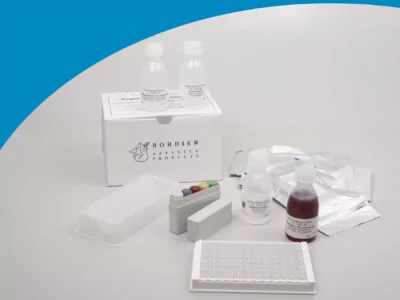
12 x 8 strips (96 tests) This ELISA kit is intended for the quantitative detection of IgG antibodies against Schistosoma mansoni and Schistosoma haematobium in human serum.
Detail
Name of Product
Schistosoma mansoni – IgG ELISA
Catalog Number
AF 9600
Short Info
This ELISA kit is intended for the quantitative detection of IgG antibodies against Schistosoma mansoni and Schistosoma haematobium in human serum.
This product is manufactured by Bordier Affinity Products in Switzerland and distributed in Germany exclusively by Milenia Biotec.
Method/Platform
ELISA in microplate format
Range/Assay Sensivity
pNPP, λ=405 nm
Test Principle
Specific antibodies in the sample will bind to Schistosoma mansoni antigens sensitized on microtiter plates. The presence of parasite specific antibodies is detected with a Protein A alkaline phosphatase conjugate.
The CellG3 assay reagent for the measurement of endo-cellulase (endo-1,4-β-glucanase) contains two components; 1) 4,6-O-benzylidene-2-chloro-4-nitrophenyl-β-D-cellotrioside (BCNPG3) and 2) thermostable β-glucosidase. The benzylidene blocking group prevents any hydrolytic action by the β-glucosidase on BCNPG3. Incubation with an endo-cellulase generates a non-blocked colourimetric oligosaccharide that is rapidly hydrolysed by the ancillary β-glucosidase. The rate of formation of 2-chloro-4-nitrophenol is therefore directly related to the hydrolysis of BCNPG3 by the endo-cellulase. The reaction is terminated and the phenolate colour is developed on addition of Tris buffer solution (pH 9.0).
Please note that a new assay kit (K-CellG5) is now available for the measurement of endo-cellulase. The CellG5 reagent contains a cellopentaose core and exhibits vastly improved sensitivity for some cellulases. In addition, the exchange of the benzylidene blocking group in CellG3 for 3-keto-butylidene in CellG5 improves the substrate’s water solubility significantly, allowing for a reduction in the concentration of DMSO required in the assay. As DMSO is known to inhibit certain cellulases, this is another benefit in using CellG5. Megazyme now recommends the use of K-CellG5 for all assays for the measurement of endo-cellulase.
The CellG3 assay reagent for the measurement of endo-cellulase (endo-1,4-β-glucanase) contains two components; 1) 4,6-O-benzylidene-2-chloro-4-nitrophenyl-β-D-cellotrioside (BCNPG3) and 2) thermostable β-glucosidase. The benzylidene blocking group prevents any hydrolytic action by the β-glucosidase on BCNPG3. Incubation with an endo-cellulase generates a non-blocked colourimetric oligosaccharide that is rapidly hydrolysed by the ancillary β-glucosidase. The rate of formation of 2-chloro-4-nitrophenol is therefore directly related to the hydrolysis of BCNPG3 by the endo-cellulase. The reaction is terminated and the phenolate colour is developed on addition of Tris buffer solution (pH 9.0).
Cluster of differentiation 57 (CD57), also known as NK-1, is an antigen detectable in natural killer cells, some T-lymphocytes and normal peripheral blood mononuclear cells, myeloid cells, and a variety of polypeptides, lipids, and chondroitin sulfate proteoglycans. CD57 is indicated as a marker for tumors of neuroendocrine origin, including pheochromocytomas, paragangliomas, carcinoid tumor, and medulloblastomas, as well as various neural tumors including neuromas, neurofibromas, schwannomas, and granular cell tumors. CD57 is also detectable in ganglioneuroma and prostate carcinoma. Anti-CD57 is used to distinguish nodular lymphocyte-predominant Hodgkin’s lymphoma from T-cell/histiocyte-rich large B-cell lymphoma, nodular sclerosis Hodgkin’s disease, and follicular lymphoma.
The 16S V1-V2 Library Preparation Kit for Illumina consists of the reagents and components required for library preparation of the 16S V1-V2 amplicon libraries to be used for next-generation sequencing on Illumina platforms. All molecular reagents including primers, enzyme mixes, indexes, and buffers are provided. Instructions for PCR clean up with the AMPure XP Magnetic Beads (supplied by customer) are also included for rapid purification of nucleic acid products generated at two steps of the workflow. The library prep workflow could be used for purified DNA inputs from different sources including stool, soil, water, saliva, plant, urine, skin swab, vaginal swab, cheek swab, nasal swab, plasma/serum, tongue swab, gum swab, and others.
The 16S V1-V2 Library Preparation Kit for Illumina has a streamlined procedure that reduces the handling time such that the library prep procedure can be completed in approximately 4 hours (see diagram below). Input DNA is first subjected to targeted PCR to amplify the V1-V2 region of the DNA encoding 16S rRNA. The post-PCR reaction is then cleaned up using AMPure XP beads. Dual index primers are then added using a limited-cycle PCR. The indexed amplicons flanked by 5′ and 3′ barcoded adaptors are then cleaned using AMPure XP beads. The libraries are then ready for quantification, pooling and sequencing.
Storage Conditions and Product Stability Norgen’s 16S V1-V2 Library Prep Kit for Illumina is shipped as one kit box (for the 24 prep kit) or two sub-component kits (for the 96 prep kit). All kits should be stored at -20°C upon arrival.
All kit components should remain stable for at least 1 year when stored at the specified storage conditions.