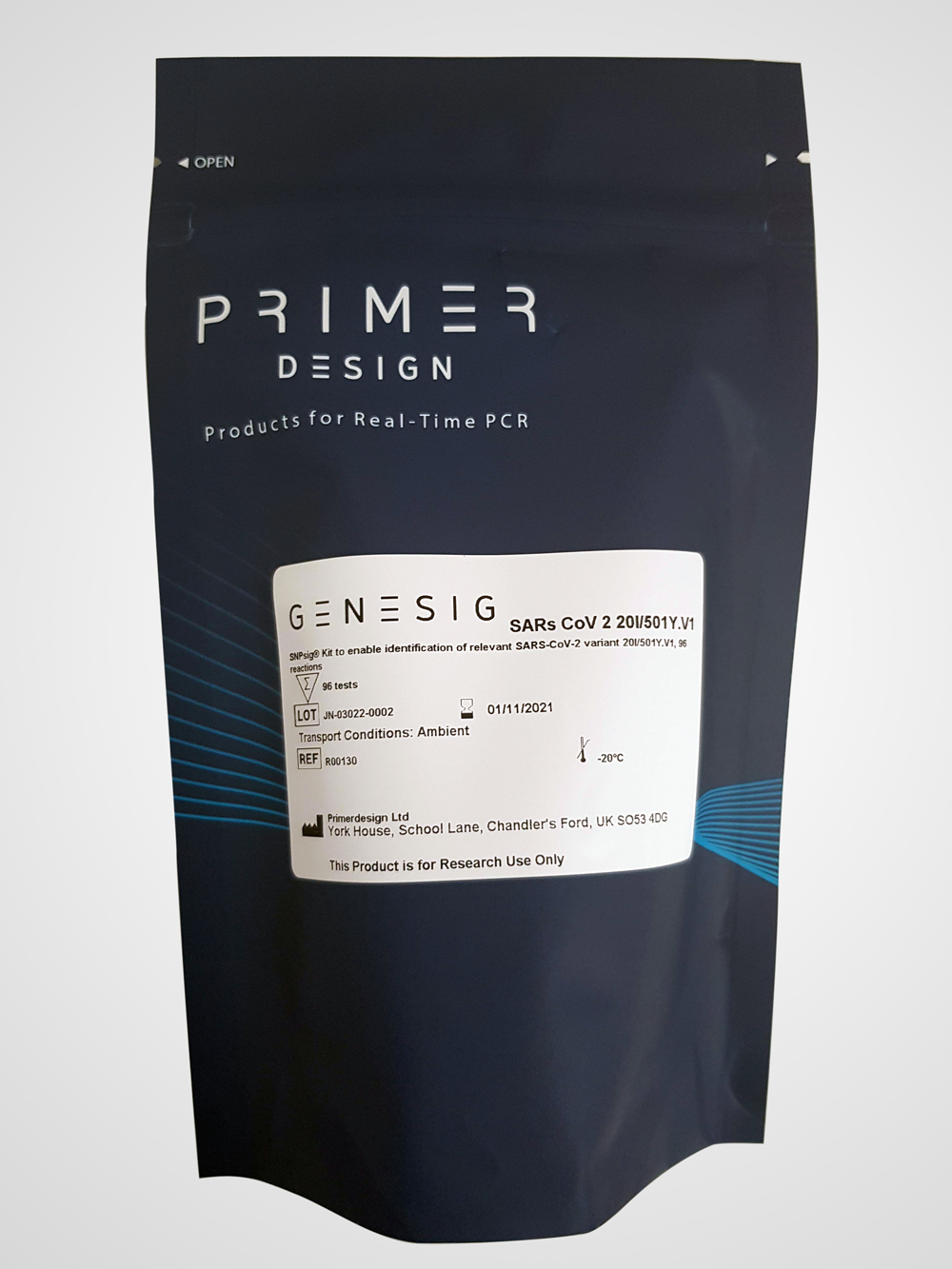
For the detection of the SARS-CoV-2 (20H/501Y.V2 South Africa) Rapid detection of specific detection profiles High priming efficiency Sensitive to < 100 copies of target
Positive copy number standard curve for quantification
Accurate controls to confirm findings
96 reactions, includes master mix
Our SNPsig® kits use our own proprietary genotyping method to enable the identification of SARS-CoV-2 variants of concern. These products can be used on any real-time PCR machine using familiar protocols, whilst resulting in exceptional genotyping data.
Positive control templates for wild-type and variants are supplied in every kit to make data interpretation simple.
Our SNPsig® technology provides an alternative to sequencing as well as S gene target failure (SGTF) that enables scientists to analyse and monitor these specific genomic mutations. Our kits can provide a pivotal role in screening for SARS-CoV-2 variants for the purpose of genomic surveillance and studies.
Other Products
Rapid Integrated Total Dietary Fiber Assay Kit
Product Info
Document
Product Info
K-RINTDF
SKU: 700004335
100 assays per kit
Content:
100 assays per kit
Shipping Temperature:
Ambient
Storage Temperature:
Short term stability: 2-8oC, Long term stability: See individual component labels
Stability:
> 2 years under recommended storage conditions
Analyte:
Dietary Fiber
Assay Format:
Enzymatic
Detection Method:
Gravimetric/HPLC
Signal Response:
Increase
Limit of Detection:
0.5 g/100 g
Total Assay Time:
~ 3 h work (over 1-2 days)
Application examples:
Food ingredients, food products and other materials.
Method recognition:
AACC Method 32-60.01, AOAC Method 2022.01, AOAC Method 2017.16, ICC Standard Method No. 185 and CODEX Method Type I
The Rapid Integrated Total Dietary Fiber Assay Kit method is validated under collaborative study (AACC Method 32-60.01, AOAC Method 2022.01, AOAC Method 2017.16, ICC Standard No. 185) and is recognized as a Type I Method by CODEX Alimentarius. The K-RINTDF method is the recommended one for the measurement of total dietary fiber in all foods that may or may not contain resistant starch. This method is updated to be more consistent with in vivo conditions in the human small intestine, i.e. a 4 h incubation time. Under these conditions more accurate measurement of resistant starch is obtained, including phosphate cross-liked starch (RS4). Use of higher enzyme concentrations ensures that resistant maltodextrins produced from non-resistant starch under the incubation conditions of the Integrated Total Dietary Fiber procedure (AOAC Methods 2009.01 and 2011.25) are no longer produced.
In this improved, rapid method, the incubation time with PAA + AMG is reduced to 4 h and the levels of both PAA and AMG are increased to ensure that resistant starch levels obtained with a set of control samples are consistent with ileostomy data. Under these conditions, the DF values obtained for most samples are the same as those obtained with AOAC Methods 2009.01 and 2011.25.
The dietary fiber fractions that are measured with this method are:
1. High Molecular Weight Dietary Fiber (HMWDF) including Insoluble Dietary Fiber (IDF) and High Molecular Weight Soluble Dietary Fiber (SDFP; soluble dietary fiber which is precipitated in the presence of 78% aqueous ethanol), and
2. Low Molecular Weight Soluble Dietary Fiber (SDFS; water soluble dietary fiber that is soluble in the presence of 78% aqueous ethanol).
Alternatively, IDF, SDFP and SDFS can be measured separately.
The enzymes used in this method are high purity and effectively devoid of contaminating enzymes active on other dietary fiber components such as β-glucan, pectin and arabinoxylan. They are supplied as freeze-dried powders; allowing the use of glycerol as an internal standard in the method.
* See McCleary, B. V., Sloane, N & Draga, A. (2015). Determination of total dietary fibre and available carbohydrates: a rapid integrated procedure that simulates in vivo digestion. Starch/Starke, 66, 1-24.
Validation of Methods
Advantages
More rapid measurement – incubation time with PAA + AMG reduced to 4 h in comparison with AOAC 2009.01 (increased levels of enzyme employed)
DF values for most samples are very similar to those obtained with AOAC Method 2009.01
Rapid Integrated Total Dietary Fiber method removes all of the limitations that have been identified with AOAC Method 2009.01*
All reagents stable for > 2 years after preparation
The method is consistent with the CODEX Alimentarius definition of dietary fiber
Mega-Calc™ software tool is available from our website for hassle-free raw data processing
Very competitive price (cost per test)
Document
The Rapid Integrated Total Dietary Fiber Assay Kit method is validated under collaborative study (AACC Method 32-60.01, AOAC Method 2022.01, AOAC Method 2017.16, ICC Standard No. 185) and is recognized as a Type I Method by CODEX Alimentarius. The K-RINTDF method is the recommended one for the measurement of total dietary fiber in all foods that may or may not contain resistant starch. This method is updated to be more consistent with in vivo conditions in the human small intestine, i.e. a 4 h incubation time. Under these conditions more accurate measurement of resistant starch is obtained, including phosphate cross-liked starch (RS4). Use of higher enzyme concentrations ensures that resistant maltodextrins produced from non-resistant starch under the incubation conditions of the Integrated Total Dietary Fiber procedure (AOAC Methods 2009.01 and 2011.25) are no longer produced.
HiPure FFPE RNA Kit supplies a simple and rapid RNA extraction for Formalin-fixed, paraffin-embedded (FFPE) tissue and sections samples. This kit is based on silica gel column purification technology, no phenol-chloroform extraction or alcohol precipitation. The whole extraction only takes 30 minutes (not including digestion time). RNA can be directly used for downstream applications such as RT-PCR, Northern blot, vitro translation and other experiments.
Details
Specifications
Features
Specifications
Main Functions
Isolation total RNA from FFPE tissue and section samples
Applications
RT-PCR, quantitative RT-PCR, Northern hybridization, Poly A purification, nucleic acid protection and in vitro translation
Purification method
Mini spin column
Purification technology
Silica technology
Process method
Manual (centrifugation or vacuum)
Sample type
FFPE tissue sample
Sample amount
6mg
Yield
20μg
Elution volume
≥20μl
Time per run
≤60 minutes
Liquid carrying volume per column
800µl
Binding yield of column
100µg
This product is based on silica column purification. Remove paraffin by Buffer DPS. Sample lysis with proteinase K digestion requires only 15 minutes. After lysis, samples are incubated at 80ºC for 15 minutes. Transfer to an adsorption column and RNA is adsorbed on the membrane, while protein is not adsorbed and is removed with filtration. After washing proteins and other impurities, RNA was finally eluted with low-salt buffer.
Advantages
High quality – high purity total RNA can be directly used in various sensitive downstream applications
Fast – several samples can be extracted in 60 minutes by column method
Safe – no phenol chloroform extraction required
Sensitive – RNA can be recovered at the level of PG
Kit Contents
Contents
R414302
D414303
Purification Times
50 Preps
250 Preps
HiPure RNA Micro Columns
50
250
2ml Collection Tubes
50
250
Buffer DPS
60 ml
250 ml
Buffer FRL
15 ml
60 ml
Buffer RLC
15 ml
60 ml
Buffer RWC*
10 ml
50 ml
Buffer RW2*
20 ml
2 x 50 ml
Protease Dissolve Buffer
1.8 ml
10 ml
Proteinase K
24 mg
120 mg
RNase Free Water
10 ml
20 ml
Storage and Stability
Proteinase K should be stored at 2-8°C upon arrival. However, short-term storage (up to 12 weeks at room temperature (15-25°C) does not affect their performance. The remaining kit components can be stored at room temperature (15-25°C) and are stable for at least 18 months under these conditions. The entire kit can be stored at 2-8°C, but in this case buffers should be redissolved before use. Make sure that all buffers are at room temperature when used.
Document
HiPure FFPE RNA Kit supplies a simple and rapid RNA extraction for Formalin-fixed, paraffin-embedded (FFPE) tissue and sections samples. This kit is based on silica gel column purification technology, no phenol-chloroform extraction or alcohol precipitation. The whole extraction only takes 30 minutes (not including digestion time). RNA can be directly used for downstream applications such as RT-PCR, Northern blot, vitro translation and other experiments.
Short term stability: 2-8oC, Long term stability: See individual component labels
Stability:
> 2 years under recommended storage conditions
Analyte:
Catalase
Assay Format:
Spectrophotometer
Detection Method:
Absorbance
Wavelength (nm):
520
Signal Response:
Increase
Limit of Detection:
0.5 U/mL
Total Assay Time:
20 min
Application examples:
Various food, biological and bacterial samples.
Method recognition:
Novel method
Megazyme’s catalase assay kit provides a simple colourimetric method for the measurement of catalase activity. The method is delivered in a fast and reliable format and may be used to detect catalase activity in various samples, including food, biological and bacterial samples. The calculation method included allows for significant variation in the concentration of the H2O2 substrate solution that is employed in the assay which translates into a reduction in the ‘hands on’ time required by the analyst in comparison to other commercial kits.
See our complete list of assay kits for the measurement enzyme activity.
Advantages
Very cost effective
Simple, convenient, rapid assay
Standard included
Mega-Calc™ software tool is available from our website for hassle-free raw data processing
Document
Megazyme’s catalase assay kit provides a simple colourimetric method for the measurement of catalase activity. The method is delivered in a fast and reliable format and may be used to detect catalase activity in various samples, including food, biological and bacterial samples. The calculation method included allows for significant variation in the concentration of the H2O2 substrate solution that is employed in the assay which translates into a reduction in the ‘hands on’ time required by the analyst in comparison to other commercial kits.