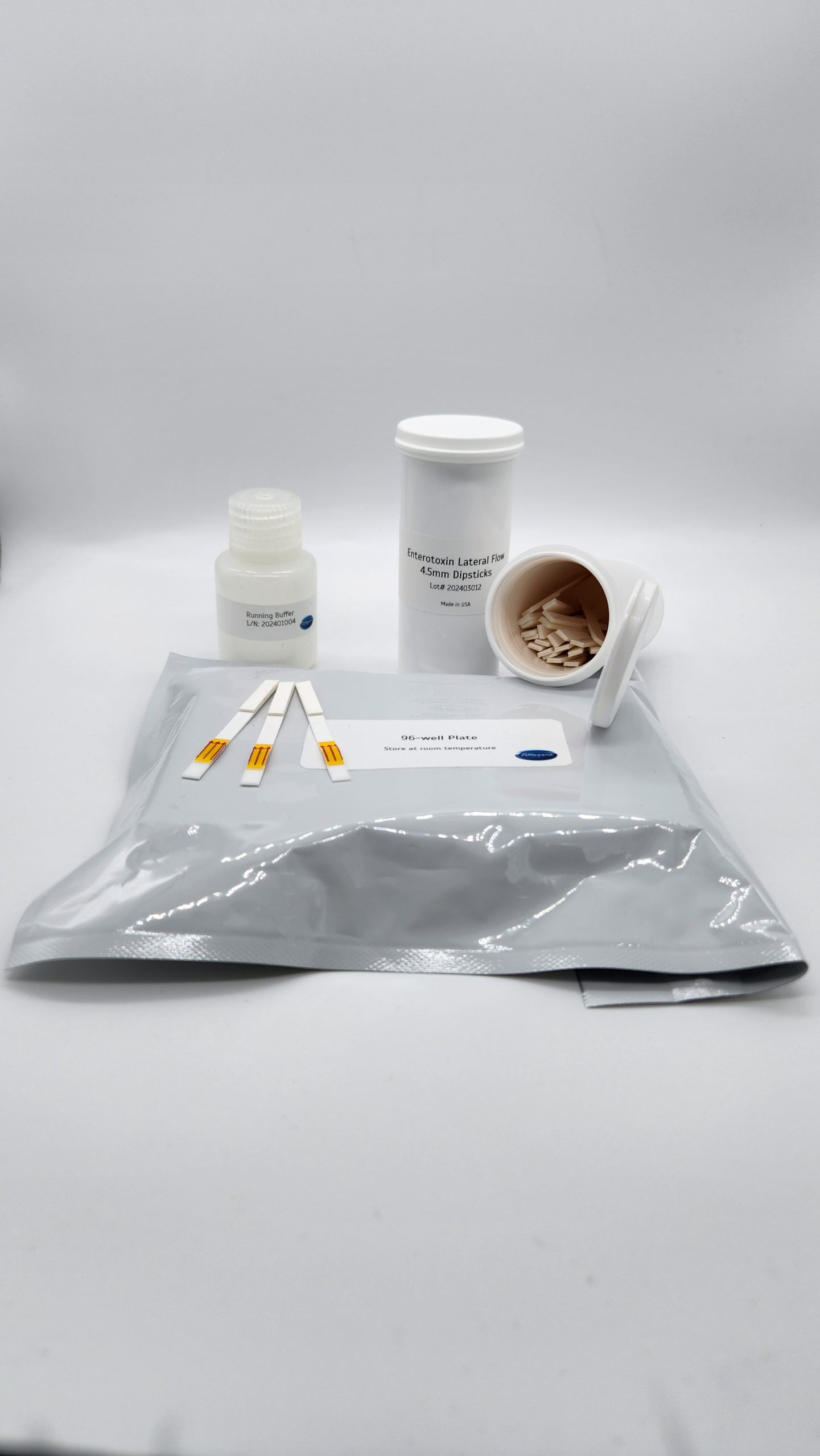
Staphylococcus Enterotoxin B (SEB) Lateral Flow Detection Kit
Facebook
X
Pinterest
Email
Rapid dipstick test for detecting Staphylococcus Enterotoxin B (SEB) in liquid samples Detects 10 ppb and greater Staphylococcus Enterotoxin B (SEB) in the sample
Detail
Rapid dipstick test for detecting Staphylococcus Enterotoxin B (SEB) in liquid samples
Detects 10 ppb and greater Staphylococcus Enterotoxin B (SEB) in the sample
The contamination of pathogenic microorganisms and their toxins in food and water is a serious issue for human health and safety. For instance, enterotoxins (SEs) produced by Staphylococcus aureus (S. aureus) are heat-stable, meaning pathological activity remains even after exposure to sterilization techniques and digestive proteases. Among the SEs, staphylococcal enterotoxin A (SEA) and B (SEB) are confirmed toxins which cause enteritis and food poisoning. Symptoms include nausea, vomiting, diarrhea, which in severe cases, may lead to fatalities in children and the elderly. These SEs, known as superantigens, non-specifically activate Tcells, leading to proliferation which ultimately results in T-cell elimination. This activation directly and indirectly induces a massive release of inflammatory cytokines.
In addition to acute poisoning, researchers reported that these toxins may play roles in the pathogenesis of autoimmune diseases. More specifically, intestinal dysbiosis (enteromicrobial imbalance) was found in patients with rheumatoid arthritis (RA) and which may overwhelm the host immune defense functions by chronic exposure to excess amounts of these pathogens (7, 8). In animal models, SEs synergistically play a role in the pathogenesis of autoimmune-related diseases, such as atopic dermatitis, food allergies, colitis, arthritis, and systemic lupus erythematosus.
Attogene is offering this highly robust test to detect SEB by lateral flow in diverse liquid sample types.
The MagPure Plasmid purification system uses the paramagnetic bead technology for high-throughput preparation of high-copy or low-copy plasmid DNA from E. coli cells. This kit also can be used with fosmid and BAC vector-based constructs. The system uses alkaline lysis followed by a MagPure purification to differentially bind plasmid DNA to paramagnetic beads. While the DNA is bound to the beads, contaminants can be rinsed away using a simple washing procedure. Because MagPure uses magnetic separation technology, the protocol does not require vacuum filtration. This makes kit extremely amenable to automation. Plasmid DNA purified with this system is most commonly used in Sanger Sequencing and PCR amplification.
Details
Specifications
Features
Specifications
Main Functions
Isolation up to 15μg endotoxin free plasmid DNA from 1-5ml bacterial culture
Applications
Enzyme digestion, sequencing, PCR and labeling, etc.
Purification technology
Magnetic beads technology
Process method
Manual or automatic
Sample type
Conventional plasmid, plasmid≤30KB
Sample amount
1-5ml
Elution volume
≥50μl
Time per run
≤80 minutes
Principle
This product is based on the purification method of high binding magnetic particles. The sample is lysed and digested under the action of lysate and Lysozyme. DNA is released into the lysate. After adding magnetic particles and binding solution, DNA will be adsorbed on the surface of magnetic particles, and impurities such as proteins will be removed without adsorption.The adsorbed particles were washed with washing solution to remove proteins and impurities, washed with ethanol to remove salts, and finally DNA was eluted by Elution Buffer.
Advantages
High purity – purified plasmid can be directly used in sequencing, enzyme digestion and PCR, etc.
Fast – it takes only 80 minutes to complete the isolation
High yield – up to 15μg plasmid can be binded in one column
RNase A and MagPure Particles should be stored at 2–8°C upon arrival. However, short-termstorage (up to 12 weeks) at room temperature (15–25°C) does not affect its performance. Theremaining kit components can be stored dry at room temperature (15–25°C) and are stable for atleast 18 months under these conditions.The entire kit can be stored at 2–8°C, but in this case buffers should be redissolved before use. Make sure that all buffers are at room temperature whenused. If any precipitates form in the buffers,warm at 37℃ to dissolve. After addition of RNase A, Buffer P1 is stable for 6 months when stored at
Document
The MagPure Plasmid purification system uses the paramagnetic bead technology for high-throughput preparation of high-copy or low-copy plasmid DNA from E. coli cells. This kit also can be used with fosmid and BAC vector-based constructs. The system uses alkaline lysis followed by a MagPure purification to differentially bind plasmid DNA to paramagnetic beads. While the DNA is bound to the beads, contaminants can be rinsed away using a simple washing procedure. Because MagPure uses magnetic separation technology, the protocol does not require vacuum filtration. This makes kit extremely amenable to automation. Plasmid DNA purified with this system is most commonly used in Sanger Sequencing and PCR amplification.
This Kit is designed to purify genomic DNA and total RNA simultaneously from a single biological sample. Lysate is first passed through a DNA spin column to selectively isolate DNA and then through an RNA column to selectively isolate RNA. Pure DNA and RNA are purified from the entire sample, in contrast to other procedures where either the biological sample or the purified total nucleic acids is divided into two before being processed separately. The kit is compatible with small amounts of a wide range of animal cells and tissues.
Details
Specifications
Features
Specifications
Main Functions
Co-isolation DNA and RNA from skin, muscle, connective tissue, fibrous tissue sample
Applications
PCR and southern blot, etc.
Purification method
Mini spin column
Purification technology
Silica technology
Process method
Manual (centrifugation or vacuum)
Sample type
Cultured cells and tissue samples
Sample amount
Tissue: < 20mg
Principle
The Kits are designed to purify both genomic DNA and total RNA from the same cellor tissue sample. Samples are first lysed and homogenized. The lysate is passed through a DNA Mini column and bind DNA. Ethanol is added to the flow-through and the sample is applied to an RNA column. DNA/RNA binds to the membrane and contaminants are washed away. High-quality RNA is eluted in as little as 30µl water using the Kit. High-quality DNA is eluted in as little as 50µl water using the Kit.
Advantages
High quality – high purity total RNA / DNA can be directly used in a variety of downstream applications
Fast – column method can complete the extraction of several samples in 30 minutes
Safe – no phenol chloroform extraction required
Simultaneous extraction- simultaneously isolate DNA and RNA from one sample
Kit Contents
Contents
R511402
R511403
Purification Times
50 Preps
250 Preps
HiPure DNA Mini Columns
50
250
HiPure RNA Mini Columns
50
250
2ml Collection Tubes
100
2 x 250
Buffer RL
30 ml
150 ml
RNA Digestion Buffer
15 ml
80 ml
Buffer DW1
30 ml
150 ml
Buffer RW1
50 ml
200 ml
Buffer RW2*
20 ml
2 x 50 ml
RNase Free Water
10 ml
30 ml
Buffer AE
10 ml
50 ml
Storage and Stability
HiPure DNA/RNA Kit can be stored dry at room temperature (15-25°C) and are stable for at least 18 months under these conditions. Make sure that all buffers are at room temperature when used. During shipment, crystals or precipitation may form in the Buffer RLC. Dissolve by warming buffer to 37°C.
Document
This Kit is designed to purify genomic DNA and total RNA simultaneously from a single biological sample. Lysate is first passed through a DNA spin column to selectively isolate DNA and then through an RNA column to selectively isolate RNA. Pure DNA and RNA are purified from the entire sample, in contrast to other procedures where either the biological sample or the purified total nucleic acids is divided into two before being processed separately. The kit is compatible with small amounts of a wide range of animal cells and tissues.