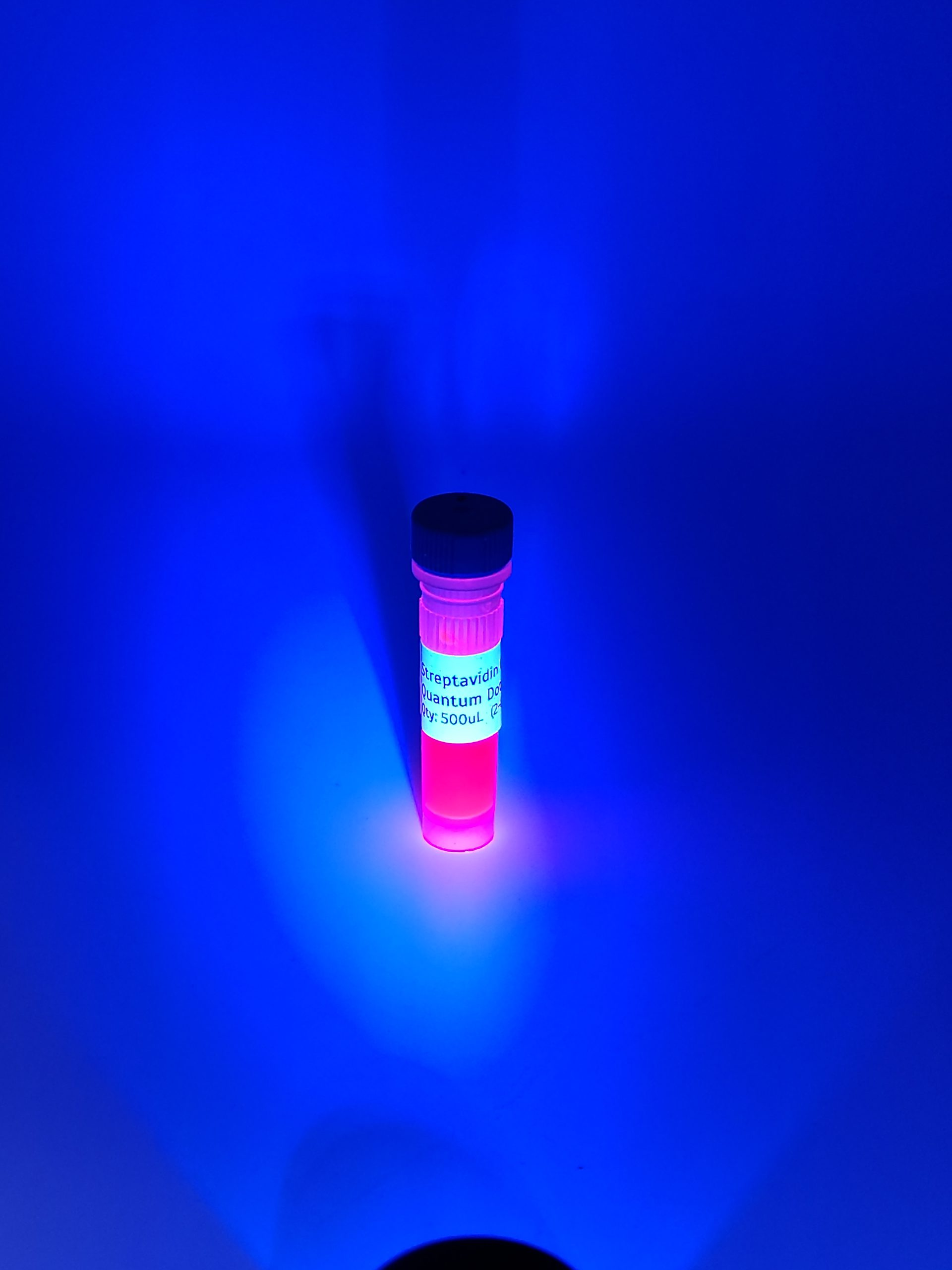
Ready to Use CdSe/ZnS Qdots Nanoparticle Streptavidin Conjugate for Lateral Flow
Our Streptavidin CdSe/ZnS Quantum Dots (QDs)conjugate is manufactured using special conjugation technology and functonally tested by lateral flow. We have coated our high quality nanoparticles with a proprietary surface coat that covalently binds the biotin forming ultra stable conjugates. The resulting Streptavidin CdSe/ZnS QDs can irreversibly bind biotin.
fluorescent broad range UV light excitation range of 100nm to 400nm, 655nm emission
Other Products
Tube sealer
Product Info
Document
Product Info
Application
The blood bag tube sealer is a compact equipment to seal the blood bags, infusion bags, urine bags by high frequency sealing system. It is widely used in blood bank, hospital, biological industry, etc.
Features
No Hemolysis
With suction feet to avoid moving, can be used in blood collecting vehicle.
Technical Parameters
Model
HG-BTS1
Sealing time
2-4S
Sealing Type
Automatic
Diameter of tube
φ2-6mm(Tube thickness≤1.5mm)
Powe supply
220V 0.7A
Consumption
150W
External Size
310*190*150mm
Package Size
405*290*240mm
Net/Gross Weight
6/7kgs
Document
The blood bag tube sealer is a compact equipment to seal the blood bags, infusion bags, urine bags by high frequency sealing system. It is widely used in blood bank, hospital, biological industry, etc.
Mucin 1 (MUC1) is a membrane-bound glycoprotein involved in a number of protective and cell-signaling functions, including cell-cell adhesion, proliferation, motility, invasion, and survival. Overexpression of MUC1 is clinically indicated in breast carcinomas, papillary thyroid carcinomas, and thymic carcinomas, and reports have named MUC1 as a useful marker for differentiating thymic carcinoma from type B3 thymoma. The expression of MUC1 is correlated with the grade of malignancy in thymic epithelial tumors, and loss of MUC1 expression has been associated with reactive gastropathy. MUC1 is not expressed in normal human epidermis, but has been detected in the epidermis of psoriatic plaques of biopsies from patients diagnosed with psoriasis vulgaris.
Mastitis is the single most costly disease of dairy cattle resulting in the reduction of milk yield and quality. The inflammation of the utter is mainly caused by bacteria, and Staphylococcus aureus is often considered the most common cause of contagious mastitis in dairy herds. S. aureus infection is estimated to be present in up to 90% of dairy farms and is responsible for 35% of the economic loss in the dairy industry (Lee et al., 2005). S. aureus is a facultatively anaerobic, Gram positive bacterium. The majority of S. aureus strains are catalase-positive and coagulasepositive, which forms the basis of traditional identification methodology.
Storage Conditions and Product Stability All kit components can be stored for 2 years after the date of production without showing any reduction in performance.
All kit components should be stored at -20°C upon arrival. Repeated thawing and freezing (> 2 x) of the Master Mix and Positive Control should be avoided, as this may affect the performance of the assay. If the reagents are to be used only intermittently, they should be frozen in aliquots.