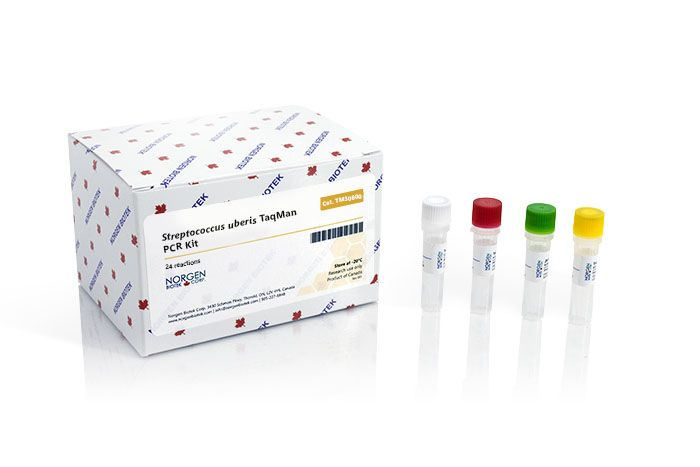
Mastitis is the single most costly disease of dairy cattle resulting in the reduction of milk yield and quality. The inflammation of the utter is mainly caused by infection of various bacteria. Streptococcus uberis is a gram-positive bacterium that is known worldwide as an environmental pathogen responsible for a high proportion of cases of mastitis in lactating cows and is also the predominant organism isolated from mammary glands during the non-lactating period. Often it is resistant to treatment and causes persistent high somatic cell counts without clinical mastitis.
Storage Conditions and Product Stability All kit components can be stored for 2 years after the date of production without showing any reduction in performance.
All kit components should be stored at -20°C upon arrival.
Component
Cat. TM30850 (100 preps)
Cat. TM30810 (100 preps)
MDx TaqMan 2X PCR Master Mix
2 x 700 μL
–
S. uberis Primer & Probe Mix
280 μL
280 μL
S. uberis Positive Control
150 μL
150 μL
Nuclease-Free Water (Negative Control)
1.25 mL
1.25 mL
Product Insert
1
1
Other Products
Bioprocessing with Salt Active Nucleases – High Salt Conditions
Product Info
Document
Product Info
Bioprocessing with Salt Active Nucleases – High Salt Conditions
OverView
For SAN HQ, SAN HQ ELISA Kit, and now SAN HQ GMP
SAN HQ GMP is biochemically identical to SAN HQ but produced under GMP conditions.
Applications
Purification of biologics from residual nucleic acids in biopharma manufacturing
Purification of recombinant proteins and enzymes for research and diagnostic use
Removal of unwanted nucleic acids contamination in molecular biology reagents in challenging conditions
Reduction of viscosity in biological samples during production and automation
Vaccine manufacturing and viral vector preparation
DNA removal in high-salt lysates
SAN HQ – Peak performance at high salt conditions
Salt Active Nuclease High Quality (SAN HQ) is a Bioprocessing Grade nuclease developed as the most efficient solution for removal of both single and double stranded DNA and RNA at high salt conditions.
This nonspecific endonuclease has peak activity at salt concentrations between 400 – 700 mM (Fig. 1)
Non-enveloped viruses like Adenoviruses and Adeno-Associated Viruses (AAV’s) are inherently more robust with two distinct advantages: 1) They exhibit higher tolerance to additives like salt and detergents and 2) their production often involves the lysis of host cells, allowing for harvesting non-secreted vectors.
For Adeno-Associated Viruses (AAVs), which are often harvested from crude cell lysate, the high salt tolerance of SAN HQ is particularly beneficial. Salt is typically added to such lysates to reduce viral aggregation, facilitating more effective nuclease action to digest residual DNA.
SAN HQ’s is engineered for optimum activity in these high salt environments ensuring that you achieve unparalleled DNA removal without compromising the integrity of these robust viral vectors.
Key Benefits
Optimized Residual DNA Removal: Ensures efficient degradation of residual DNA in high-salt conditions, meeting stringent quality requirements for biologics and vaccines.
Boosted AAV Vector Purification: Enhances the purification process for adeno-associated viral vectors in high-salt conditions, improving quality and yield.
Streamlined Workflow: Eliminates the need for desalting stages, simplifying the bioprocessing protocol and saving time and resources.
Enable High-Throughput Processes: Facilitates scale-up and automation by working effectively in high-salt environments, increasing operational throughput.
Potential Surge in Virus Yield: Operates under conditions that may boost the titer yield of AAV production, potentially enhancing overall viral yield.
Economized Enzyme Usage: Reduces the need for excess enzyme and additional process adjustments, resulting in significant cost savings.
Minimized Risk of Process Disruptions: Offers reliable performance in various high-salt bioprocessing conditions, reducing the likelihood of disruptions due to enzyme inhibition.
Reliability: Provides consistent enzyme activity in challenging high-salt conditions, adding a layer of predictability and dependability to your operations.
Broader Applicability: Versatile enough to be used in a wide range of viral vector systems, expanding your research and production capabilities.
Enhanced Viral Stability: High-salt levels stabilize viral vectors, and SAN HQ operates effectively in these conditions, maintaining high yield and quality.
Host Cell Lysis: Facilitates efficient lysis of host cells in high-salt conditions, optimizing the harvest of both secreted and non-secreted viral vectors.
Key Features
High purity (≥ 98%)
No protease detected
Supplied with extended product documentation
Compatible with SAN HQ ELISA
The Challenge in Removing Host Cell Chromatin Impurities
In bioprocessing, the primary role of a nuclease is to efficiently digest and fragment host-cell DNA into sufficiently small pieces, facilitating its removal during downstream processing. While most nucleases can effectively degrade naked DNA into tiny fragments under optimal conditions—as demonstrated by M-SAN HQ and SAN HQ, which can digest dsDNA into fragments smaller than 6 nt—the reality in bioprocessing is more complex. (See fig. 5)
The DNA targeted for removal often exists as chromatin, embedded in a complex matrix containing remnants of the lysed host cell as well as large amounts of the therapeutic product.The product may or may not have an affinity for the chromatin you aim to remove.
High salt is often applied to mitigate issues like aggregation. The real challenge lies in a nuclease’s ability to efficiently fragment chromatin under these more complicated, high-salt, conditions—not merely degrading naked DNA under ideal circumstances.
SAN HQ ELISA kit is developed for the detection and quantification of SAN HQ and SAN HQ GMP. The kit is designed as a classical sandwich ELISA, with two monoclonal antibodies specific towards SAN HQ nuclease (fig 6).
Features
Sensitive: 0.4 – 25.6 ng/ml
Precise: RSD ≤ 15%
Accurate: 100% ± 15%
Stability: 12 months when stored between +2°C to +8°C
Document
For SAN HQ, SAN HQ ELISA Kit, and now SAN HQ GMP
SAN HQ GMP is biochemically identical to SAN HQ but produced under GMP conditions.
The ITS1 Library Preparation Kit for Illumina consists of the reagents and components required for library preparation of the fungal target ITS1 libraries to be used for next-generation sequencing on Illumina platforms. All molecular reagents including primers, enzyme mixes, indexes, and buffers are provided. Instructions for PCR clean up with the AMPure XPMagneticBeads(supplied by customer) are also included for rapid purification of nucleic acid products generated at two steps of the workflow. The library prep workflow could be used for purified DNA inputs from different sources including stool, soil, water, saliva, plant, urine, skin swab, vaginal swab, cheek swab, nasal/swab, plasma/serum, tongue swab, gum swab, and others.
The ITS1 Library Preparation Kit for Illumina has a streamlined procedure that reduces the handling time such that the library prep procedure can be completed in approximately 4 hours (see diagram below). Input DNA is first subjected to targeted PCR to amplify the ITS1 region of the fungal DNA.The post-PCR reaction is then cleaned up using AMPure XPbeads. Dual index primers are then added using a limited-cycle PCR. The indexed amplicons flanked by 5′ and 3′ barcoded adaptors are then cleaned using AMPure XPbeads. The libraries are then ready for quantification, pooling and sequencing.
Storage Conditions and Product Stability Norgen’s ITS1 Library Prep Kit for Illumina is shipped as one kit box (for the 24 prep kit) or two sub-component kits (for the 96 prep kit). All kits should be stored at -20°C upon arrival.
All kit components will remain stable for at least 1 year when stored at the specified storage conditions.
p504s, also known as α-methylacyl coenzyme A racemase (AMACR), is an enzyme localized in the peroxisome and mitochondria, which functions in β-oxidation of branched chain fatty acids, as well as bile synthesis. AMACR has been clinically indicated as a tissue biomarker for prostate cancer and colorectal cancer, as well as high-grade prostatic intraepithelial neoplasia, a precursor lesion of prostate cancer. p504s overexpression has also been detected in a number of other cancers including ovarian, breast, bladder, lung, and renal cell carcinomas, lymphoma, and melanoma.