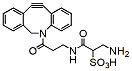
Sulfo DBCO-Amine can be used to derivatize carboxyl-containing molecules or activated esters (e.g. The NHS ester) with DBCO moiety through a stable amide bond. The low mass weight will add minimal spacer to modified molecules and the hydrophilic sulfonated spacer arm will greatly improve water solubility of DBCO derivatized molecules. DBCO is commonly used for copper-free Click Chemistry reactions. Reagent grade, for research purpose. Please contact us for GMP-grade inquiries.
Detail
Sulfo DBCO-Amine can be used to derivatize carboxyl-containing molecules or activated esters (e.g. The NHS ester) with DBCO moiety through a stable amide bond. The low mass weight will add minimal spacer to modified molecules and the hydrophilic sulfonated spacer arm will greatly improve water solubility of DBCO derivatized molecules. DBCO is commonly used for copper-free Click Chemistry reactions. Reagent grade, for research purpose. Please contact us for GMP-grade inquiries.
Other Products
Conveniently Test RNA Isothermal PCR Kit At Home Reagent Buffer
Product Info
Document
Product Info
Product Description
Conveniently Test RNA At Home With At Home Test Kit – Reagents Buffers
Product Detail
Kit Storage and term of Validity
Storage term: stored at ≤-20℃,keep away from light, avoid heavy weight and repeated freezing and thawing.
Term of Validity: 14 months
Isothermal nucleic acid Principle Summary
This kit is based on a rapid nucleic acid amplification technology at room temperature and constant temperature:at room temperature and constant temperature(generally 39℃~42℃),reverse transcriptaseuses specific primers and template RNA tosynthesize cDNA strands,and binds the auxiliary protein and single strand with the help of the protein, the recombinase and the primer form a complex; perform a homology search and bind the target homology domain, at this time a D-loop region is formed at the homology positionand strand exchange begins; accompanied by the recombinase from the complex upon dissociation,the polymerase also bindsto the 3′ end of the primer,initiating chainextension.It is suitable for laboratory-level RNA amplification and RNA amplification for other detection purposes.
Isothermal nucleic acid Product Features
1/ High sensitivity and specificity, short reaction time.
2/ The reagent form is freeze-dried, stable and easy to operate.
3/ The reaction can be operated by metal bath and water bath pot without purchasing expensive PCR apparatus.
Technical Parameters:
Parameters
Details
Product Name
RNA Isothermal Amplification Kit Basic
Manufacturer
Amp-future
Storage Temperature
-20°C
Kit Components
Enzymes, Buffers ,Reagents
Packaging
48 Tests/box
Detection Limit
500-1000copies/µL
Shipping
ICE
Test Time
5-20mins
Isothermal nucleic acid Applications
Suitable for RNA isothermal rapid amplification kit(BASIC type)
Primer: Require pair of nucleotide primers with the length of 25-35 bp.
RNA basic kit reaction temperature is 39 to 42℃ and time is 5-20 minutes.
Notes
1/ Please avoid nucleic acid contamination and set blank control during reaction due to the high sensitivity of the kit.
2/ Please take out the required quantity of MIRA reaction units for the experiment, and put the rest under storage conditions when performing the experiment.
Mycoplasma is the smallest and simplest prokaryotic organism. There is a risk of mycoplasma contamination during cell culture, and mycoplasma contamination of cells has become a common problem worldwide. Mycoplasma contamination may seriously affect the state of cells, change the gene expression and metabolic characteristics of cells, lead to slow cell growth, abnormal differentiation and death, and seriously affect cell function. Bacteria, yeast or mold contamination in cell culture can be seen under an optical microscope, but mycoplasma contamination is usually not visible under an optical microscope and must be detected by specific detection methods. Common methods for detecting mycoplasma contamination include mycoplasma isolation and culture, special biochemical tests such as ELISA and luminescence, and DNA fluorescent staining detection. Among the above detection methods, most of the operation steps are relatively cumbersome, the sensitivity is not high, the mycoplasma types cannot be distinguished, special instruments are required, or the time required is long. The qPCR method is relatively simple and convenient to operate, and the results can be obtained in 2 hours.
Features of MycoSEQ Mycoplasma Detection Kit
• Provide results in less than 2 hours. Good negative and positive controls. • No live mycoplasma required: The MycoSEQ Mycoplasma Detection Kit does not contain any live mycoplasma and does not require the use of live mycoplasma for validation • Can be used with gDNA, inactivated mycoplasma, or live mycoplasma • Can be used as an alternative to the standard 28-day culture test • Can be used in conjunction with culture-based methods to provide preliminary results while awaiting the 28-day test results
The MycoSEQ Plus Mycoplasma Detection Kit is part of an integrated workflow for adventitious drug, impurity, and contaminant detection during biopharmaceutical manufacturing. The entire workflow includes the sample preparation kit, which provides a manual sample preparation method, which together with the qPCR analysis can provide results in 2 hours. (Please note that complex matrices may require additional upfront processing steps as described in the various available protocols.)
Contents and Storage
• Mycoplasma qPCR MIX, store at -15°C to -25°C, store at 2°C to 8°C after first use, protected from light. • Mycoplasma Positive Control, -15°C to -25°C. • Mycoplasma Negative Control, store at -15°C to -25°C, store at 2°C to 8°C after first use.
Document
Note: Price not include shipment & duty, contact us to get full quote. DuckyBio’s Mycoplasma PCR Detection Kit is a TaqMan™-based quantitative PCR (qPCR) kit for detecting mycoplasma contamination in biological materials such as cultured cells. Designed and tested using criteria often applied toward rapid mycoplasma detection in biotherapeutic manufacturing cell culture lot release, the MycoSEQ Plus kit enables results that meet or exceed guidance on sensitivity and specificity expectations as described in European Pharmacopoeia (E.P. 2.6.7, 2007), US Pharmacopoeia (US63) and Japanese Pharmacopoeia. When used with a suitable sample preparation method, the MycoSEQ Plus kit can detect less than 5 CFU/mL.
This test discovers beer germs in a timely and precise manner
Method/Platform
PCR
Range/Assay Sensivity
10^4 – 10^5 cfu/mL
Test Principle
The technological basis for the GenLine tests is the polymerase chain reaction (PCR) combined with lateral flow tests.
Labelled specific primers are used to amplify specific DNA fragments. In addition to the target gene, a control gene, which is also present in the PCR mixes, is amplified in order to make sure that the PCR process works properly.
The resulting PCR products carry the labels of the incorporated primers.
In a second part of the test, the created PCR products are detected by a lateral flow Test Strip. A “molecular sandwich” is formed and becomes visible as a line on the test Strip.
Document
Brief Instructions The PCR reagents and the samples are prepared. After the addition of the sample to the PCR reagents, the PCR is started. The resulting PCR products are detected by a simple lateral flow test