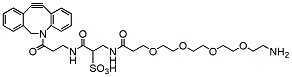
Sulfo DBCO-PEG4-Amine is a water-soluble carboxyl-reactive building block with extended PEG spacer arm. In the presence of of activators (e.g. EDC, or HATU), this reagent can be used to derivatize carboxyl groups or activated esters (e.g. The NHS ester) through a stable amide bond. The hydrophilic sulfonated spacer arm greatly improves water solubility of DBCO derivatized molecules and a provides a long and flexible connection. DBCO is commonly used for copper-free Click Chemistry reactions. Reagent grade, for research purpose. Please contact us for GMP-grade inquiries.
Detail
Sulfo DBCO-PEG4-Amine is a water-soluble carboxyl-reactive building block with extended PEG spacer arm. In the presence of of activators (e.g. EDC, or HATU), this reagent can be used to derivatize carboxyl groups or activated esters (e.g. The NHS ester) through a stable amide bond. The hydrophilic sulfonated spacer arm greatly improves water solubility of DBCO derivatized molecules and a provides a long and flexible connection. DBCO is commonly used for copper-free Click Chemistry reactions. Reagent grade, for research purpose. Please contact us for GMP-grade inquiries.
Nucleic acid testing (NAT) is the method of choice for detection and quantification of a wide range of micro organisms. Primerdesign manufactures and supplies high quality quantitative real-time PCR kits for the detection and simultaneous quantification of numerous significant pathogens . A copy number standard curve is provided for quantification and an the internal extraction template (DNA or RNA), controls for the quality of the nucleic acid extraction and eliminates false negative results.
The kit is designed with the broadest possible detection profile to ensure that all clinically relevant strains and subtypes are detected. Target sequences are selected by working with data from key opinion leaders in the field. Multiple sequence alignments and unprecedented real-time PCR expertise in design and validation ensure the best possible kit.
Details of the target and priming specificity are included in the individual handbooks above.
Packaged, optimised and ready to use. Expect Better Data.
Document
Exceptional value for money Rapid detection of all clinically relevant subtypes Positive copy number standard curve for quantification Highly specific detection profile High priming efficiency Broad dynamic detection range (>6 logs) Sensitive to < 100 copies of target
Accurate controls to confirm findings
PEG13-bis(Amino-Tri-(Propargyl-PEG2-ethoxymethyl)-methane) is large molecule with two sets of three terminal alkynes joined together by a large PEG linker. The alkynes are most frequently used in copper click chemistry with azides. The PEG linkers as well as numerous amide bonds provide high aqueous solubility to this compound, which may alter ADME of this compound.
Document
PEG13-bis(Amino-Tri-(Propargyl-PEG2-ethoxymethyl)-methane) is large molecule with two sets of three terminal alkynes joined together by a large PEG linker. The alkynes are most frequently used in copper click chemistry with azides. The PEG linkers as well as numerous amide bonds provide high aqueous solubility to this compound, which may alter ADME of this compound.
Nucleic acid testing (NAT) is the method of choice for detection and quantification of a wide range of micro organisms. Primerdesign manufactures and supplies high quality quantitative real-time PCR kits for the detection and simultaneous quantification of numerous significant pathogens . A copy number standard curve is provided for quantification and an the internal extraction template (DNA or RNA), controls for the quality of the nucleic acid extraction and eliminates false negative results.
The kit is designed with the broadest possible detection profile to ensure that all clinically relevant strains and subtypes are detected. Target sequences are selected by working with data from key opinion leaders in the field. Multiple sequence alignments and unprecedented real-time PCR expertise in design and validation ensure the best possible kit.
Details of the target and priming specificity are included in the individual handbooks above.
Packaged, optimised and ready to use. Expect Better Data.
Document
Exceptional value for money Rapid detection of all clinically relevant subtypes Positive copy number standard curve for quantification Highly specific detection profile High priming efficiency Broad dynamic detection range (>6 logs) Sensitive to < 100 copies of target
Accurate controls to confirm findings
150 reactions