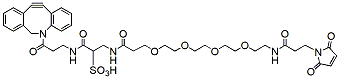
Sulfo DBCO-PEG4-Maleimide is a water-soluble click chemistry reagent with a maleimide group and a DBCO moiety. The hydrophilic PEG spacer arm improves solubility in aqueous buffers. Maleimide group specifically and efficiently reacts with thiols to form stable thioether bonds. The low mass weight will add minimal spacer to modified molecules and will enable simple and efficient incorporation of DBCO moiety onto cysteine-containing peptides or other thiol-containing biomolecules. DBCO is commonly used for copper-free Click Chemistry reactions. Reagent grade, for research purpose. Please contact us for GMP-grade inquiries.
Detail
Sulfo DBCO-PEG4-Maleimide is a water-soluble click chemistry reagent with a maleimide group and a DBCO moiety. The hydrophilic PEG spacer arm improves solubility in aqueous buffers. Maleimide group specifically and efficiently reacts with thiols to form stable thioether bonds. The low mass weight will add minimal spacer to modified molecules and will enable simple and efficient incorporation of DBCO moiety onto cysteine-containing peptides or other thiol-containing biomolecules. DBCO is commonly used for copper-free Click Chemistry reactions. Reagent grade, for research purpose. Please contact us for GMP-grade inquiries.
The MBG4 reagent contains a single substrate, namely 4,6-O-benzylidene-2-chloro-4-nitrophenyl-β-(31-β-D-cellotriosyl-glucoside) (BCNPBG4). The benzylidene acetal group prevents any hydrolytic action by exo-acting hydrolytic enzymes such as β-glucosidase or cellobiohydrolase.
Mixed linkage β-glucanase (endo-1,3:1,4-β-glucanase) / lichenase (EC 3.2.1.73) acts specifically to release 2-chloro-4-nitrophenol (CNP) from this substrate. The rate of release of CNP is directly related to the β-glucanase/lichenase activity in a sample. The reaction is terminated and the phenolate colour is developed on addition of Tris buffer solution (pH = 10.0).
Note that the substrate is not hydrolysed by β-glucosidase or cellobiohydrolase. The substrate can be hydrolysed by certain endo-cellulases (e.g. Trichoderma sp.) but this does not result in an increase in absorbance.
Discover more assay kits for enzyme activity measurement.
Data calculators are located in the Documents tab.
Advantages
Very cost effective
All reagents stable for > 2 years
Specific for endo-1,3:1,4-β-glucanase/lichenase
Simple, convenient, rapid assay
Well suited to automation
Malt flour standard and lichenase standard included
Document
The MBG4 reagent contains a single substrate, namely 4,6-O-benzylidene-2-chloro-4-nitrophenyl-β-(31-β-D-cellotriosyl-glucoside) (BCNPBG4). The benzylidene acetal group prevents any hydrolytic action by exo-acting hydrolytic enzymes such as β-glucosidase or cellobiohydrolase.
Cytokeratin 18 (CK18) is present in simple, glandular, and transitional epithelial cells, but is absent in stratified epithelial cells. CK18 usually multimerizes with Cytokeratin 8, and Anti-Cytokeratin 18 is useful for detecting adenocarcinomas of simple and glandular epithelium origin, as well as poorly differentiated squamous carcinoma cells.
This product is suitable for rapid extraction of DNA from FFPE sample. This kit uses two combination methods. High-salt Bind is conducive to remove pigments or polysaccharides from complex FFPE samples, so as to improve the purity of nucleic acid and avoid blocking aligent 2100. Alcohol mediated adsorption is conducive to improve the nucleic acid yield of high-yield samples.
Details
Specifications
Features
Specifications
Main Functions
Isolation high pure total DNA from FFPE using high bind beads
Applications
PCR and viral DNA detection, etc.
Purification technology
Magnetic beads technology
Process method
Manual or automatic
Sample type
Paraffin embedded tissue samples
Sample amount
1-6 slices of 10-20μm
Elution volume
≥30μl
Time per run
≤60 minutes
Principle
This product is based on the purification method of high binding magnetic particles. The sample is lysed and digested under the action of lysate and Protease. DNA is released into the lysate. After adding magnetic particles and binding solution, DNA will be adsorbed on the surface of magnetic particles, and impurities such as proteins will be removed without adsorption. The adsorbed particles were washed with washing solution to remove proteins and impurities, washed with ethanol to remove salts, and finally DNA was eluted by Elution Buffer.
Advantages
High yield – most optimal process, recovery up to 90%
Economy – less than 50% of the price of Qiagen and other imported products
High purity – OD 260/280 : 1.7-1.9, OD 260/230 : 1.5-2.0
Kit Contents
Contents
D632301D
D632302D
Purification Times
48 Preps
96 Preps
MagPure Particles N
1.1 ml
2.5 ml
RNase A
10 mg
20 mg
Proteinase K
24 mg
48 mg
Protease Dissolve Buffer
3 ml
6 ml
Buffer DPS
60 ml
100 ml
Buffer ATL
15 ml
30 ml
Buffer BST1
30 ml
60 ml
Buffer BW1
13 ml
44 ml
Elution Buffer
15 ml
30 ml
Storage and Stability
Proteinase K, RNase A and MagPure Particles N should be stored at 2-8°C upon arrival. However, short-term storage (up to 12 weeks) at room temperature (15-25°C) does not affect their performance. The remaining kit components can be stored at room temperature (15-25°C) and are stable for at least 18 months under these conditions.
Document
This product is suitable for rapid extraction of DNA from FFPE sample. This kit uses two combination methods. High-salt Bind is conducive to remove pigments or polysaccharides from complex FFPE samples, so as to improve the purity of nucleic acid and avoid blocking aligent 2100. Alcohol mediated adsorption is conducive to improve the nucleic acid yield of high-yield samples.